Dumbbell Svend Press
Compound exercise, Free weightsOverview
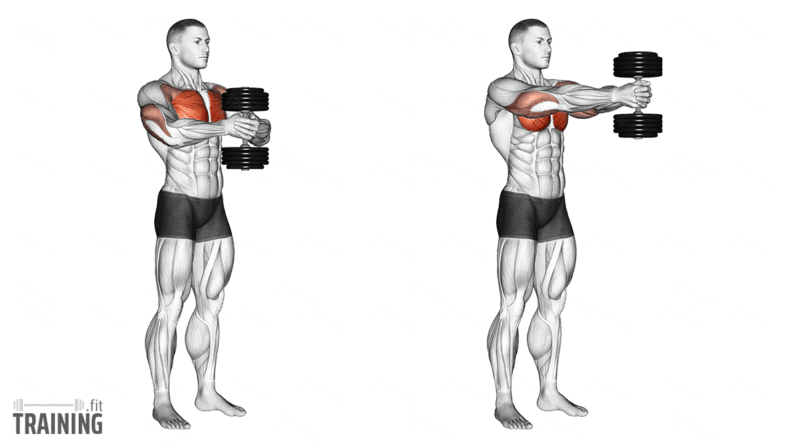
Main muscles
- Chest: Large pectoral muscle
(Musculus pectoralis major) - Chest: Small pectoral muscle
(Musculus pectoralis minor) - Shoulder: Anterior deltoid muscle
(Musculus deltoideus, Pars clavicularis) - Triceps: Three-headed arm muscle
(Musculus triceps brachii)
Training plans
Dumbbell Svend Press is a suitable substitute for similar exercises in or as a supplement to various training plans.
Dumbbell Svend Press: Basics and alternatives
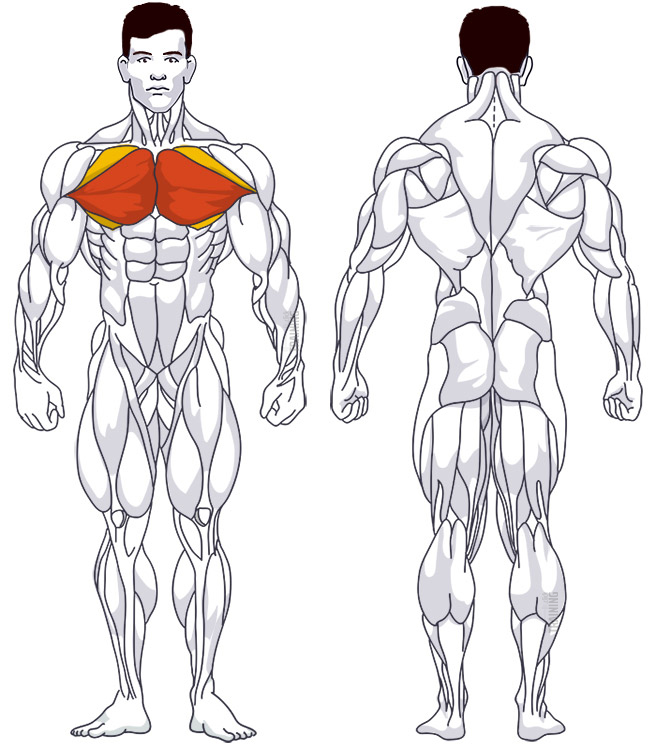
Involved main muscle groups:
Dumbbell Svend Press
With one dumbbell, the Svend press combines a forward press with an inward hand squeeze. Hold the dumbbell securely in both hands at your chest, extend your elbows, then bring it back. Your chest helps with the squeeze while your shoulders hold the weight against gravity.
That’s why the weight works differently than in dumbbell bench presses, where you press upward while lying down. Band chest presses have you pressing forward against the resistance of a band. For the standing Svend press, pick a light dumbbell and keep the forward movement controlled.
Correct execution
Hold one dumbbell upright with both hands securely around the handle, as shown in the illustration. Keep it close to the center of your chest and choose a weight you can hold at arm’s length without leaning backward. You can also hold it horizontally at both ends, as in the video.
Keep squeezing your hands together while holding the dumbbell securely. Press your arms forward at about chest height and keep your ribs stacked over your pelvis. A small, steady range is better than reaching farther by arching your back or shrugging your shoulders toward your ears.
Check your grip while the dumbbell is still close to your chest. Both hands need enough room on it, clear of any collars or locks, and if the shape doesn’t allow that, choose another dumbbell instead of balancing it on your fingertips. Keep your fingers closed as you press your hands together.
Let your elbows bend naturally on the return, with your forearms pointing toward the dumbbell. Keep them from flaring into a fly and stop at your starting position rather than pulling the weight into your breastbone. Breathe steadily. You should be able to hold the forward position briefly with your weight balanced over your feet.
Video tutorial
Step-by-step instructions
Stand upright and hold a light dumbbell securely in both hands close to the center of your chest.
Keep your elbows bent and gently press your hands together.
Extend your elbows to move the dumbbell forward, keeping it around chest height.
Pause where you can hold the weight without leaning back or letting your wrists collapse.
Bend your elbows and bring the dumbbell back toward your chest with control. Finish the set by lowering the weight securely before relaxing your grip.
Common mistakes
A heavy dumbbell can make you lean backward just to keep it raised. Reduce the weight if your torso moves with each repetition. Don’t lift the dumbbell toward eye level to gain extra distance.
Another mistake is holding the dumbbell only by pressing your flat palms together, which isn’t secure, especially with a slippery weight. Keep a firm grip the whole time, and don’t let the inward squeeze cost you control of the dumbbell as your arms extend.