Kettlebell Double Windmill
Compound exercise, Free weightsOverview
Main muscles
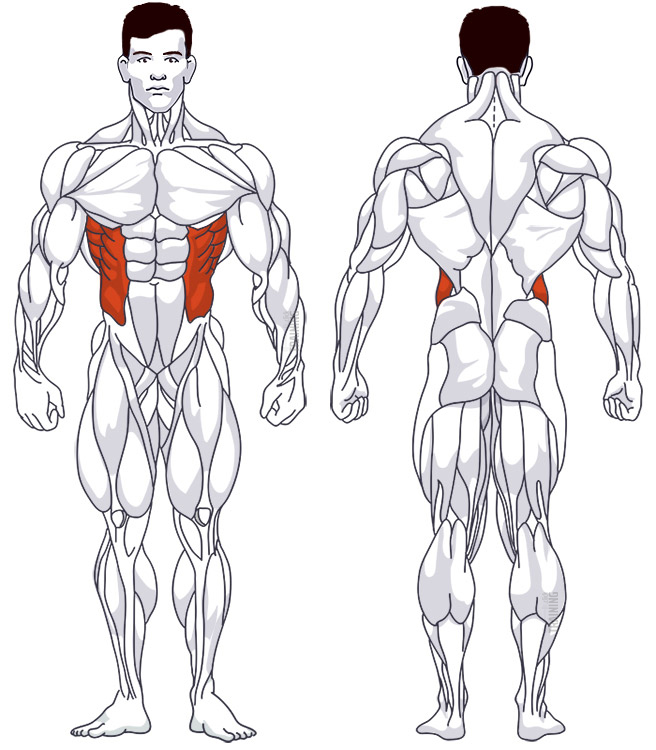
- Abdomen: External oblique abdominal muscle
(Musculus obliquus externus abdominis) - Abdomen: Transverse abdominal muscle
(Musculus transversus abdominis) - Shoulder: Anterior deltoid muscle
(Musculus deltoideus, Pars clavicularis) - Shoulder: Medial deltoid muscle
(Musculus deltoideus, Pars acromialis) - Buttocks: Large gluteus maximus
(Musculus gluteus maximus) - Thigh: Thigh flexor
(Musculus biceps femoris)
Training plans
Kettlebell Double Windmill is a suitable substitute for similar exercises in Abs workout or as a supplement to various training plans.
Kettlebell Double Windmill: Basics and alternatives
Involved main muscle groups:
Kettlebell Double Windmill
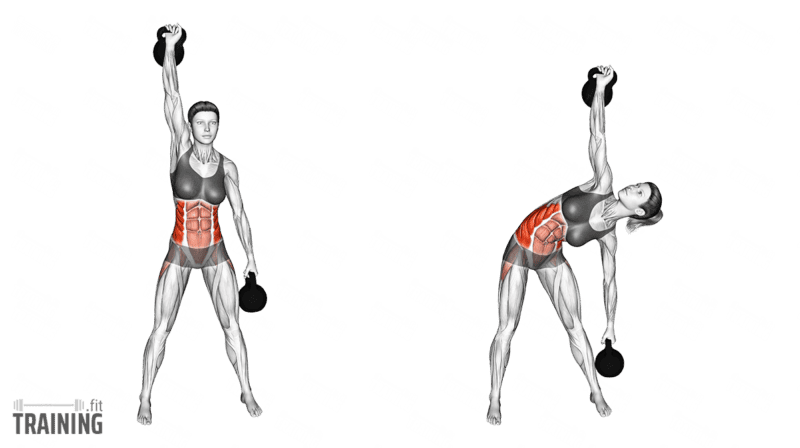
The double kettlebell windmill adds a second weight to the windmill position. You’ll hold one bell overhead on a straight arm and the other in your lowered hand. Shift your hips and lean, then return upright under control. Your core and shoulders hold the position while your hips help you straighten up.
In the Kettlebell Windmill, your lower hand is free, so you can use it to guide the descent along your leg. Here, that hand carries a load. In the Kettlebell Bent Press, you move underneath a weight from a bent-arm starting position. In the double windmill, your arm holding the overhead bell is already straight before you start lowering your torso.
Correct execution
Get comfortable with a single-weight windmill first. Bend your hips and knees to pick up two light bells. Bring one to your shoulder and press it overhead while the other hangs beside your opposite thigh. Get set with both weights under control, not swinging.
Turn your feet comfortably away from your raised arm. Push the hip under the overhead bell diagonally back, keeping that leg mostly straight and letting your other knee bend slightly. Then lean your torso to the side and turn your chest, with your raised arm staying vertical. The lower bell travels along the inside of the leg on the same side as your lower hand. Go only as deep as you can control; the bell doesn’t have to touch the floor. Reverse the hip movement to stand up, keeping both arms where they are. At the end, lower the overhead bell to your shoulder, bring both weights to your sides and set them down with control.
Your two bells don’t have to weigh the same, so choose each one separately if matching weights would make either position hard to control. Before you go deeper, check that the hanging bell clears your foot and shin, and hold its handle securely with a straight wrist, not angled outward. If you need to reposition, stand up first and let both weights settle.
Video tutorial
Step-by-step instructions
Pick up two light kettlebells and stand up steadily.
Bring one bell to your shoulder and press it overhead, keeping the other beside your thigh.
Angle your feet away from your raised arm and shift your hip on the overhead side diagonally backward.
Lean and turn your torso while keeping your raised arm vertical and guiding the lower bell along the inside of the leg on the same side as your lower hand.
Stop at a controlled depth and stand back up without swinging either bell.
Lower the overhead bell to your shoulder, bring both weights down and set them on the floor before switching sides.
Common mistakes
Letting the lower kettlebell pull you deeper means the weight decides how deep you go, not you. If your raised arm tilts or your back rounds as the lower bell goes down, shorten the movement or go back to the single-weight version.
Keep the arm holding the lower bell straight so it continues to hang as your torso moves. Set both weights down before switching sides; don’t swap arms while the bells are moving.