Kettlebell Turkish Get Up To Hand
Compound exercise, Free weightsOverview
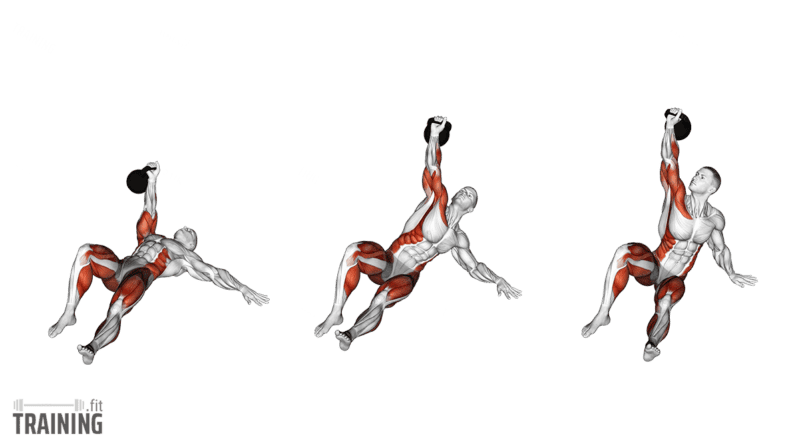
Main muscles
- Abdomen: Straight abdominal muscle
(Musculus rectus abdominis) - Abdomen: External oblique abdominal muscle
(Musculus obliquus externus abdominis) - Abdomen: Transverse abdominal muscle
(Musculus transversus abdominis) - Shoulder: Anterior deltoid muscle
(Musculus deltoideus, Pars clavicularis) - Triceps: Three-headed arm muscle
(Musculus triceps brachii)
Training plans
Kettlebell Turkish Get Up To Hand is a suitable substitute for similar exercises in Abs workout or as a supplement to various training plans.
Kettlebell Turkish Get Up To Hand: Basics and alternatives
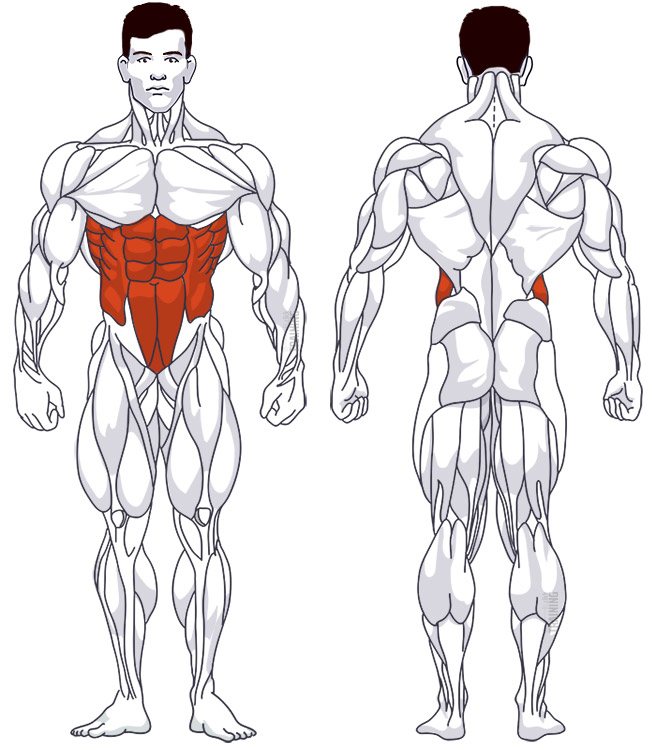
Involved main muscle groups:
Kettlebell Turkish Get Up To Hand
This partial Turkish get-up covers the first stages of the full exercise: you’ll roll from your back onto your free elbow, then press through that hand to sit taller. Your other hand holds a kettlebell above your shoulder. Your abs control the transition while your shoulders and arms support you and the weight.
You’ll stop once you’re sitting up, supported on your hand; the bridge, kneeling and standing stages belong to the full get-up. In the Kettlebell Windmill, you control an overhead bell while standing and leaning your torso. Sit Ups raise your torso without a one-sided overhead hold. The Kettlebell Bent Press moves your standing body underneath a weight.
Correct execution
Practice the sequence without a kettlebell first. For the right side, lie on your right side beside the bell. Grip it with your right hand and support it with your left, roll onto your back with it close to your chest, then press it up with both hands. Bend your right knee and plant that foot; extend your left leg and lay your left arm diagonally away from your torso.
Keep your right wrist straight, arm extended upward and eyes on the bell throughout. Push through your right foot and roll diagonally onto your left elbow with the bell balanced over your shoulder. Your left elbow should finish beneath your left shoulder; adjust your free arm’s starting position during unweighted practice if needed. Turn your supporting forearm outward so your fingers point behind you, then press through the heel of your hand to straighten that arm and sit tall, keeping your hand down. Return to your elbow and lower your torso smoothly. Bring the bell to your chest with both hands and roll toward it to set it down.
Video tutorial
Step-by-step instructions
Practice the back-to-elbow-to-hand sequence without a weight.
Lie on your right side with a light kettlebell in front of your chest. Grip it with your right hand, support it with your left and roll onto your back with the bell close to your chest.
Use both hands to press the bell above your right shoulder. Bend your right knee and plant that foot, then extend your left leg and free arm diagonally on the floor.
Push through your right foot and roll onto your left elbow, keeping the bell balanced above your right shoulder.
Rotate your supporting forearm away from your body so your fingers point behind you, and press through the heel of your hand until you sit tall on a straight support arm.
Lower onto your left elbow and then return your torso to the floor, keeping your loaded arm controlled.
Bring the bell to your chest with both hands and roll onto your right side to set it down before changing sides.
Common mistakes
Trying to sit straight up can pull the bell ahead of your shoulder and lift your planted foot. Use the diagonal roll toward your supporting elbow and practice the path without a load if needed.
Under the weight, it’s easy to sink into your supporting shoulder or let the wrist holding the kettlebell bend backward. Push actively through both arms and use a bell that’s light enough to control every transition. On the way down, dropping from your hand straight onto your back skips the controlled return, so lower yourself onto your elbow first.