Kettlebell Bent Press
Compound exercise, Free weightsOverview

Main muscles
- Abdomen: External oblique abdominal muscle
(Musculus obliquus externus abdominis) - Abdomen: Transverse abdominal muscle
(Musculus transversus abdominis) - Shoulder: Anterior deltoid muscle
(Musculus deltoideus, Pars clavicularis) - Triceps: Three-headed arm muscle
(Musculus triceps brachii) - Buttocks: Large gluteus maximus
(Musculus gluteus maximus) - Thigh: Quadriceps
(Musculus quadriceps femoris)
Training plans
Kettlebell Bent Press is a suitable substitute for similar exercises in Abs workout or as a supplement to various training plans.
Kettlebell Bent Press: Basics and alternatives
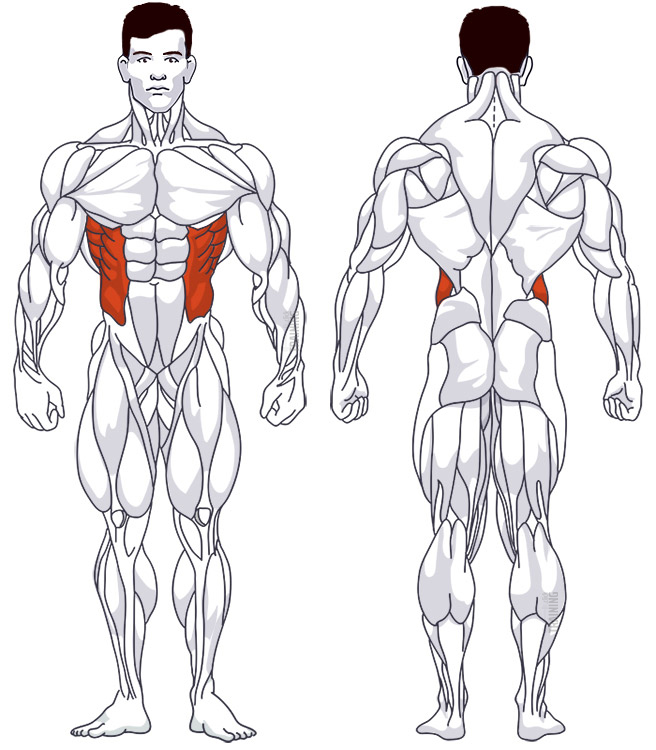
Involved main muscle groups:
Kettlebell Bent Press
The kettlebell bent press takes an unusual route from shoulder to overhead: you’ll turn and lower your body beneath the weight as your arm straightens, then stand up. Your shoulder and arm support it while your trunk, hips and legs control the movement.
In the Kettlebell Windmill, your arm is already overhead when you start lowering your upper body. The Kettlebell Turkish Get Up To Hand involves holding a kettlebell above you during the first part of a get-up from the floor. With dumbbell shoulder presses, your body stays much more upright as your arms move the weights. The bent press takes more practice, so it’s worth learning its stages with a light kettlebell and a trainer who knows the lift.
Correct execution
The name can be misleading: much of the movement comes from lowering your body beneath the bell. Learning that path with a light weight matters more than forcing a conventional overhead press.
Bring the kettlebell to your shoulder, using both hands to help if needed. Set your feet comfortably apart and turn them away from the side holding the weight. Rotate your upper body enough to rest your upper arm against your side. Keep your forearm beneath the kettlebell and your wrist straight, without forcing your elbow behind you.
Bend at your hips and turn your chest as you move down and away from the kettlebell. Your elbow straightens as you move under the weight; don’t try to drive the bell far upward. For support, place your free hand on the thigh on the same side and bend your knees as needed.
Once your arm is straight and the kettlebell is balanced over your shoulder, bring your hips underneath it and stand up. Lower the weight to your shoulder with control before starting another repetition or changing sides.
Video tutorial
Step-by-step instructions
Bring a light kettlebell to a secure shoulder rack and take a comfortable stance with your feet turned away from the kettlebell.
Turn your upper body and rest your upper arm against your side, keeping your forearm under the kettlebell.
Bend at your hips and lower your body away from and underneath the weight.
Let your elbow straighten as you descend, resting your free hand on the thigh on the same side if it helps.
Balance the bell over your shoulder with your arm straight, then bring your hips underneath and stand upright.
Lower the kettlebell to your shoulder under control and reset before repeating or changing sides.
Common mistakes
Don’t treat the bent press like a strict press: if you drive the kettlebell up with your arm, it’s hard to get underneath it. Keep the weight supported while your body changes position.
Your upper arm rests against your side early in the movement, then moves away as your elbow straightens. Don’t force your arm to stay there. Keep the bell from drifting behind you and balance it overhead before standing. Use a lighter weight and rehearse the stages if you can’t control the transition.