Barbell Bench Squat
Compound exercise, Free weightsThis article is verified by 2 studies/publications.
Overview
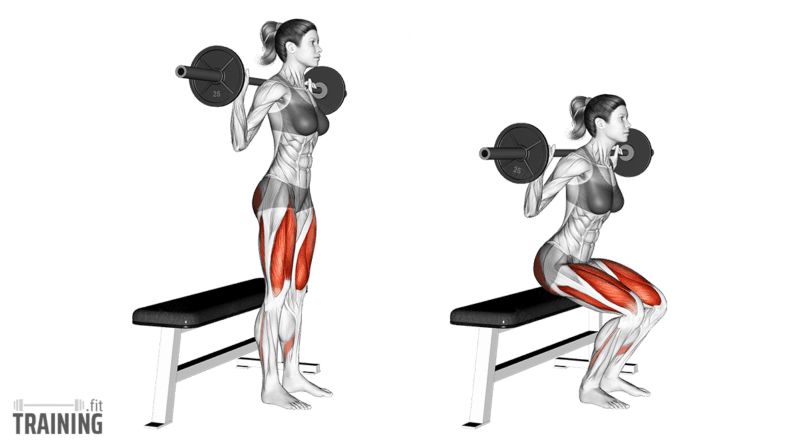
Main muscles
- Thigh: Quadriceps
(Musculus quadriceps femoris) - Thigh: Thigh flexor
(Musculus biceps femoris) - Buttocks: Large gluteus maximus
(Musculus gluteus maximus) - Back: Back extensor
(Musculus erector spinae)
Training plans
Here you can find example plans for barbell bench squat training:
Barbell Bench Squat: Basics and alternatives
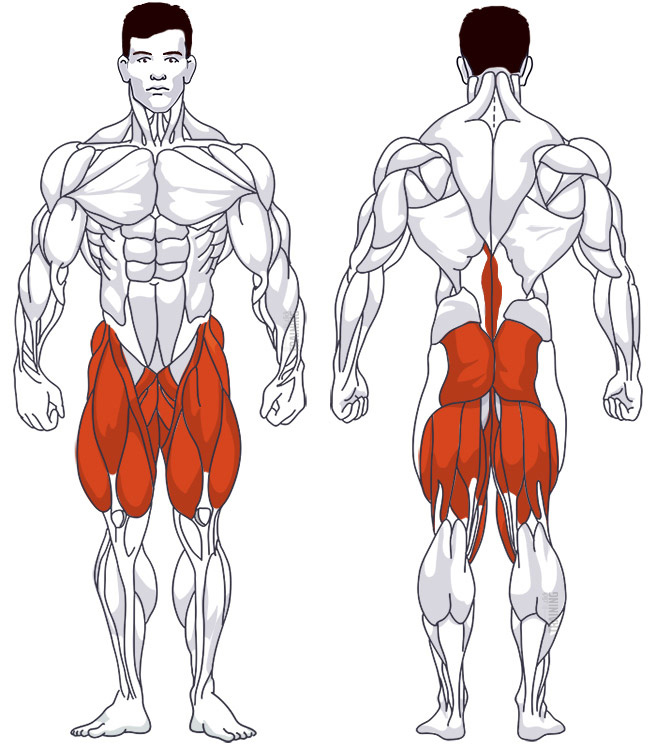
Involved main muscle groups:
Barbell Bench Squat
Barbell bench squats are a variation of classic barbell squats with a brief seated pause on a bench or box. You’ll hold the bar across your upper back, lower yourself until you sit gently on the surface, and then stand back up. Your thighs and butt move the weight while your abs and back muscles keep your upper body steady.
The seat gives you a useful depth reference when your foot position stays consistent. Choose a load you can control. Dumbbell Box Squats let you practice the pause with weights beside your body instead of a barbell on your back.
Correct execution
The seated pause gives each squat a clear bottom position. You’ll still support the bar and keep your trunk firm during that pause, rather than relaxing onto the bench.
Place a sturdy bench or box inside a suitable rack and choose a height you can reach under control, without folding forward. Make sure it can’t slide or tip and that you can return the bar to the hooks without tripping over it. Set the safety bars just below the height the barbell reaches when you’re seated on the bench or box.
Rest the bar on your upper-back muscles and get a firm grip. After unracking, take your squat stance in front of the surface. Bend your hips and knees under control until your butt gently touches the seat. Keep your feet planted and your core tight during the brief pause, then stand straight back up. Set the bench where your normal squat takes you, so you don’t have to reach a long way behind you to find it.
Rehearse the full sequence with an empty bar, including the walkout and rerack. Leave room to take your stance without stepping over the bench feet. Under a loaded bar, keep looking ahead rather than twisting around to find the seat.
Use the same sitting point and a similar brief pause each time. Contact on one edge of the bench can tilt your pelvis and bar even when both feet stay planted. If you land off center, stand and reset before repeating. If you change the bench height, check the safety bars again so they remain just below the barbell’s new lowest position.
Video tutorial
Step-by-step instructions
Set a stable bench or box in the rack and check the hook and safety-bar heights.
Position the bar across your upper back, grip it firmly and brace before unracking.
Step into a stable stance with the sitting surface directly behind you.
Bend your hips and knees and lower slowly until your butt rests gently on the surface.
Pause briefly while keeping your core braced and both feet firmly supported.
Stand by extending your hips and knees together, without rocking or bouncing.
After the final repetition, return the bar to both rack hooks before stepping out.
Common mistakes
Don’t drop onto the bench for the last bit of the descent; that turns a controlled squat into a hard landing. If you can’t reach the seat gently, use less weight or a higher surface.
Don’t relax once you’re seated or rock backward to create momentum. Keep your feet planted, core tight and upper body steady through the pause. Check the bench before each set; reaching backward for a misplaced seat can disturb your squat path.
What the science says
The barbell squat to a bench or box is often called a box squat in research, and a few small studies with experienced lifters have compared it with the regular barbell squat. The studies examined individual sessions, showing differences in movement, forces and muscle activity rather than long-term strength or muscle gains.
In a 2012 study, 12 male powerlifters did a traditional squat, a wide-stance powerlifting squat and a box squat at 30, 50 and 70% of their 1-rep max, lifting as fast as possible. In the box squat, they used a wide stance (about 92 cm) and kept their shins more vertical, which shifted their center of mass backward. The box squat produced the smallest peak turning forces (joint moments) at the spine and ankle, and the traditional squat produced the largest. The findings apply to the wide-stance, powerlifting-style box squat tested here.[1]
In a 2010 study, 8 resistance-trained men did single reps of regular squats and box squats at 60–80% of their 1-rep max. Peak force and power on the way up were generally similar, with the box squat slightly higher at some loads. The thigh and lower back muscles were generally more active in the regular squat. The authors conclude that the pause on the box, which removes the quick rebound at the bottom, hurts performance only slightly.[2]
Sources
- A Biomechanical Comparison of the Traditional Squat, Powerlifting Squat, and Box Squat. Swinton PA, Lloyd R, Keogh JW, Agouris I, Stewart AD. Journal of Strength and Conditioning Research. 2012;26(7):1805–1816. doi: 10.1519/jsc.0b013e3182577067.
- Comparison of Kinetic Variables and Muscle Activity During a Squat vs. a Box Squat. McBride JM, Skinner JW, Schafer PC, Haines TL, Kirby TJ. Journal of Strength and Conditioning Research. 2010;24(12):3195–3199. doi: 10.1519/jsc.0b013e3181f6399a.