Kettlebell Swing
Compound exercise, Free weightsThis article is verified by 4 studies/publications.
Overview
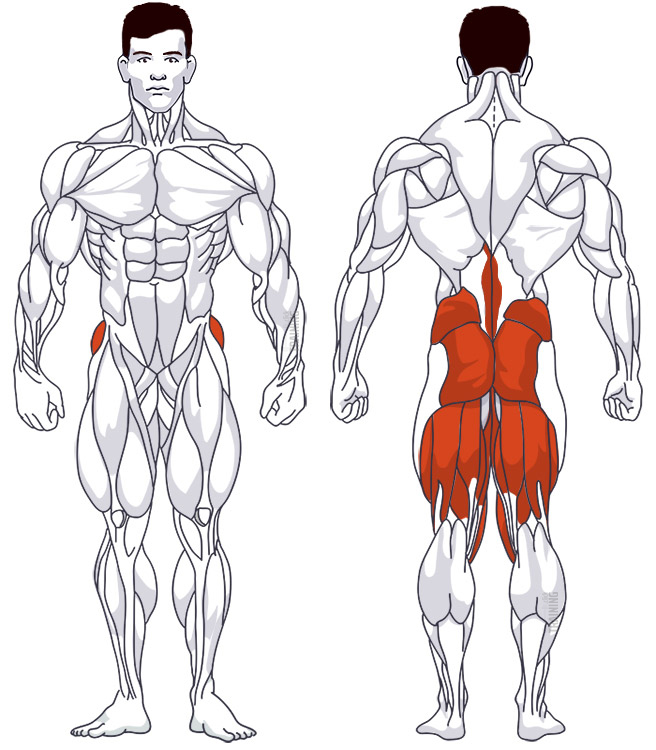
Main muscles
- Buttocks: Large gluteus maximus
(Musculus gluteus maximus) - Thigh: Thigh flexor
(Musculus biceps femoris) - Back: Back extensor
(Musculus erector spinae)
Training plans
Kettlebell Swing is a suitable substitute for similar exercises in Conditioning and full-body or as a supplement to various training plans.
Kettlebell Swing: Basics and alternatives
Involved main muscle groups:
Kettlebell Swing
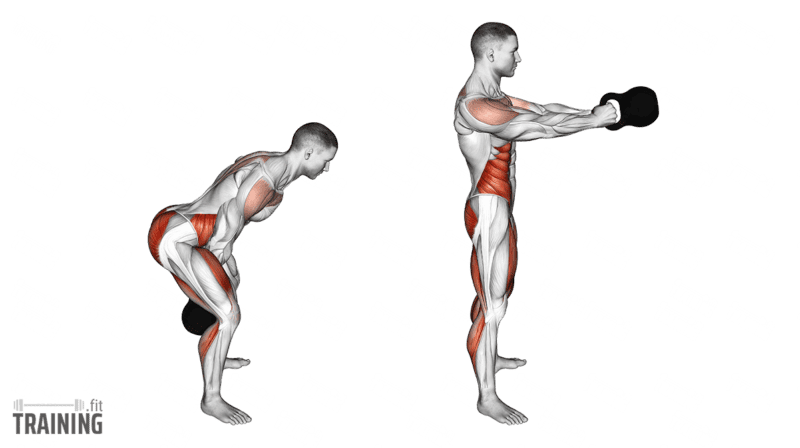
The kettlebell swing is a classic hip-driven exercise for your butt and the backs of your thighs. You’ll swing the bell between your legs, then straighten your hips quickly to send it forward. Your abs and lower back muscles steady your back while your arms guide the bell. In this two-handed version, the bell rises to around chest height.
The hip movement is similar to the Band Pull Through, where you straighten your hips against an anchored fitness band. The Barbell Hip Thrust also trains hip extension, with your upper back resting on a bench. The swing adds speed and timing: you’ll move from a backswing into a hip drive, then let the kettlebell briefly float in front of you.
Correct execution
The power comes from your hips, not your arms. Practicing the hip hinge first helps you feel the difference between swinging the weight and lifting it with your shoulders.
Clear space in front of and behind you. Place the kettlebell in front of your feet, close enough to reach by pushing your hips back and bending your knees slightly, keeping your back in its natural position. Grip it firmly with both hands and practice the hip movement slowly before adding speed.
Pull the bell back between your upper thighs, then quickly straighten your hips and knees to stand upright. Keep your arms mostly straight and let the hip drive carry the weight upward. You don’t need to lift it to an exact height or swing it overhead.
Stay upright as the kettlebell begins to fall. When your arms return toward your ribs, push your hips back to receive the next backswing. Exhale as you drive upward and breathe in on the return. Keep your whole foot on the floor, without rocking onto your heels or rising onto your toes.
Let your knees bend enough for the backward hip movement; don’t hold your legs rigid. If the kettlebell starts swinging to one side, set it down and check your grip and stance. To finish, let the bell make its final backswing, then guide it forward onto the floor with control.
Video tutorial
Step-by-step instructions
Stand behind the kettlebell with room for it to pass between your thighs.
Push your hips back, bend your knees slightly and grip the handle with both hands.
Pull the kettlebell back between your upper thighs while keeping your back steady.
Extend your hips and knees quickly to stand upright and let the bell float toward chest height.
Let the bell fall back down, then push your hips back as your arms return toward your ribs.
Repeat the rhythm with a secure grip and park the bell on the floor after the final backswing.
Common mistakes
Sitting straight down turns the backswing into a squat and can send the bell too close to the floor. Move your hips backward and keep the bell passing near your upper thighs.
Bending your elbows or shrugging the bell up turns the hip-driven swing into an arm lift. Use a manageable weight and let your hip drive determine its height. Don’t lean back at the top. Wait until the bell returns toward you before pushing your hips back.
What the science says
The kettlebell swing has been studied for muscle activity, back loading, power output and training effects. Most studies had small samples that were either all male or all female. None measured muscle growth.
In a 2013 study with 16 female elite handball and soccer players, the swing and the Romanian deadlift produced very high hamstring activity. Both worked the inner hamstring (semitendinosus) harder than the outer one (biceps femoris). The supine leg curl showed the opposite pattern.[1]
In a 2012 study, 7 men swung a 16-kg kettlebell. Each swing triggered short bursts of activity of about 80% of the maximum in the glutes and 50% in the lower back muscles. A computer model showed an unusual shear load in the lower spine, opposite to that of a traditional lift. The authors suggest these loading patterns could explain why many people say swings help their back, while a few find they irritate it.[2]
In a 6-week study, 21 young men trained 2 times a week with either kettlebell swings or jump squats. Across both groups, maximum half-squat strength rose by about 10% and vertical jump height by about 20%, with no significant difference between the groups. The study didn’t include a non-training control group.[3]
When 16 men did swings with kettlebells of 16–32 kg, their power output was greater than in back squats and largely comparable to jump squats. The squats, however, tended to produce higher peak forces. Net impulse, which measures force applied over time, was highest with the heaviest swings.[4]
Sources
- Kettlebell swing targets semitendinosus and supine leg curl targets biceps femoris: an EMG study with rehabilitation implications. Zebis MK, Skotte J, Andersen CH, Mortensen P, Petersen HH, Viskær TC, et al. British Journal of Sports Medicine. 2013;47(18):1192–1198. doi: 10.1136/bjsports-2011-090281.
- Kettlebell Swing, Snatch, and Bottoms-Up Carry: Back and Hip Muscle Activation, Motion, and Low Back Loads. McGill SM, Marshall LW. Journal of Strength and Conditioning Research. 2012;26(1):16–27. doi: 10.1519/jsc.0b013e31823a4063.
- Kettlebell Swing Training Improves Maximal and Explosive Strength. Lake JP, Lauder MA. Journal of Strength and Conditioning Research. 2012;26(8):2228–2233. doi: 10.1519/jsc.0b013e31825c2c9b.
- Mechanical Demands of Kettlebell Swing Exercise. Lake JP, Lauder MA. Journal of Strength and Conditioning Research. 2012;26(12):3209–3216. doi: 10.1519/jsc.0b013e3182474280.