Bird Dog
Compound exercise, Body weightThis article is verified by 5 studies/publications.
Overview
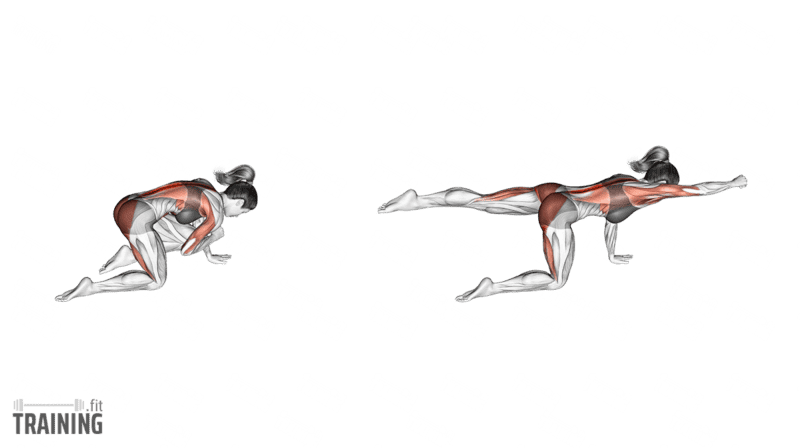
Main muscles
- Back: Back extensor
(Musculus erector spinae) - Buttocks: Large gluteus maximus
(Musculus gluteus maximus) - Abdomen: Straight abdominal muscle
(Musculus rectus abdominis)
Workout plan
Here you can find example plans for bird dog training:
Bird Dog: Basics and alternatives
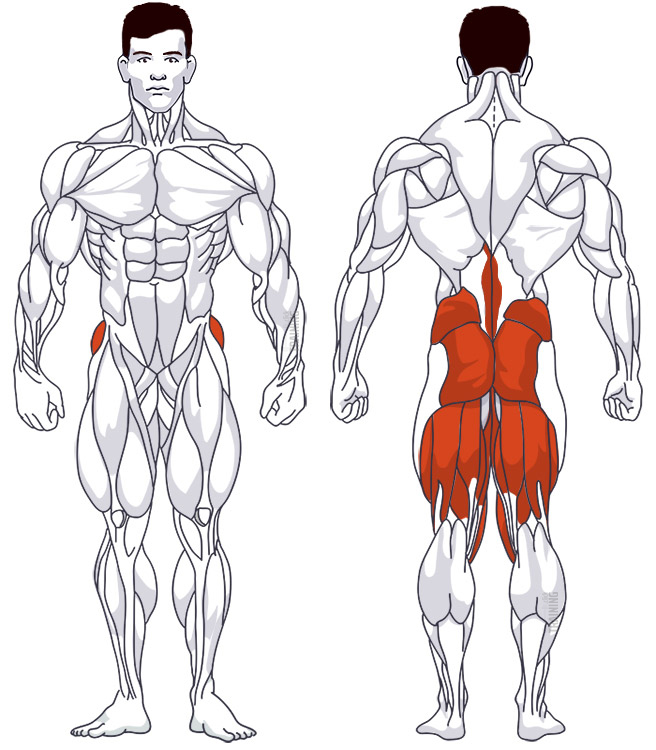
Involved main muscle groups:
Bird Dog
The bird dog is a classic core exercise that starts on your hands and knees. Reach one arm forward and the opposite leg back while keeping your body steady. Your back and abdominal muscles hold you in position, and your butt helps move your leg behind you.[1]
The banded bird dog adds elastic resistance between the reaching hand and foot. In dead bugs, you practice controlled leg movements while lying on your back. The ordinary bird dog needs only a comfortable floor surface and enough room to reach without hitting nearby objects.
Correct execution
The challenge is keeping your back and pelvis steady as one hand and the opposite knee leave the floor. A long, low reach is enough; lifting your hand or foot higher doesn’t make for a better rep.
Place your hands under your shoulders and your knees under your hips. Gently tighten your abs and keep the natural curve in your lower back. Focus on reaching long in opposite directions. Keep your shoulders and both sides of your pelvis level.
Reach to trunk height, or lower for more control. Pause, then return your hand and knee to the floor. You can also draw your elbow and knee in toward each other before reaching again. Keep it controlled; your elbow and knee don’t need to touch, and the simpler floor return is fine. Keep your neck aligned with your upper body and breathe throughout.
It’s worth breaking the movement down first. Slide one foot back with your toes still touching the floor, then reach one arm forward while both knees stay down. Once both feel steady on their own, lift an arm and the opposite leg together. Keep your chest facing the floor and your supporting shoulder down, away from your ear.
Use a firm mat beneath your knees and spread the fingers of your supporting hand. Your hand should remain flat rather than rolling onto its outer edge. A small weight shift is normal as you lift your hand and knee, but you shouldn’t have to lean far sideways to raise them.
Video tutorial
Step-by-step instructions
Set up on your hands and knees, hands under shoulders and knees under hips.
Brace gently and look down between your hands.
Reach one arm forward and the opposite leg backward without turning your pelvis.
Pause at a height where you can keep your back position steady.
Return your hand and knee under your body with control, setting them down before changing sides.
Repeat on the other side; only add the inward elbow-and-knee movement if you can control it.
Common mistakes
Lifting your leg too high often increases your back arch or turns your pelvis outward. Reach farther behind you at a lower height instead.
A large sideways shift before reaching changes your support position. Keep pressure through your supporting hand and knee, and shorten the reach if needed. In the inward variation, don’t force your elbow and knee together into a rushed curl; reset on all fours for more control.
If you’re not sure whether one side of your pelvis rises as you reach, a short video from behind can help. Watch it between reps, and keep your eyes on the floor while you’re holding the position.
What the science says
The bird dog is commonly studied in back rehabilitation research. Most studies measured muscle activity in single sessions, which shows how hard your muscles work, not whether the exercise makes them stronger over time.
In a study of 29 healthy volunteers, the internal oblique (a deep side abdominal muscle) was most active on the side of the raised arm during the bird dog. The lower back muscles (erector spinae) were most active on the opposite side.[2]
Adding movement to the bird dog hold, such as drawing squares with the hand or foot, increased activity in many muscle groups in a study with 8 healthy men. Bracing the abdominal wall increased oblique activity across the exercises tested.[3]
A study with 3 groups of about 30 adults aged 21–35 found that arm and leg raises on all fours kept the lower back muscles below 50% of their maximum, as did bridges and side bridges. Lower back activity reached 77% or more during face-down back extensions.[4]
When 12 healthy people did the bird dog, their obliques were more active than the six-pack muscle (rectus abdominis), and the lower back and glute muscles worked hardest when the leg on the same side was raised. Activity stayed at or below 41% of maximum in every measured muscle, so the authors doubt that the exercise is intense enough to strengthen the muscles of healthy people.[5]
The findings suggest that the bird dog is a low-intensity exercise for the trunk, with greater demands when movement is added.
Sources
- Electromyographic activity of trunk and hip muscles during stabilization exercises in four-point kneeling in healthy volunteers. Stevens VK, Vleeming A, Bouche KG, Mahieu NN, Vanderstraeten GG, Danneels LA. European Spine Journal. 2007;16(5):711–718. doi: 10.1007/s00586-006-0181-1.
- Trunk muscle activation during stabilization exercises with single and double leg support. García-Vaquero MP, Moreside JM, Brontons-Gil E, Peco-González N, Vera-Garcia FJ. Journal of Electromyography and Kinesiology. 2012;22(3):398–406. doi: 10.1016/j.jelekin.2012.02.017.
- Exercises for Spine Stabilization: Motion/Motor Patterns, Stability Progressions, and Clinical Technique. McGill SM, Karpowicz A. Archives of Physical Medicine and Rehabilitation. 2009;90(1):118–126. doi: 10.1016/j.apmr.2008.06.026.
- Surface Electromyographic Analysis of the Low Back Muscles During Rehabilitation Exercises. Ekstrom RA, Osborn RW, Hauer PL. Journal of Orthopaedic & Sports Physical Therapy. 2008;38(12):736–745. doi: 10.2519/jospt.2008.2865.
- Electromyographic activity of selected trunk muscles during dynamic spine stabilization exercises. Souza GM, Baker LL, Powers CM. Archives of Physical Medicine and Rehabilitation. 2001;82(11):1551–1557. doi: 10.1053/apmr.2001.26082.