Dumbbell High Pull
Compound exercise, Free weightsThis article is verified by 4 studies/publications.
Overview
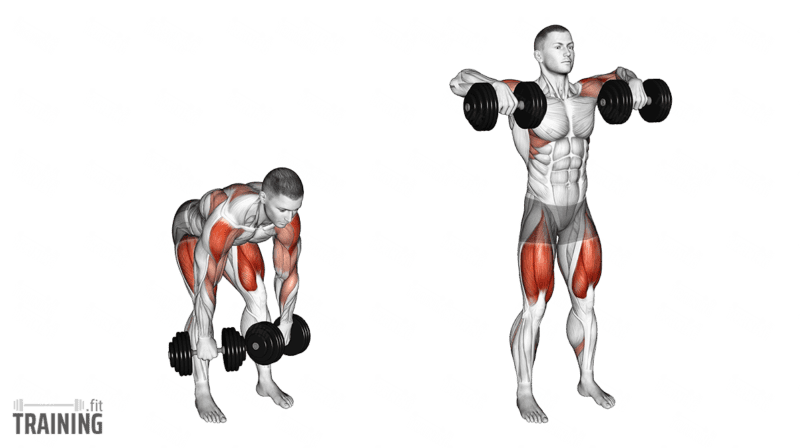
Main muscles
- Neck: Trapezius muscle
(Musculus trapezius) - Shoulder: Medial deltoid muscle
(Musculus deltoideus, Pars acromialis) - Thigh: Quadriceps
(Musculus quadriceps femoris) - Buttocks: Large gluteus maximus
(Musculus gluteus maximus) - Thigh: Thigh flexor
(Musculus biceps femoris) - Back: Back extensor
(Musculus erector spinae)
Training plans
Dumbbell High Pull is a suitable substitute for similar exercises in Neck training or as a supplement to various training plans.
Dumbbell High Pull: Basics and alternatives
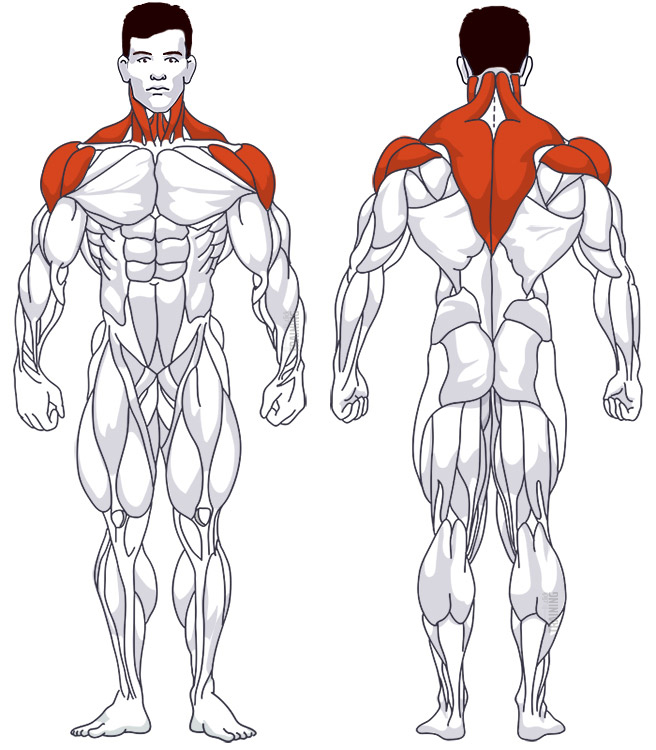
Involved main muscle groups:
Dumbbell High Pull
The dumbbell high pull combines an explosive leg and hip drive with an upper-body pull. Extend your legs and hips to drive the weights up, then lift your elbows outward to guide them close to your body. Your shoulders and upper back join the pull after your lower body starts it.
Dumbbell upright rows use a slower pull, with no drive from your legs. With dumbbell deadlifts, you can practice the leg and hip part of the lift on its own. It’s a good idea to learn both parts with a manageable weight before you put them together in the high pull.
Correct execution
Hold a dumbbell in each hand with an overhand grip, then push your hips back and lean forward until the weights are around knee height. Bend your knees enough to stay balanced and keep your back under control. Start the upward movement by pushing through the floor and extending the hips. Keep your arms straight at first.
As you near an upright position, let your shoulders rise and guide your elbows outward so the dumbbells come up toward your lower chest. There’s no overhead catch in this variation. Lower the weights with control back to knee height and push your hips back again before the next rep. Your heels may come up naturally, but you don’t need to jump.
Keep both dumbbells level at the start, with enough room to pass in front of your knees. Your grip stays overhand as your elbows lead the pull, so your palms don’t turn up like in a curl. Leave a little space between the weights so they don’t bump together in front of your chest.
Let your elbows straighten as the dumbbells descend, then push your hips back to receive them near knee height. Get into that hinge before the weights pull your shoulders forward. Start again once you’re balanced and the weights have stopped moving.
Video tutorial
Step-by-step instructions
Stand with your feet about hip-width apart.
Hold a dumbbell in each hand with an overhand grip.
Brace your torso, soften your knees and hinge to bring the weights near knee height.
Drive through your feet and extend your hips and knees while keeping your arms straight at first.
As the weights rise, shrug and guide your elbows outward and upward, keeping the dumbbells close.
Finish around lower-chest height without leaning backward or trying to catch the weights overhead.
Lower with control, return to the hinge and reset before repeating.
Common mistakes
If you pull with your arms before your hips have straightened, your legs and hips do less of the work. Practice the sequence with light weights: legs and hips first, then the upper-body pull.
Don’t fling the dumbbells away from you or let one rise much faster than the other. Reduce the load if timing or the return is hard to control. Finish tall; don’t push your hips forward into a backward lean.
Pause between repetitions instead of bouncing straight into the next pull. If you can’t lower the weights under control, stop and use lighter dumbbells. Use the same starting height for both hands so one side doesn’t begin its pull before the other.
What the science says
Research specifically on the dumbbell high pull is scarce. The studies below used the barbell hang high pull, which starts with the bar hanging in front of your thighs, so they describe the movement pattern rather than the dumbbell version.
In a 10-week study, 18 college swimmers (8 men, 10 women) with at least 1 year of strength training experience trained with either hang high pulls or trap-bar jump squats. Both groups made progress. Their results didn’t differ significantly in jump height, jump power or maximal pulling force. The jump squat group had a moderate, though not statistically significant, edge in height and power when jumping from a paused squat, and the authors note that loaded jumps need less coaching than weightlifting lifts.[1]
A review of the weightlifting literature argues that pulling variations without a catch, including the hang high pull, may provide a training stimulus as good as, or better than, lifts with a catch, such as the power clean. These pulling variations are also easier to learn.[2]
On a force plate, 16 strength-trained men produced about the same peak force in the hang high pull as in the hang power clean, and slightly more total force over the whole lift (impulse). Force production was highest in the jump shrug, where you jump and shrug with the bar instead of pulling it high.[3]
In another study, 8 weightlifters did hang high pulls and hang power cleans at 40–100% of the heaviest hang power clean they could lift once. At 40–70%, the high pull produced more power, a faster movement and a higher bar path. At loads of 80% and above, power was roughly the same in both lifts.[4]
Sources
- Comparison of the Hang High Pull and Loaded Jump Squat for the Development of Vertical Jump and Isometric Force-Time Characteristics. Oranchuk DJ, Robinson TL, Switaj ZJ, Drinkwater EJ. Journal of Strength and Conditioning Research. 2019;33(1):17–24. doi: 10.1519/jsc.0000000000001941.
- Weightlifting Pulling Derivatives: Rationale for Implementation and Application. Suchomel TJ, Comfort P, Stone MH. Sports Medicine. 2015;45(6):823–839. doi: 10.1007/s40279-015-0314-y.
- Force-Time–Curve Comparison Between Weight-Lifting Derivatives. Suchomel TJ, Sole CJ. International Journal of Sports Physiology and Performance. 2017;12(4):431–439. doi: 10.1123/ijspp.2016-0147.
- Comparison of the Power Output Between the Hang Power Clean and Hang High Pull Across a Wide Range of Loads in Weightlifters. Takei S, Hirayama K, Okada J. Journal of Strength and Conditioning Research. 2021;35(Suppl 1):S84–S88. doi: 10.1519/jsc.0000000000003569.