Floor T Raise
Compound exercise, Body weightThis article is verified by 4 studies/publications.
Overview
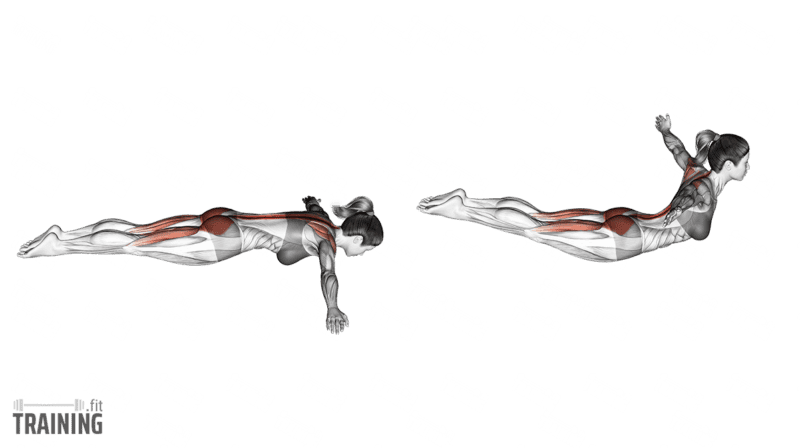
Main muscles
- Back: Back extensor
(Musculus erector spinae) - Buttocks: Large gluteus maximus
(Musculus gluteus maximus) - Neck: Trapezius muscle
(Musculus trapezius) - Shoulder: Posterior deltoid muscle
(Musculus deltoideus, posterior deltoid muscle)
Training plans
Floor T Raise is a suitable substitute for similar exercises in lower back training or as a supplement to various training plans.
Floor T Raise: Basics and alternatives
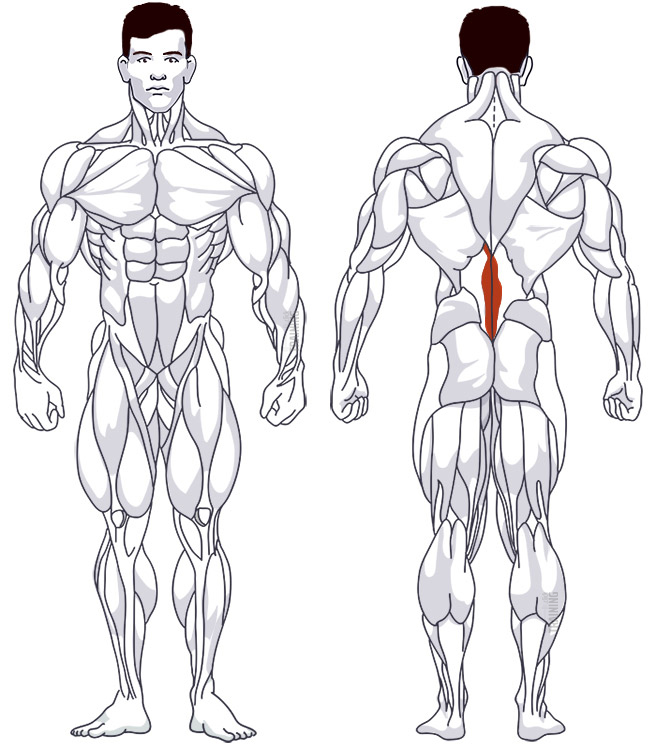
Involved main muscle groups:
Floor T Raise
The floor T-raise is a Superman variation that combines a small chest-and-leg lift with a T-shaped arm position. On a mat, lie on your stomach and lift your chest and legs together. Your back muscles and butt help raise you while your upper back and rear shoulders hold your arms out.
Lying back extensions use the same basic floor position with a different arm placement. Reverse Flys focus more directly on moving your arms at your shoulders. In the floor T-raise shown here, you lift your chest and legs as well as your arms.
Correct execution
Lie on your stomach on a firm, padded surface. Extend your arms out to the sides at about shoulder level to form a T. Keep your legs straight and roughly hip-width apart, with your knees facing the mat. Look down so your neck stays in line with your trunk.
Lift your chest, arms and legs smoothly at the same time while your stomach and pelvis stay on the mat and your hands don’t push off. A small lift is all you need.
Keep your arms out to the sides the whole time, reaching gently outward with your shoulders and hands in a comfortable position. Keep your knees straight and lift your legs from your hips.
Hold briefly while continuing to breathe, then lower your upper body, arms and legs gently. Let them settle on the mat before repeating. If you find it difficult to lift both ends together, practice raising just the upper body or just the legs while the other part rests on the floor.
Video tutorial
Step-by-step instructions
Lie face down on a mat with your legs extended and your arms out to the sides in a T.
Keep your gaze toward the floor and your neck in line with your torso.
Lift your chest, arms and legs a small distance from the floor without a sudden kick.
Hold the raised position briefly, keeping your pelvis supported and breathing steadily.
Lower your upper body, arms and legs under control. Pause on the mat before repeating the same small lift.
Common mistakes
It’s tempting to look forward by lifting your chin, but that only bends your neck back and doesn’t lift your body any higher. Keep your gaze down and let your head move with your chest.
Trying to arch as high as possible or bouncing through your lower back is a common mistake. If you can’t pause comfortably at the top, make the lift smaller and smoother. Also keep your arms out to the sides in the T; sweeping them behind you just creates momentum.
Rocking from your chest onto your thighs means you’re no longer lifting both ends together. Start from a settled position and raise your chest and legs smoothly together. Keep looking down while holding; don’t turn your head to check your feet.
What the science says
Research on the floor T-raise specifically is limited. Researchers have measured the Superman, which uses the same chest-and-leg lift, and T-shaped arm raises while lying face down. These studies measured muscle activity in single sessions, which shows how hard a muscle works, not how much it grows.
In one study, 10 healthy men did the Superman and 3 other back-stabilizing exercises at 5 graded difficulty levels. Trunk muscle activity generally increased as the difficulty level rose. For the Superman, holding the position longer increased the total activity of the lower back muscles (multifidus and erector spinae) and of the six-pack muscle (rectus abdominis).[1]
In 45 healthy people, lying face down and raising the arm out to the side while turning it outward was 1 of 4 exercises out of 12 with a favorable balance in the trapezius. Activity was relatively high in the middle or lower trapezius, which pulls the shoulder blades back and down, compared with the upper portion that shrugs the shoulders.[2]
In another study of 30 healthy people, 2 of 10 exercises produced the most middle trapezius activity: a T-shaped arm raise with outward arm rotation, and an overhead arm raise while lying face down.[3]
Lower back muscle activity was also measured in 3 groups of about 30 adults aged 21–35. The full Superman, with arms and legs lifted, was 1 of 3 exercises that made these muscles work at about 77–82% of their maximum; a face-down back extension to a straight body line was another. Activity remained below 50% during arm and leg raises performed face down or on all fours.[4]
Sources
- Electromyographic Changes in Trunk Muscles During Graded Lumbar Stabilization Exercises. Kim CR, Park DK, Lee ST, Ryu JS. PM&R. 2016;8(10):979–989. doi: 10.1016/j.pmrj.2016.05.017.
- Rehabilitation of Scapular Muscle Balance: Which Exercises to Prescribe?. Cools AM, Dewitte V, Lanszweert F, Notebaert D, Roets A, Soetens B, et al. The American Journal of Sports Medicine. 2007;35(10):1744–1751. doi: 10.1177/0363546507303560.
- Surface Electromyographic Analysis of Exercises for the Trapezius and Serratus Anterior Muscles. Ekstrom RA, Donatelli RA, Soderberg GL. Journal of Orthopaedic & Sports Physical Therapy. 2003;33(5):247–258. doi: 10.2519/jospt.2003.33.5.247.
- Surface Electromyographic Analysis of the Low Back Muscles During Rehabilitation Exercises. Ekstrom RA, Osborn RW, Hauer PL. Journal of Orthopaedic & Sports Physical Therapy. 2008;38(12):736–745. doi: 10.2519/jospt.2008.2865.