Knees Over Toes in the Squat
Compound exercise, Free weightsThis article is verified by 4 studies/publications.
Overview
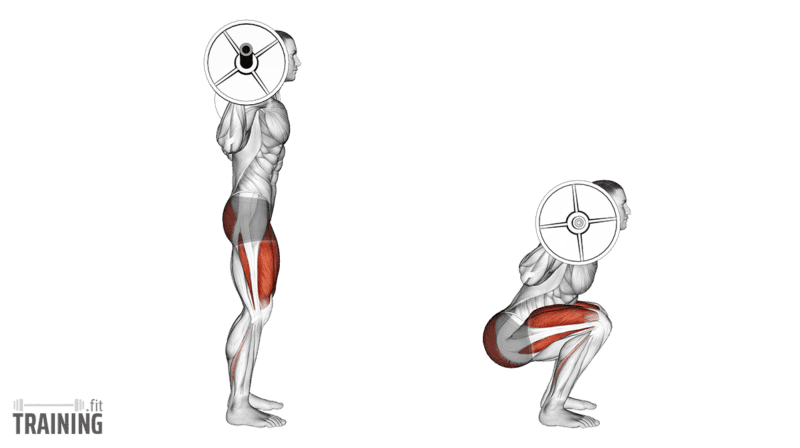
Main muscles
- Thigh: Quadriceps
(Musculus quadriceps femoris) - Buttocks: Large gluteus maximus
(Musculus gluteus maximus) - Back: Back extensor
(Musculus erector spinae)
Training plans
Knees Over Toes in the Squat is a suitable substitute for similar exercises in Thigh training or as a supplement to various training plans.
Knees Over Toes in the Squat: Basics and alternatives
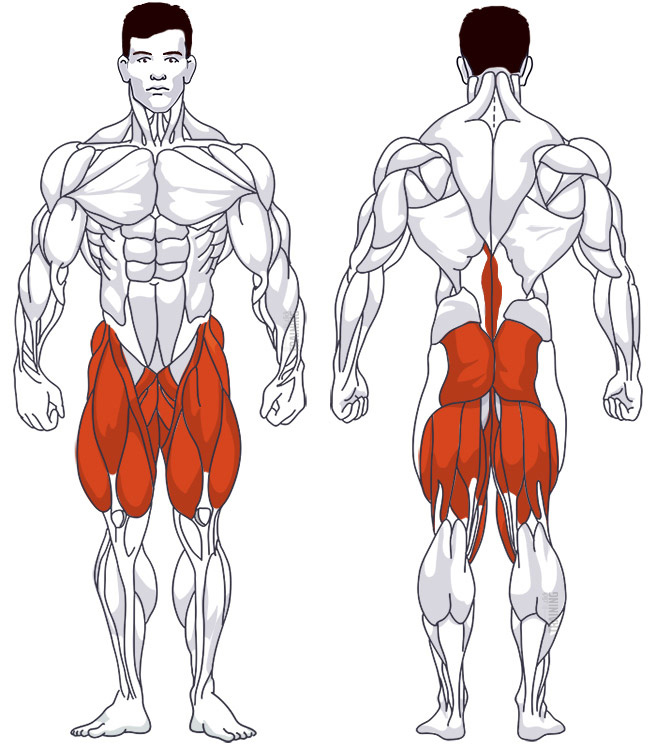
Involved main muscle groups:
Knees Over Toes in the Squat
Your knees don’t have to stop at your toes when you squat. They move forward as you lower your body, and how far they travel depends on your proportions, stance, depth and where you hold the weight. Forcing them to stay behind your toes can push your hips farther back and make your upper body lean forward.
A 2023 review of barbell-squat research argues against a blanket restriction on forward knee movement in healthy, trained people. It also describes rehabilitation situations where limiting that movement may be useful. The review doesn’t establish one safe knee angle for everyone.[1]
Where you hold the bar changes how you balance, as the starting positions for Barbell Squats and Front Squats show. Lunges also bend your knees and hips, but their split stance makes them a separate case. Below, you’ll use an ordinary squat to check your own movement.
Correct execution
Start without extra weight. Place your feet about shoulder-width apart and turn your toes slightly outward if that feels comfortable. Bend your knees and hips together, keeping pressure across your whole foot. Let your knees move in the direction of your toes without trying to stop them at an imaginary line.
If your heels lift, your feet roll inward or your upper body suddenly tips as you descend, adjust your stance or squat less deeply. These signs help you check your movement, but there’s no fixed distance your knees are allowed to travel. Bar position and load matter too, so front and back squats can look different from the side.
A side-view recording can help you see what your knees, hips and upper body do together. Include your whole body and feet in the frame, then watch the recording after the set. Avoid turning your head toward a side mirror while you’re squatting. Keep the weight position the same and change one thing at a time, such as your stance or depth, so you can judge which adjustment helps you stay balanced.
If your movement is restricted as part of rehabilitation, follow the individual plan you’ve been given. A general technique guide can’t determine those limits for you.
Video tutorial
Step-by-step instructions
Stand without extra weight, with your feet fully on the floor in a comfortable squat stance.
Tighten your abs gently and begin bending your knees and hips together.
Let your knees move in the direction of your toes while keeping pressure across your whole foot.
Lower only as far as you can comfortably control, keeping your heels on the floor.
Stand back up smoothly. Adjust your stance or depth before the next repetition if you lost your balance. Add weight only once you can repeat the movement consistently. Check that your feet stay planted and your upper body remains controlled with the added load.
Common mistakes
A common mistake is keeping your knees behind your toes at all costs. This can push your hips too far back and tip your upper body forward, so pay attention to the whole squat, not just that one cue.
Don’t make the opposite mistake of forcing your knees as far forward as possible and lifting your heels to get there. Let the forward movement happen naturally. Your knees also don’t have to reach the same position as someone else’s: their proportions, stance and squat variation may be different.
What the science says
In 3 lab studies, researchers compared barbell squats in which the knees could move forward freely with squats in which they had to stay behind the toes. The studies measured single sessions. They describe shifts in joint loading rather than changes in injury risk over time.
In a 2003 study, 7 weight-trained men did parallel squats with a barbell as heavy as their body weight, once with the knees free to move forward and once with a wooden barrier stopping their knees at the toes. With the barrier, the load on the knee joint (torque) dropped by about a fifth, while the load on the hip rose more than 10-fold, and the upper body leaned further forward. The authors concluded that allowing the knees to move slightly beyond the toes may be necessary for sensible joint loading.[2]
In a 2012 study, 20 people squatted with no extra load or with a quarter or half of their body weight on a barbell, again with and without restricted knee travel. Unrestricted squats produced higher peak loads at the knee and lower loads at the hip. The knees also bent further at the bottom, to about 106 degrees instead of 86 degrees, while hip bending stayed similar. The authors interpret the higher hip loads with restricted knee travel as an indication of greater lower back strain.[3]
A 2013 study by the same research group tracked the trunk and spine of 30 people with the same loads. When the knees could move forward freely, they moved through a larger range, while the spine moved less between the lower and upper back and the upper back changed its curve less. The authors recommend that coaches avoid an overly strict knees-behind-toes rule.[4]
Sources
- The Limitations of Anterior Knee Displacement during Different Barbell Squat Techniques: A Comprehensive Review. Illmeier G, Rechberger JS. Journal of Clinical Medicine. 2023;12(8):2955. doi: 10.3390/jcm12082955.
- Effect of Knee Position on Hip and Knee Torques During the Barbell Squat. Fry AC, Smith JC, Schilling BK. Journal of Strength and Conditioning Research. 2003;17(4):629–633. doi: 10.1519/1533-4287(2003)017<0629:eokpoh>2.0.co;2.
- Comparison of the Angles and Corresponding Moments in the Knee and Hip During Restricted and Unrestricted Squats. Lorenzetti S, Gülay T, Stoop M, List R, Gerber H, Schellenberg F, et al. Journal of Strength and Conditioning Research. 2012;26(10):2829–2836. doi: 10.1519/jsc.0b013e318267918b.
- Kinematics of the Trunk and the Lower Extremities During Restricted and Unrestricted Squats. List R, Gülay T, Stoop M, Lorenzetti S. Journal of Strength and Conditioning Research. 2013;27(6):1529–1538. doi: 10.1519/jsc.0b013e3182736034.