Ring Leg Curl
Compound exercise, Body weightThis article is verified by 3 studies/publications.
Overview
Main muscles
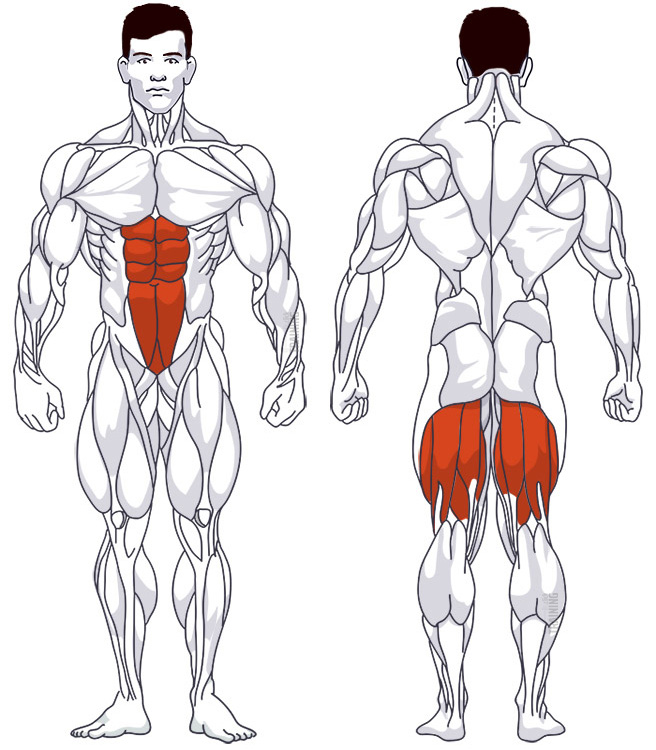
- Thigh: Thigh flexor
(Musculus biceps femoris) - Buttocks: Large gluteus maximus
(Musculus gluteus maximus) - Abdomen: Straight abdominal muscle
(Musculus rectus abdominis)
Training plans
Here you can find example plans for ring leg curl training:
Ring Leg Curl: Basics and alternatives
Involved main muscle groups:
Ring Leg Curl
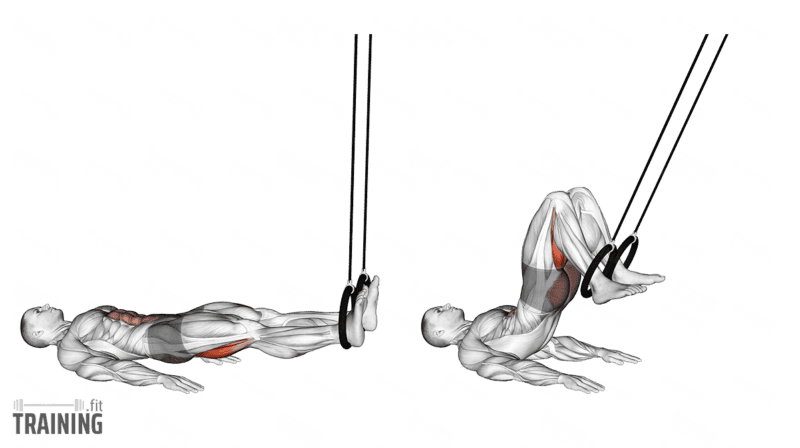
Ring leg curls are a challenging bodyweight exercise for the back of your thighs. With your heels in low rings and your upper back on the floor, you lift your hips and bend your knees to draw your heels toward you, then extend your legs again. Your hamstrings control the curl, and your butt helps keep your hips raised.
Lying leg curls use a machine with your torso supported face down.
Correct execution
Adjust both rings to the same low height and check the straps and anchor. Lie on your back and place your heels securely in the rings, with enough clearance to move your legs. Rest your arms on the floor and keep your head and upper back supported.
Press through your heels to lift your hips, then bend your knees to pull the rings toward your butt. Your hips can rise as your heels come closer; just don’t finish the curl by arching your back. Slowly straighten your knees, keeping your hips off the floor, and stop extending your legs before your hips start to drop. Lower your hips all the way before you take your feet out of the rings.
Place your heels in the rings with your pelvis on the floor, then press down gently to test contact. Keep the rings aligned with your feet rather than drifting into a wide split. Check that both straps swing freely, clear of nearby equipment.
Start with a short curl and watch whether both knees bend together. Keep your palms on the floor for support rather than lifting your arms and making an already unfamiliar setup harder. Only extend your legs as far as you can keep both heels seated.
Video tutorial
Step-by-step instructions
Set both rings to an equal low height.
Check the straps and anchor.
Lie on your back, place one heel securely in each ring and rest your arms beside you.
Brace your abdomen and lift your hips by pressing through your heels.
Bend both knees to pull your heels toward your butt while keeping your upper back supported.
Slowly straighten your legs, keeping your hips off the floor.
Repeat through a controlled range, then lower your pelvis before removing your feet.
Common mistakes
Pulling the rings toward you with a sudden swing makes the return difficult to control. Begin with a small knee movement and keep both rings traveling together.
Don’t arch your lower back or push your head into the floor to lift your hips. Let your shoulders and upper back support you while your hips and knees move. If the rings are uneven or a heel feels loose, fix the problem before the next rep; twisting your pelvis won’t make up for it.
If a heel slips out of place, don’t go searching for the ring with your hips still in the air. Lower your pelvis, reposition your foot and make sure both heels are secure before you lift again.
What the science says
There don’t seem to be any studies of ring leg curls with both feet in rings, but several have looked at similar curls with a ball, sliders or a suspension trainer. These studies measured hamstring activity during a single session rather than long-term muscle or strength gains.
In 31 healthy young adults (18 men) who did 3 repetitions of each exercise, the ball leg curl produced lower hamstring activity than the Nordic hamstring curl. The authors suggest that this lower activity may make ball leg curls, like stiff-leg deadlifts, suitable early in a strength program.[1]
A 2026 study with 10 men and 10 women used computer modeling to estimate hamstring forces. While lowering in a single-leg slider curl, the force in one hamstring muscle (the long head of the biceps femoris) reached about 0.9 times body weight. That wasn’t significantly different from sprinting at full speed. The slider curl stretched the hamstrings less than almost all the other exercises and running speeds. The Romanian deadlift produced the greatest forces.[2]
A study tested 10 hamstring exercises in 20 elite female track and field athletes. A suspension trainer curl produced medium hamstring activity, 50–80% of a maximal contraction. In this curl, they lay on their back with both feet in the straps and hips raised, bending one knee at a time. Activity was highest in a single-leg curl done by sliding the heel on a piece of rug.[3]
Sources
- Muscle Activation Differences During Eccentric Hamstring Exercises. Guruhan S, Kafa N, Ecemis ZB, Guzel NA. Sports Health: A Multidisciplinary Approach. 2021;13(2):181–186. doi: 10.1177/1941738120938649.
- Hamstring force and stretch during progressively increasing running speeds and the eccentric phase of resistance training exercises commonly used for injury prevention and rehabilitation. Breed R, Hulm S, Hickey JT, Timmins RG, Opar D, Banyard HG, et al. British Journal of Sports Medicine. 2026;60(6):420–428. doi: 10.1136/bjsports-2025-110847.
- Muscle and intensity based hamstring exercise classification in elite female track and field athletes: implications for exercise selection during rehabilitation. Tsaklis P, Malliaropoulos N, Mendiguchia J, Korakakis V, Tsapralis K, Pyne D, et al. Open Access Journal of Sports Medicine. 2015;6:209–217. doi: 10.2147/oajsm.s79189.