Resistance Band Leg Curl
Isolation exercise, Free weightsThis article is verified by 4 studies/publications.
Overview

Main muscles
- Thigh: Thigh flexor
(Musculus biceps femoris)
Training plans
Here you can find example plans for resistance band leg curl training:
Resistance Band Leg Curl: Basics and alternatives
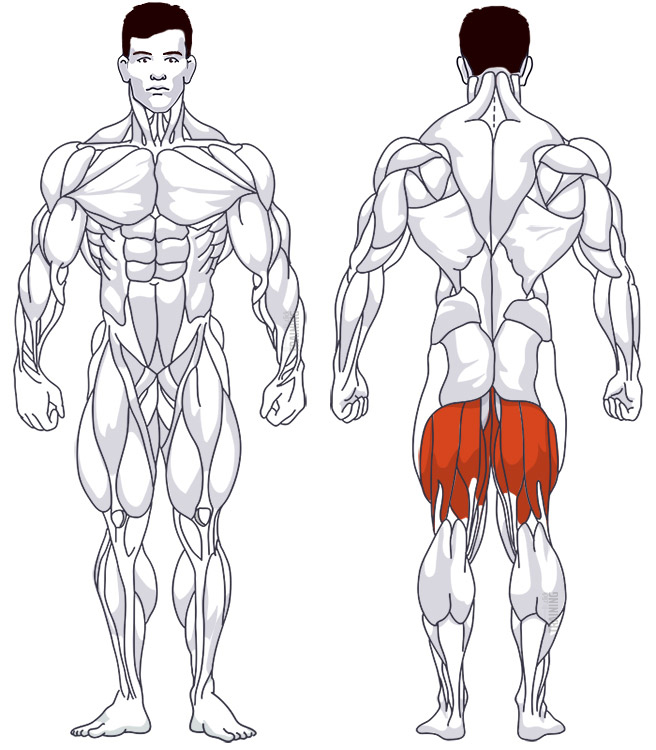
Involved main muscle groups:
Resistance Band Leg Curl
A standing band leg curl targets your hamstrings, the muscles at the back of your thighs, through a simple knee bend. You’ll bring your heel toward your butt against the band while your thigh stays near its starting position and your other leg supports you.
Lying leg curls support your body on a machine. Ring leg curls use suspended feet and raised hips instead. For the standing version, holding a support lightly lets you focus on the curl, so each rep doesn’t become a balance test.
Correct execution
Attach a band to a secure low anchor in front of you and connect the free end to your working ankle with a suitable cuff or secure loop. Step back until there’s a little tension, then place most of your weight on the other foot. Hold a stable support if needed.
Stand tall and keep your working thigh close to your supporting thigh. Bend your knee to bring your heel back and up. Stop before you have to swing your thigh, twist your pelvis or lean forward; your heel doesn’t have to touch your butt. Lower your foot slowly against the band’s pull and let your leg settle before the next curl. Choose a light band that lets you keep the same controlled path on both sides.
Before you start, set up close enough to your hand support that you can hold it lightly while standing tall. Keep your standing knee slightly relaxed and that foot flat, and leave room behind you for your heel to rise.
Check that the band pulls in line with your working leg. A sideways anchor can rotate the cuff and draw your knee across your standing leg. Reposition yourself with the band relaxed if its path is angled across your body.
Video tutorial
Step-by-step instructions
Secure the band to a low front anchor and attach it safely around your working ankle.
Face the anchor and step back to create light tension, using a stable hand support if needed.
Shift your weight onto your standing leg and keep your torso upright.
Bend your working knee and bring your heel toward your butt, keeping your thigh still.
Pause at a comfortable bend and lower your foot slowly. Repeat with the same controlled thigh position. Then move carefully toward the anchor until the band is slack before changing the attachment to your other ankle.
Common mistakes
Moving your thigh backward adds hip extension to your knee curl. Keep your thigh still and bend at your knee to move your lower leg.
Leaning forward or arching your back to lift your heel higher is a common mistake. Shorten the curl if your pelvis starts moving. On the return, don’t let your foot snap toward the anchor; a lighter band lets you lower it with control.
Rising onto the toes of your standing foot lifts your whole body along with your working heel. Keep that foot flat and stop the curl at a height you can reach while your body stays level.
What the science says
There appears to be no research specifically on the standing band leg curl. The studies below look at machine leg curls and at other band hamstring exercises, so they show what hip position and band resistance can change rather than how this exact version works.
In a 12-week study, 20 healthy adults trained one leg with seated leg curls and the other with lying leg curls on machines. MRI scans showed that the hamstrings grew more with the seated curl (14% vs. 9%), which the authors link to training the muscles in a more stretched position. Your hip stays straight in the standing band curl, just as it does in the lying curl. However, the study didn’t test the standing band version.[1]
In 25 physically active men, training with fast, light hamstring contractions against elastic bands was compared with heavy, slow hamstring training. Knee-bending strength increased by 16–21% after the heavy training. The band group instead improved their strength at very fast speeds (by 31%), how quickly they could bend and straighten their knees, and their 30-m sprint.[2]
When 22 healthy adults lay face down and bent the knee against an elastic band at a hard effort (8 out of 10), their hamstrings reached high activity, about 71–77% of the maximum. The researchers’ aim was to identify exercises for people confined to a hospital bed.[3]
A study with 13 men and 6 women aged 28–67 compared hamstring curls with elastic tubing and on a machine. Both reached similarly high peak hamstring activity, but the band version produced slightly less activity with the knee more extended (30–50 degrees) and felt harder (7.6 vs. 5.9 out of 10). These measurements describe muscle activity in a single session, rather than muscle growth.[4]
Sources
- Greater Hamstrings Muscle Hypertrophy but Similar Damage Protection after Training at Long versus Short Muscle Lengths. Maeo S, Huang M, Wu Y, Sakurai H, Kusagawa Y, Sugiyama T, et al. Medicine & Science in Sports & Exercise. 2021;53(4):825–837. doi: 10.1249/mss.0000000000002523.
- Effects of High Velocity Elastic Band versus Heavy Resistance Training on Hamstring Strength, Activation, and Sprint Running Performance. Janusevicius D, Snieckus A, Skurvydas A, Silinskas V, Trinkunas E, Cadefau JA, et al. Journal of Sports Science & Medicine. 2017;16(2):239–246. PMID: 28630577.
- Electromyographic evaluation of high-intensity elastic resistance exercises for lower extremity muscles during bed rest. Vinstrup J, Skals S, Calatayud J, Jakobsen MD, Sundstrup E, Pinto MD, et al. European Journal of Applied Physiology. 2017;117(7):1329–1338. doi: 10.1007/s00421-017-3620-2.
- Effectiveness of Hamstring Knee Rehabilitation Exercise Performed in Training Machine vs. Elastic Resistance: Electromyography Evaluation Study. Jakobsen MD, Sundstrup E, Andersen CH, Persson R, Zebis MK, Andersen LL. American Journal of Physical Medicine & Rehabilitation. 2014;93(4):320–327. doi: 10.1097/phm.0000000000000043.