Dumbbell Box Squats
Compound exercise, Free weightsThis article is verified by 3 studies/publications.
Overview
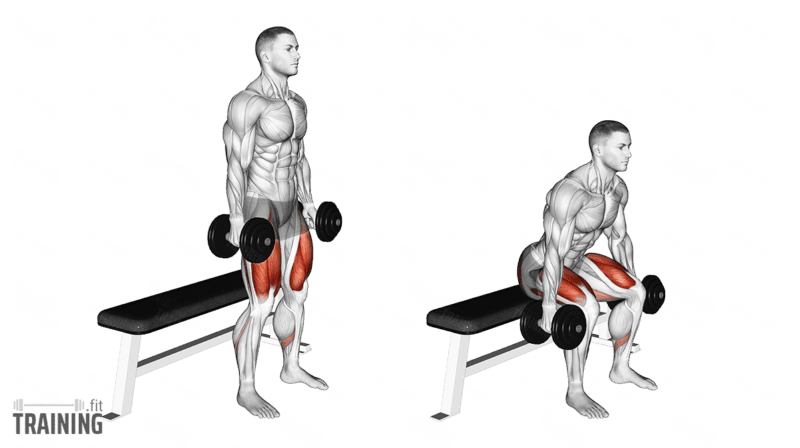
Main muscles
- Thigh: Long adductor muscle
(Musculus adductor longus) - Thigh: Quadriceps
(Musculus quadriceps femoris) - Thigh: Thigh flexor
(Musculus biceps femoris) - Buttocks: Large gluteus maximus
(Musculus gluteus maximus)
Training plans
Here you can find example plans for dumbbell box squats training:
Dumbbell Box Squats: Basics and alternatives
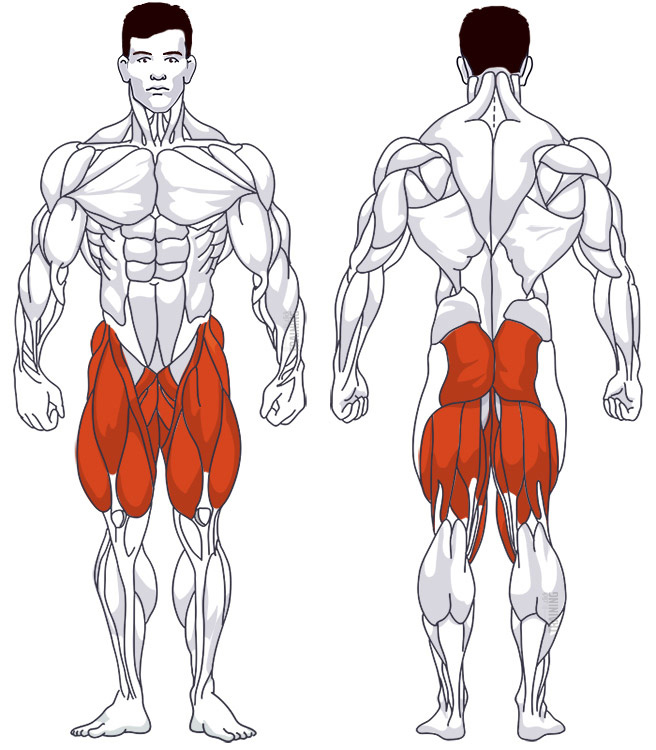
Involved main muscle groups:
Dumbbell Box Squats
Dumbbell box squats are a variation of dumbbell squats with a built-in target: you sit down briefly on a bench or box, then stand back up. You hold a dumbbell at each side, and your thighs and butt do the work as you lower and rise.
The box gives you a clear end point for the descent. Choose a height that lets you sit down and stand up with control. In barbell box squats, the weight rests across your upper back instead, and you’ll also need a rack.
Correct execution
Place a stable bench or box behind you that won’t slide or tip, and practice sitting down on it without weights first. It should be close enough to reach in a normal squat and high enough that you can stand up smoothly.
Line up with the middle of the seat, then pick up the dumbbells by bending your hips and knees. Hold them beside your thighs with your palms facing inward and your arms straight. Leave enough room for both weights to pass the edges of the box.
Bend your hips and knees together and lower until you sit gently on the surface. Your upper body can lean forward naturally for balance, as long as you don’t collapse over your legs. Pause briefly with your abs tight and both feet planted, then push through your feet to stand up smoothly, dumbbells still at your sides.
Keep your feet in place so you touch the same spot on the seat every time. Don’t turn around to look for the box while holding the weights. If you’re reaching farther back each time, put the weights down and reset your stance before continuing.
Video tutorial
Step-by-step instructions
Position a stable bench or box behind you and practice sitting down on it without weights to check the distance.
Bend at the hips and knees to pick up the dumbbells, then stand with them at your sides and palms facing inward.
Stand with your feet about shoulder-width apart and tighten your abs.
Bend your hips and knees and lower yourself onto the surface lightly and under control.
Pause briefly while keeping your feet planted and dumbbells clear of the bench. Push through both feet to stand upright, then repeat without swinging the weights. After the last repetition, bend your hips and knees to set both dumbbells down under control.
Common mistakes
A low box can tempt you to drop onto it for the last part of the descent. Raise the surface or reduce the weight until you can sit down gently.
Rocking back, bouncing off the seat or swinging the dumbbells uses momentum to stand. Keep your upper body tight as long as you’re holding the weights, with the dumbbells at your sides. If they hit the bench, adjust your hand position or use a narrower seat.
Don’t shuffle your feet while seated to create momentum for standing. Keep them planted during the pause and as you stand. If you have to reposition them every rep, use a higher box and practice the transition without the dumbbells first.
What the science says
We couldn’t find a study on dumbbell box squats. Research on loaded squats and on barbell box squats covers the 2 parts of this exercise separately, and it measured single sessions rather than long-term results.
In 19 recreationally active men, squats with a barbell, dumbbells, a weighted vest or a kettlebell all produced more leg muscle activity than squats without weight. The kettlebell squat showed a different pattern: one of the inner hamstring muscles (semitendinosus) worked harder and the muscle at the front of the shin (tibialis anterior) worked less than with the other weights.[1]
A study with 12 male powerlifters compared a barbell box squat with 2 other squat styles at 30–70% of their 1-rep max. For the box squat, the lifters stood wide and kept their shins more upright, shifting their center of mass backward. The peak turning forces (joint moments) at the spine and ankle were the lowest of the 3 squats. Because the researchers tested a powerlifting-style box squat with the bar on the back, the findings don’t describe the dumbbell version exactly.[2]
In another study, 8 resistance-trained men performed single reps of barbell squats and box squats with 60–80% of their maximum load. Peak force and power while standing up were mostly similar, with small advantages for the box squat at 70% and 80%. Muscle activity in the thigh and lower back muscles was generally higher in the regular squat, but the authors describe the differences overall as minimal and conclude that the pause on the box has limited negative effects on performance.[3]
Sources
- Effect of Loading Devices on Muscle Activation in Squat and Lunge. Wu HW, Tsai CF, Liang KH, Chang YW. Journal of Sport Rehabilitation. 2020;29(2):200–205. doi: 10.1123/jsr.2018-0182.
- A Biomechanical Comparison of the Traditional Squat, Powerlifting Squat, and Box Squat. Swinton PA, Lloyd R, Keogh JW, Agouris I, Stewart AD. Journal of Strength and Conditioning Research. 2012;26(7):1805–1816. doi: 10.1519/jsc.0b013e3182577067.
- Comparison of Kinetic Variables and Muscle Activity During a Squat vs. a Box Squat. McBride JM, Skinner JW, Schafer PC, Haines TL, Kirby TJ. Journal of Strength and Conditioning Research. 2010;24(12):3195–3199. doi: 10.1519/jsc.0b013e3181f6399a.