Dumbbell Sumo Squat (Handle Grip)
Compound exercise, Free weightsThis article is verified by 4 studies/publications.
Overview
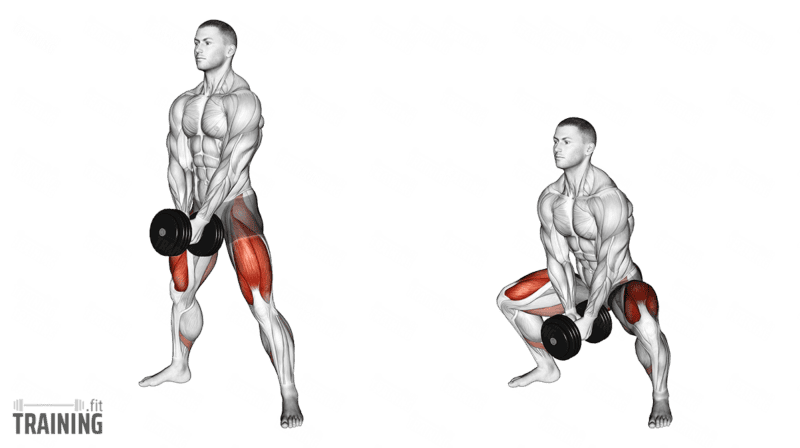
Main muscles
- Thigh: Long adductor muscle
(Musculus adductor longus) - Thigh: Quadriceps
(Musculus quadriceps femoris) - Thigh: Thigh flexor
(Musculus biceps femoris) - Buttocks: Large gluteus maximus
(Musculus gluteus maximus)
Training plans
Here you can find example plans for dumbbell sumo squat (handle grip) training:
Dumbbell Sumo Squat (Handle Grip): Basics and alternatives
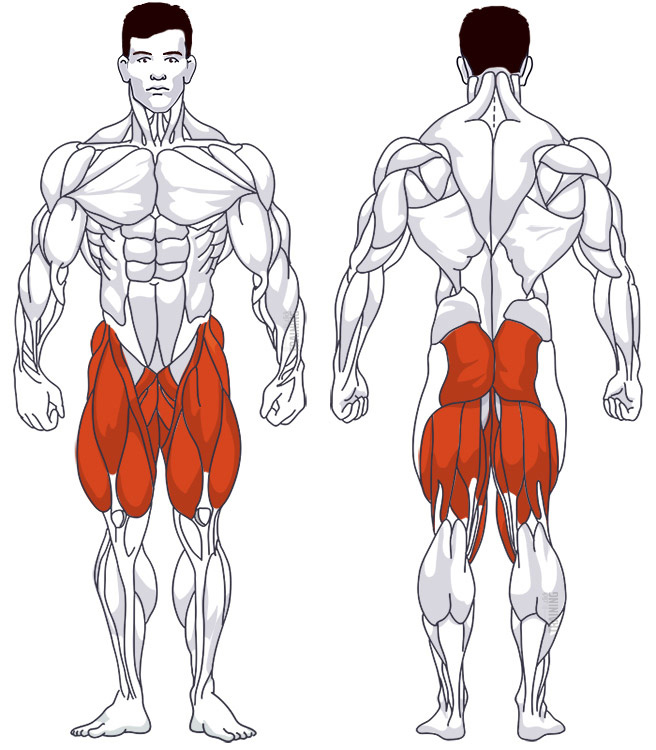
Involved main muscle groups:
Dumbbell Sumo Squat (Handle Grip)
This sumo squat keeps the equipment simple: you take a wide stance and hold one dumbbell. Both hands grip its handle between your legs; your stance leaves room for the weight as you bend your hips and knees. Your thighs and butt do the work, with your inner thighs also contributing.
With dumbbell goblet squats, you hold the weight at your chest instead. Side lunges offer another exercise with a wide stance, but you shift toward one leg. In the sumo squat, both feet stay planted and the dumbbell hangs between them.
Correct execution
Both hands share one dumbbell handle in this version. A handle that fits your grip lets you concentrate on the squat instead of adjusting your hands around the plates mid-repetition.
Choose a handle long enough for both hands to close securely side by side, clear of the plates. If it’s too short, change dumbbells or use a goblet squat. Don’t loosen your grip with either hand or hold the collar to make room.
Let the dumbbell hang horizontally between your thighs with your arms straight. Take a comfortably wide stance and turn your toes outward. You should be able to bend your knees in the same direction as your feet without rolling onto the edges of your soles.
Brace your abs and lower yourself by bending your hips and knees. Keep the dumbbell level and centered beneath you, and stop before it touches the floor. How low you can go depends on the size of the dumbbell and the length of your arms, so don’t reach down or stand on loose platforms to force more depth.
Press through both feet to stand up. Your arms stay straight, and the dumbbell rises with your body without swinging or tilting toward one leg.
Video tutorial
Step-by-step instructions
Hold one dumbbell by its central handle with both hands and let it hang horizontally.
Take a comfortably wide stance with your toes turned outward.
Brace your core and bend your hips and knees to lower your butt between your feet.
Keep your knees pointing in the same direction as your toes and the dumbbell clear of the floor.
Press through both feet to extend your legs and hips.
Stand tall without swinging the dumbbell, then repeat with control.
Common mistakes
A wider stance isn’t automatically better. If your knees fall inward or your feet roll onto their edges, bring your feet a little closer together until you can control the movement.
Don’t pull the dumbbell up with your arms; your legs and hips should do the work. Let it hang between your legs and press through your feet to stand up. Once you’ve reached the bottom of your squat, stand back up from there without bouncing the dumbbell off the floor; leaning farther forward just to lower it doesn’t make your squat any deeper.
What the science says
Very little research addresses this particular dumbbell variation. Studies on wide-stance barbell squats, plus a study on sumo squats as an inner-thigh exercise, show what the wide stance may change. All of these studies measured muscle activity in single sessions, not muscle growth.
In a study, 10 male competitive bodybuilders did several barbell squat variations at 80% of their max. During the lift, both sumo versions—with the usual foot position or with the feet turned out further—produced more activity in the outer front thigh (vastus lateralis) and inner thigh (adductor longus) than front squats. Only the sumo version with extra outward foot rotation also produced more adductor longus activity than regular back squats to parallel or below parallel.[1]
A 2026 study with 12 men and 6 women found that a wide stance in the barbell back squat increased the activity of the inner front thigh muscle (vastus medialis). No single combination of stance, bar position and load was consistently best, so the authors suggest choosing the one that feels most comfortable.[2]
When 24 physically active college students did 6 common inner-thigh exercises, the sumo squat came last in the ranking for activity of the adductor longus. Activity was highest during side-lying hip adduction, with ball squeezes in second place.[3]
In an older study with 6 experienced lifters, the widest stance in back squats increased only gluteus maximus activity, and only with no load or at 70% of the max. Changing stance width didn’t significantly affect activity in the quadriceps, hamstrings or the inner thigh’s adductor magnus.[4]
A wider stance may slightly increase activity in some thigh or glute muscles. The studies disagree about which muscles show that increase.
Sources
- The Activation of Gluteal, Thigh, and Lower Back Muscles in Different Squat Variations Performed by Competitive Bodybuilders: Implications for Resistance Training. Coratella G, Tornatore G, Caccavale F, Longo S, Esposito F, Cè E. International Journal of Environmental Research and Public Health. 2021;18(2):772. doi: 10.3390/ijerph18020772.
- The effects of bar positioning, stance width, repetition, and load on muscle activity during the barbell back squat. Lee CXY, Crossman AJ, Kedgley AE. PLOS ONE. 2026;21(8):e0354893. doi: 10.1371/journal.pone.0354893.
- Adductor Longus Activation During Common Hip Exercises. Delmore RJ, Laudner KG, Torry MR. Journal of Sport Rehabilitation. 2014;23(2):79–87. doi: 10.1123/jsr.2012-0046.
- The Effect of Stance Width on the Electromyographical Activity of Eight Superficial Thigh Muscles During Back Squat With Different Bar Loads. Paoli A, Marcolin G, Petrone N. Journal of Strength and Conditioning Research. 2009;23(1):246–250. doi: 10.1519/jsc.0b013e3181876811.