Dumbbell Glute Bridge
Isolation exercise, Free weightsThis article is verified by 3 studies/publications.
Overview
Main muscles
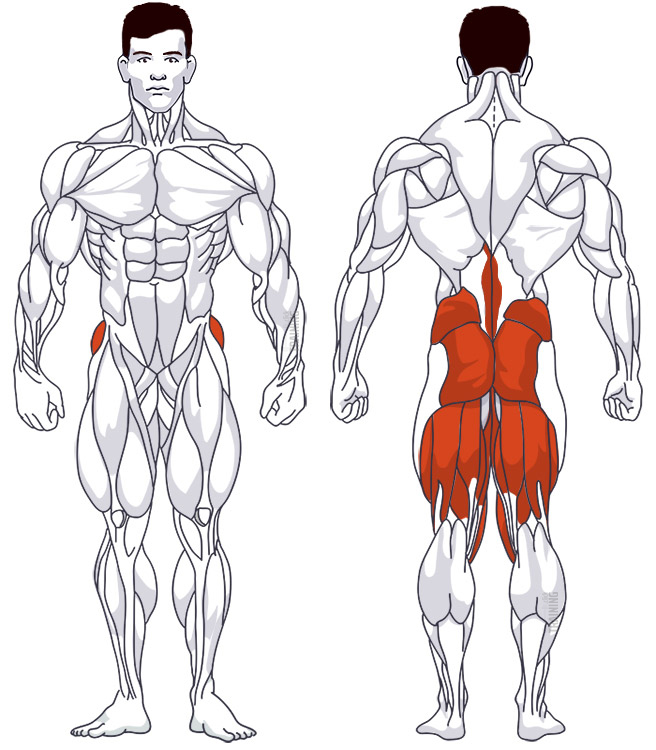
- Buttocks: Large gluteus maximus
(Musculus gluteus maximus) - Thigh: Thigh flexor
(Musculus biceps femoris)
Training plans
Here you can find example plans for dumbbell glute bridge training:
Dumbbell Glute Bridge: Basics and alternatives
Involved main muscle groups:
Dumbbell Glute Bridge
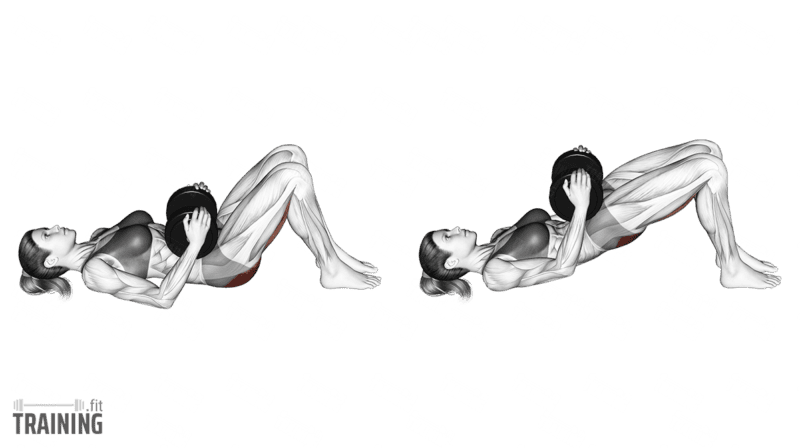
For the dumbbell glute bridge, you’ll need one dumbbell. Place it across your hips, lie back with your knees bent and lift your hips while your shoulders stay on the floor. Your butt and hamstrings work against the added weight.
A dumbbell takes up little space, but its shape affects how comfortably it rests on your hips. Barbell glute bridges use a longer bar and need a different setup.
Correct execution
If you’re using an adjustable dumbbell, check that the plates and locking mechanism are secure. Sit on the floor and place the handle across your hip crease, with the two ends balanced on either side. Keep it below your abdomen. A suitable pad can make the contact more comfortable, provided it stays firm and doesn’t let the weight slide.
Hold the dumbbell securely with both hands as you lie back, and keep your fingers out from under the ends so they can’t get trapped when you lower it. A slow first rep shows you whether you can keep it steady. Your hands just hold the weight in place; they don’t push it away from your body.
Place your feet about hip-width apart and gently tighten your abs. Press through both feet to lift your hips, keeping your head and upper back on the floor. Stop when your shoulders, hips and knees are roughly in line, without arching your lower back to lift farther.
Lower your hips slowly to the floor. Keep the dumbbell centered over your pelvis throughout, and stop to adjust it if it moves. Let the weight settle before sitting up and removing it with both hands.
Video tutorial
Step-by-step instructions
Sit down and place a dumbbell across your hip crease, with a pad underneath if you need one.
Lie back with bent knees and flat feet, keeping both hands on the dumbbell.
Gently tighten your abs and press through both feet to raise your hips.
Stop when your shoulders, hips and knees are roughly in line, without arching your lower back.
Pause briefly and lower your hips slowly to the floor.
After the final repetition, let the weight settle, then sit up and remove it with both hands.
Common mistakes
A rolling dumbbell makes the load difficult to control. Stop and reposition it instead of trying to catch it while your hips are raised.
Pushing only through your toes, or letting your knees suddenly cave in or drift apart, changes your support. Keep your whole foot down and knees aligned with your feet. If you have to arch your back to finish the lift, use a lighter weight or return to the bodyweight bridge.
If you can lift the dumbbell during the bridge but struggle to place or remove it, use a lighter one. You can also practice without added weight until you can manage the full exercise, including the start and finish.
What the science says
There doesn’t seem to be any research on the dumbbell glute bridge itself. Studies of barbell and bodyweight bridges provide some related evidence. Keep in mind that they measured muscle activity in a single session or short-term sprint performance, not muscle growth.
A 2019 review of 39 studies on bodyweight exercises that extend the hip gives a sense of the starting point. In the group that includes bridges, glute activity averaged about 33% of the maximum, with the single-leg bridge highest at 54%. The review excluded exercises with added weight, and the included studies used different methods to measure maximum activity.[1]
In one study, 10 men did barbell glute bridges and barbell hip thrusts. The upper and lower parts of the main glute muscle (gluteus maximus) were more active in the glute bridge, and so, on average, was the side glute muscle. The hip thrust worked the outer front thigh harder.[2]
In a 2025 study, 40 teenage male soccer players with at least 2 years of strength training did a set of glute bridges or hip thrusts. They sprinted before and 7 minutes after, while a third group sprinted without either exercise. Both exercises had moderate effects on sprint force and power compared with their earlier sprints, and small effects on 30-m sprint times compared with the control group. The 2 exercises differed only slightly.[3]
Sources
- Examination of Gluteus Maximus Electromyographic Excitation Associated with Dynamic Hip Extension during Body Weight Exercise: A Systematic Review. Macadam P, Feser EH. International Journal of Sports Physical Therapy. 2019;14(1):14–31. doi: 10.26603/ijspt20190014.
- Electromyographic differences of the gluteus maximus, gluteus medius, biceps femoris, and vastus lateralis between the barbell hip thrust and barbell glute bridge. Kennedy D, Casebolt JB, Farren GL, Fiaud V, Bartlett M, Strong L. Sports Biomechanics. 2024;23(12):2935–2949. doi: 10.1080/14763141.2022.2074875.
- The Acute Effects Of Hip Thrust and Glute Bridge Exercises With Different Loads on Sprint Performance and Horizontal Force–Velocity Profile in Adolescent Soccer Players: A Post-Activation Performance Enhancement Approach. Çabuk S, İnce İ. European Journal of Sport Science. 2025;25(2):e12255. doi: 10.1002/ejsc.12255.