Smith Machine Shrug
Isolation exercise, MachineThis article is verified by 4 studies/publications.
Overview
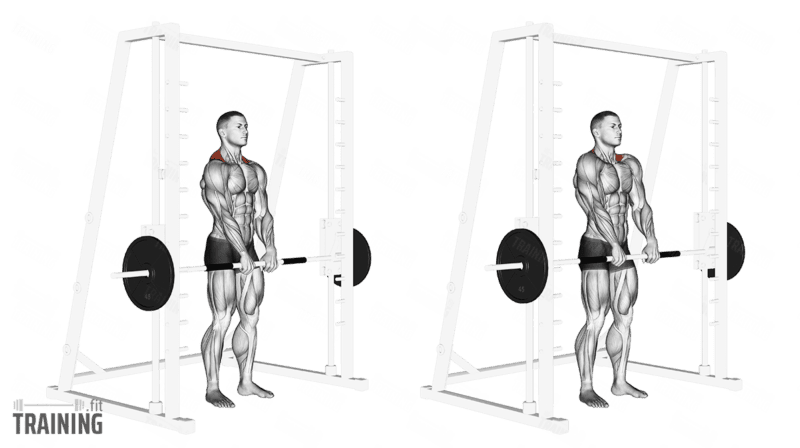
Main muscles
- Neck: Trapezius muscle
(Musculus trapezius)
Training plans
Smith Machine Shrug is a suitable substitute for similar exercises in or as a supplement to various training plans.
Smith Machine Shrug: Basics and alternatives
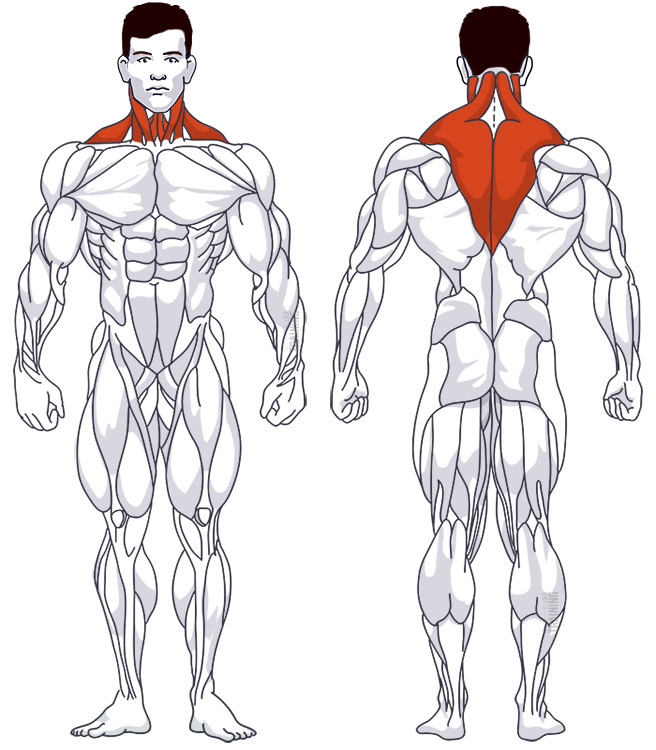
Involved main muscle groups:
Smith Machine Shrug
Smith machine shrugs use a small, simple movement to train your upper trapezius. Hold the guided bar in front of your thighs with straight arms, then raise and lower your shoulders. The bar travels only a short distance.
Barbell Shrugs use a free bar with no rails, and Cable Shrugs use the pull of the cable for resistance. On the Smith machine, find a position where the bar can move freely while you stand still.
Correct execution
The shrug itself is a short shoulder movement. Once the bar is clear of your thighs, you can focus on lifting and lowering your shoulders without help from your knees.
Set the bar just below the height of your relaxed hands and test the movement with a light load. Grip it overhand just outside your thighs. Leave enough space for the bar to move without scraping along your legs. If the rails are angled, check the whole shrug before adding weight.
Release the hooks and stand upright. Let the bar settle, then raise both shoulders toward your ears while your arms stay straight. Keep your head in line with your body and your wrists steady. Pause briefly, then slowly lower your shoulders back to their natural starting position; don’t force them down any further.
Keep your hands firmly closed around the bar. If it starts rolling into your fingers or you need to move a hand, rack it before adjusting your grip. Your upper body stays still as your shoulders rise and fall. At the end, engage both hooks and check that the bar is supported before letting go.
Video tutorial
Step-by-step instructions
Set the Smith bar and stops so you can unrack and rerack it from a comfortable standing position.
Stand close to the bar, grip it overhand just outside your thighs and release the hooks.
Keep your upper body still and your arms straight.
Lift both shoulders toward your ears while your knees and elbows stay still.
Pause briefly, then lower your shoulders slowly to the starting position. After the set, engage both hooks and check that the bar is supported before letting go.
Common mistakes
Keep your knees still: bending and straightening them turns the shrug into a leg-driven lift. If your shoulders can’t start the movement on their own, reduce the weight.
Rolling your shoulders in circles or pushing your head forward isn’t part of the shrug: your shoulders simply move up and down with control. If the bar rubs hard against your legs, adjust your stance; don’t lean back to make it pass.
Before the set, test the short shrug with the hooks released and clear of the rack supports. Keep them clear throughout the movement until you deliberately rerack the bar.
What the science says
Few studies have examined the Smith machine shrug itself. The studies below come mostly from rehabilitation research and measure muscle activity in single sessions, which shows how hard a muscle works, not how much it grows.
In 26 people, a weighted shrug with the arms at the sides, a shrug with the arms overhead and a shoulder blade squeeze with the arms overhead all produced similarly high activity in the upper trapezius. During the overhead shrug, activity in the levator scapulae and rhomboids, smaller muscles near the shoulder blade, was lower than in the standard shrug, while the overhead squeeze worked the rhomboids and the middle and lower trapezius most.[1]
Another study, involving 23 healthy people and 14 people with unstable shoulders (multidirectional instability), compared the standard shrug with a version done with the arms raised 30 degrees out to the sides. Both groups showed increased upper and lower trapezius activity with the modified shrug.[2]
Of 10 shoulder exercises tested in 30 healthy people, the one-arm shrug produced the most upper trapezius activity.[3]
In 12 women with chronic neck muscle pain, the shrug produced the highest trapezius activity, followed by the lateral raise and the upright row. However, the lateral raise and upright row achieved this with much lighter weights: 3–10 kg, compared with 20–30 kg for the shrug.[4]
The shrug consistently produces high upper trapezius activity. These studies don’t establish whether a guided bar affects that activity differently from free weights.
Sources
- Modifying the shoulder joint position during shrugging and retraction exercises alters the activation of the medial scapular muscles. Castelein B, Cools A, Parlevliet T, Cagnie B. Manual Therapy. 2016;21:250–255. doi: 10.1016/j.math.2015.09.005.
- Modifying a shrug exercise can facilitate the upward rotator muscles of the scapula. Pizzari T, Wickham J, Balster S, Ganderton C, Watson L. Clinical Biomechanics. 2014;29(2):201–205. doi: 10.1016/j.clinbiomech.2013.11.011.
- Surface Electromyographic Analysis of Exercises for the Trapezius and Serratus Anterior Muscles. Ekstrom RA, Donatelli RA, Soderberg GL. Journal of Orthopaedic & Sports Physical Therapy. 2003;33(5):247–258. doi: 10.2519/jospt.2003.33.5.247.
- Muscle Activation During Selected Strength Exercises in Women With Chronic Neck Muscle Pain. Andersen LL, Kjær M, Andersen CH, Hansen PB, Zebis MK, Hansen K, et al. Physical Therapy. 2008;88(6):703–711. doi: 10.2522/ptj.20070304.