Smith Machine Upright Row
Compound exercise, MachineThis article is verified by 4 studies/publications.
Overview
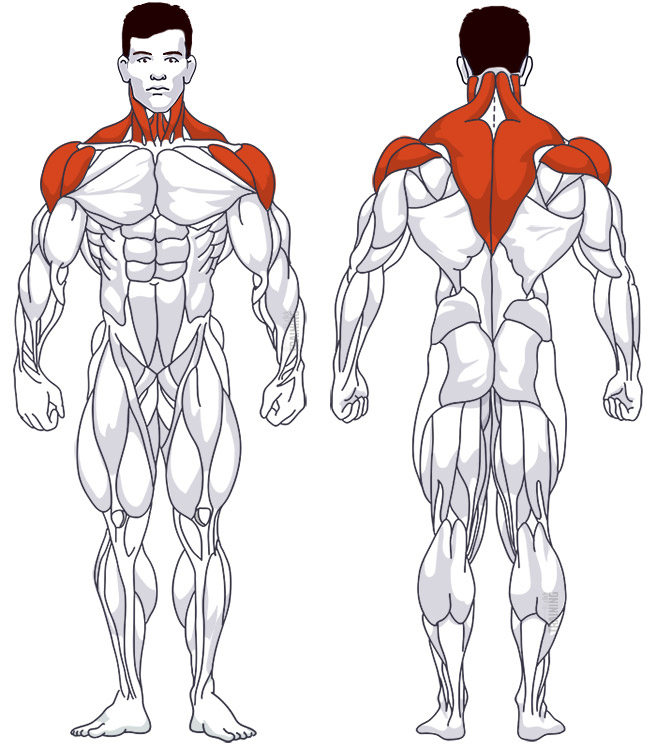
Main muscles
- Neck: Trapezius muscle
(Musculus trapezius) - Shoulder: Medial deltoid muscle
(Musculus deltoideus, Pars acromialis)
Training plans
Smith Machine Upright Row is a suitable substitute for similar exercises in Neck training or as a supplement to various training plans.
Smith Machine Upright Row: Basics and alternatives
Involved main muscle groups:
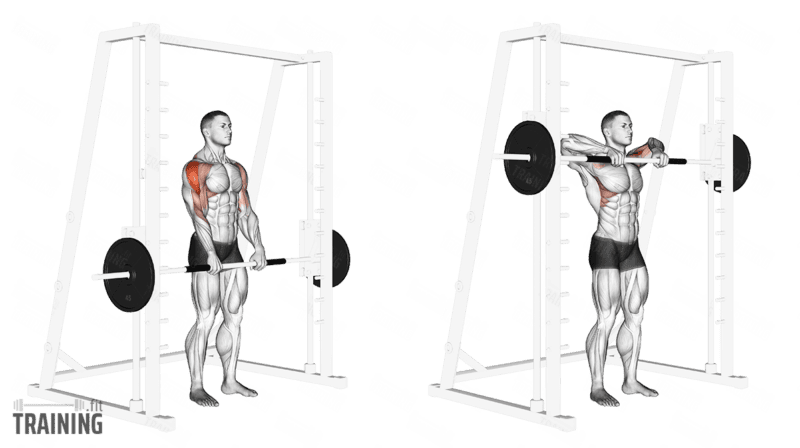
Smith Machine Upright Row
The Smith machine upright row is a guided-bar exercise for your shoulders and trapezius. Lead with your elbows as you move them out and up, pulling the bar in front of you with your legs still.
Barbell upright rows use a freely moving bar, while dumbbell upright rows let your hands move independently. The Smith machine follows a fixed path, so check that you can complete the movement comfortably from your chosen stance.
Correct execution
Because the bar path is fixed, your stance and grip matter all the more. You can keep the raise modest if going higher makes you shrug or lean to clear the bar.
Set the bar around thigh height and grip it overhand at about shoulder width or a little wider. Place your hands evenly on either side of the center. With a light load, find a stance where the bar can pass close to your body while you stay upright. It shouldn’t rub hard against you.
Check both the bottom and top of the movement. A position that clears your thighs may still feel awkward higher up. If the rails are angled, follow the machine’s intended orientation. Rack the bar before changing your stance.
Release the hooks and lift your elbows outward, guiding the bar toward your lower chest. Your upper arms should finish at or below about shoulder height, and it’s fine to stop sooner. Keep your wrists comfortable and your hands firmly closed around the bar, even if a looser grip would let you pull it higher.
Lower smoothly along the rails with your upper body and legs still. At the end of the set, engage both hooks and check that the bar is supported.
Video tutorial
Step-by-step instructions
Adjust the bar and safety stops, then test a comfortable stance and grip with a light load.
Hold the bar overhand and release the hooks while keeping your torso upright.
Raise your elbows outward and upward to guide the bar close to your body.
Stop within a comfortable range, with your upper arms at or below shoulder height.
Lower the bar smoothly while your knees and upper body stay still. After the set, engage both hooks and confirm that the bar is supported.
Common mistakes
A very narrow grip can make your wrists bend sharply as your elbows rise. If that happens, adjust your hand spacing. A wider grip makes your shoulders and trapezius work harder, so you can try one as long as your wrists and shoulders stay comfortable.
Leaning back to clear the bar or using your legs to start each pull are typical mistakes. If the fixed rails make a smooth, upright repetition difficult, change your stance or reduce the weight. And if the top of the movement hurts, stop lower; there’s no need to reach a particular chest height.
Also avoid pushing your chin forward over the rising bar. Look straight ahead, and lower the bar sooner if it gets close to your face. The goal isn’t the highest possible pull but a still upper body and smoothly moving elbows.
What the science says
The Smith machine upright row hasn’t been studied extensively. The studies below look at muscle activity, grip width and how high you pull. Muscle activity measured in a single session shows how hard a muscle works, not how much it grows.
In one study, 16 weight-trained men did barbell upright rows with grips from half to 2 times shoulder width. The wider the grip, the harder the shoulder muscles (deltoids) and the trapezius worked, and the less the biceps did. Differences were clearest at the widest grip. The authors recommend a wide grip to involve the shoulders and trapezius more.[1]
A study of 12 women with chronic neck muscle pain compared 5 exercises. Trapezius activity was among the highest in the upright row, alongside the shrug and the lateral raise. The upright row reached this level with much lighter weights than the shrug: 3–10 kg instead of 20–30 kg.[2]
Researchers used ultrasound to measure the space beneath the shoulder’s bony roof in 25 healthy young men holding 4 kg. The rotator cuff tendons pass through this space. It was larger with the arm at shoulder height and turned outward than at the top of an upright row pulled above shoulder height, or at shoulder height without that outward turn.[3]
When 46 men who lifted weights recreationally were compared with 31 who didn’t, the lifters more often showed signs of shoulder impingement. Doing upright rows or lateral raises above shoulder height was linked to these signs, although this type of comparison can’t establish cause and effect.[4]
Sources
- Effect of Grip Width on Electromyographic Activity During the Upright Row. McAllister MJ, Schilling BK, Hammond KG, Weiss LW, Farney TM. Journal of Strength and Conditioning Research. 2013;27(1):181–187. doi: 10.1519/jsc.0b013e31824f23ad.
- Muscle Activation During Selected Strength Exercises in Women With Chronic Neck Muscle Pain. Andersen LL, Kjær M, Andersen CH, Hansen PB, Zebis MK, Hansen K, et al. Physical Therapy. 2008;88(6):703–711. doi: 10.2522/ptj.20070304.
- Ultrasound evaluation of the subacromial space in healthy subjects performing three different positions of shoulder abduction in both loaded and unloaded conditions. Longo S, Corradi A, Michielon G, Sardanelli F, Sconfienza LM. Physical Therapy in Sport. 2017;23:105–112. doi: 10.1016/j.ptsp.2016.08.007.
- Characteristics of Shoulder Impingement in the Recreational Weight-Training Population. Kolber MJ, Cheatham SW, Salamh PA, Hanney WJ. Journal of Strength and Conditioning Research. 2014;28(4):1081–1089. doi: 10.1519/jsc.0000000000000250.