Assisted Machine Dips
Compound exercise, MachineOverview
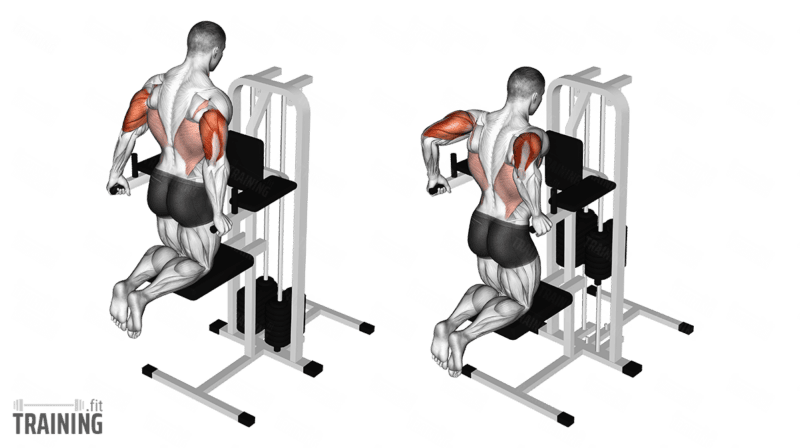
Main muscles
- Chest: Large pectoral muscle
(Musculus pectoralis major) - Chest: Small pectoral muscle
(Musculus pectoralis minor) - Shoulder: Anterior deltoid muscle
(Musculus deltoideus, Pars clavicularis) - Triceps: Three-headed arm muscle
(Musculus triceps brachii)
Training plans
Assisted Machine Dips is a suitable substitute for similar exercises in Chest training or as a supplement to various training plans.
Assisted Machine Dips: Basics and alternatives
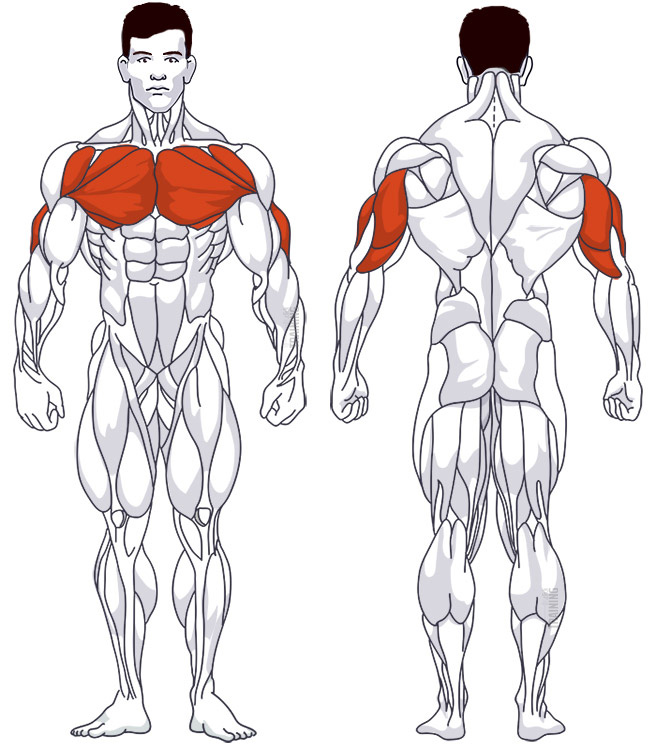
Involved main muscle groups:
Assisted Machine Dips
Assisted machine dips are dips done on a counterweighted machine. You kneel on a moving pad that supports part of your body weight, hold the dip handles and lower and raise your body between them, working your triceps, chest and front shoulders. The movement is the same as in dips, with help from the machine’s counterweight.
On this machine, more weight usually means more help, so the exercise gets easier. That’s different from a seated dip machine, where you push loaded handles downward. Band Assisted Dips are another assisted variation, using a fitness band instead of a counterweight and knee pad.
Correct execution
The assistance lets you practice the dip with less of your body weight to lift.
Follow the machine’s setup instructions and choose enough assistance for a controlled repetition. If the handles adjust or rotate, lock both in the same position before climbing on. Use the entry steps, grip the handles firmly and lower both knees onto the pad with control.
Keep your lower legs clear of the frame and steps. Begin with your arms nearly straight and your upper body upright, allowing a slight forward lean if that feels comfortable. Bend your elbows to lower, keeping them fairly close to your body without squeezing them against your ribs.
Start with a shallow dip and only go deeper while your shoulders stay controlled and you can press back up smoothly. There’s no exact elbow angle to aim for. Keep your upper body in the same position, and don’t snap your elbows straight at the top.
The knee pad should move with your body. If you push it down by straightening your hips while your shoulders stay put, you’re just moving the pad.
Video tutorial
Step-by-step instructions
Select the assistance weight and adjust both dip handles to matching, secure positions if needed.
Use the entry steps, grip both handles firmly and place your knees on the pad as directed by the machine instructions.
Support your body between the handles with your arms nearly straight. Keep your lower legs clear of the frame.
Bend your elbows and lower slowly, letting the knee pad follow your body.
Press through both hands to return to the top position without swinging your legs or upper body.
Bring the pad back to its upper resting position under control. Keep holding the handles as you use the steps to get off.
Common mistakes
A common mix-up: on a counterweighted machine, more weight means more help, not less. To lift more of your own body weight, reduce the assistance after checking the machine’s labels; the same number may feel different on another model.
Don’t bounce at the bottom or let your shoulders creep up toward your ears; add assistance if you can’t press back up smoothly. When you finish, jumping off can let the pad shoot up, so bring it to rest and use the steps.
Never move the weight pin while kneeling on the moving pad. Return the machine to rest and step off before changing the setting.