Dumbbell Reverse Curls
Isolation exercise, Free weightsThis article is verified by 2 studies/publications.
Overview
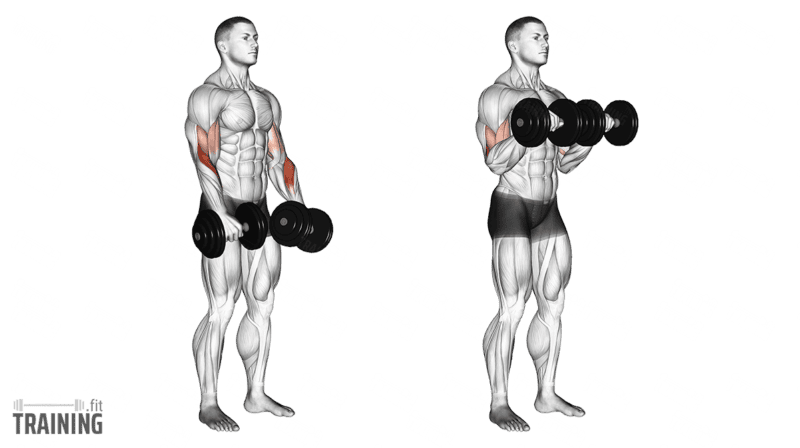
Main muscles
- Biceps: Arm flexor
(Musculus biceps brachii) - Biceps: Upper arm muscle
(brachialis muscle) - Forearm: Brachioradialis
(Musculus brachioradialis)
Training plans
Dumbbell Reverse Curls is a suitable substitute for similar exercises in or as a supplement to various training plans.
Dumbbell Reverse Curls: Basics and alternatives
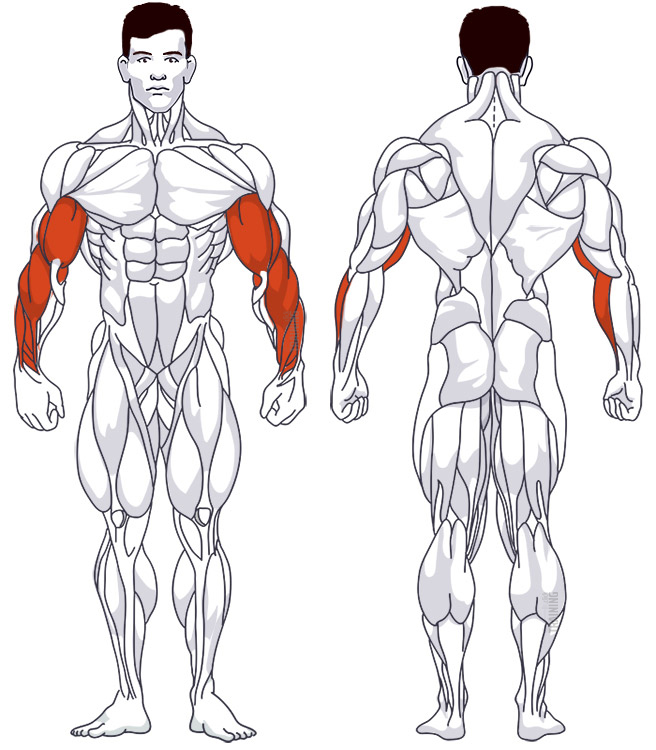
Involved main muscle groups:
Dumbbell Reverse Curls
Dumbbell reverse curls change the classic curl’s grip. You’ll keep an overhand grip throughout, bending your elbows to lift the dumbbells. Your biceps and other elbow flexors do the lifting while your forearm muscles steady your wrists. You may need lighter weights than for palms-up curls.
If you’d like your palms facing each other, try Hammer Curls. Zottman Curls mix both grips: you lift with your palms up and lower with an overhand grip.
Correct execution
The overhand grip can feel quite different from an ordinary curl. You’ll need a weight that lets you keep your wrists aligned through the return as well as the lift.
Stand with the dumbbells in front of or just beside your thighs, the backs of your hands facing forward. Grip the middle of each handle and wrap your thumbs around it. Keep your upper arms close to your body as your elbows bend, without rolling your shoulders inward.
Try the movement without weights first if the grip feels unfamiliar. Turn your forearms into the overhand position, then bend and straighten your elbows while keeping your wrists in line with your forearms. Follow the same comfortable path with light dumbbells.
Curl only as high as you can with your wrists aligned and upper arms at your sides. Keep space between the weights at the top; don’t turn your palms inward to bring them together.
Lower slowly until your arms return to the starting position, keeping the overhand grip. Allow enough room for the dumbbells to pass in front of your hips. Keep breathing as you hold the weights firmly; don’t shrug your shoulders or hold your breath just to maintain the grip.
Video tutorial
Step-by-step instructions
Stand with one dumbbell in each hand and your feet about hip-width apart.
Turn both hands into an overhand grip, with your palms facing backward and your arms down beside your torso.
Bend your elbows and raise the dumbbells, keeping your overhand grip.
Keep your shoulders still and stop before your wrists start to bend backward.
Lower the dumbbells steadily while maintaining the same grip. Return to the starting position with your arms straight, without dropping or bouncing the weights.
Common mistakes
Don’t let your wrists bend backward; that changes where the weights sit in your hands. If you can’t keep your wrists straight, use lighter dumbbells. Lifting your upper arms forward to finish the curl adds a shoulder raise; keep them at your sides.
Keep the overhand grip as you lower. Turning your hands at the top changes the exercise into another curl variation.
Watch out for the curl turning into small wrist lifts while your forearms barely move: the movement should come from bending your elbows. At the bottom, straighten your arms smoothly. If you snap them down, you create a bounce for the next rep.
What the science says
The 2 studies below compared palms-up, palms-down and neutral grips while bending the elbow. Neither study used dumbbells, and some of their findings conflict. Both measured muscle activity in a single session, so they don’t show which grip builds more muscle.
In one study, 10 male competitive bodybuilders did cable curls with different grips, each with a weight they could lift 8 times in that grip. With an underhand grip, biceps activity during the lift was 19% higher than with an overhand grip. The forearm muscle on the thumb side (brachioradialis) was also slightly more active with the underhand grip. The overhand and neutral grips produced more front shoulder activity.[1]
A lab study with 16 healthy adults (12 men and 4 women) had them bend their elbows slowly and steadily with the palm facing down, up or sideways. With the palm down, the brachioradialis was consistently more active than in the other 2 positions, but changing hand position didn’t significantly affect biceps activity.[2]
The studies therefore disagree about how an overhand grip divides the work between the biceps and forearm muscles. They used very different setups: a loaded cable curl in experienced bodybuilders and slow lab movements. So their results aren’t directly comparable.
Sources
- Biceps Brachii and Brachioradialis Excitation in Biceps Curl Exercise: Different Handgrips, Different Synergy. Coratella G, Tornatore G, Longo S, Toninelli N, Padovan R, Esposito F, et al. Sports. 2023;11(3):64. doi: 10.3390/sports11030064.
- Muscular coordination of biceps brachii and brachioradialis in elbow flexion with respect to hand position. Kleiber T, Kunz L, Disselhorst-Klug C. Frontiers in Physiology. 2015;6:215. doi: 10.3389/fphys.2015.00215.