Squat Jerk
Compound exercise, Free weightsThis article is verified by 3 studies/publications.
Overview
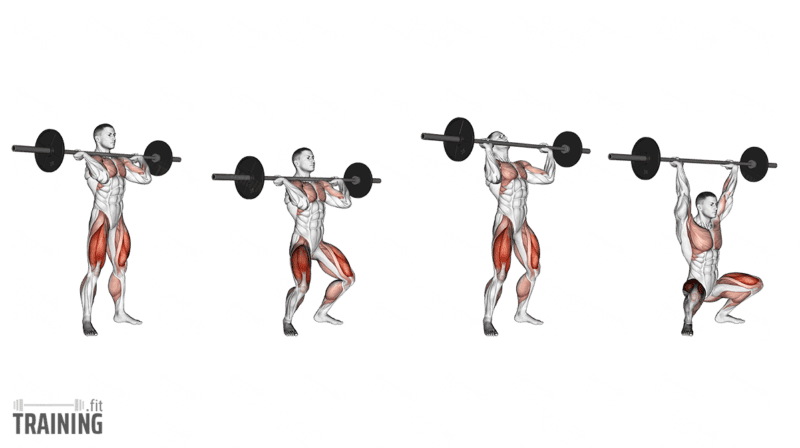
Main muscles
- Thigh: Quadriceps
(Musculus quadriceps femoris) - Buttocks: Large gluteus maximus
(Musculus gluteus maximus) - Shoulder: Anterior deltoid muscle
(Musculus deltoideus, Pars clavicularis) - Shoulder: Medial deltoid muscle
(Musculus deltoideus, Pars acromialis) - Triceps: Three-headed arm muscle
(Musculus triceps brachii) - Abdomen: Transverse abdominal muscle
(Musculus transversus abdominis)
Training plans
Squat Jerk is a suitable substitute for similar exercises in Conditioning and full-body or as a supplement to various training plans.
Squat Jerk: Basics and alternatives
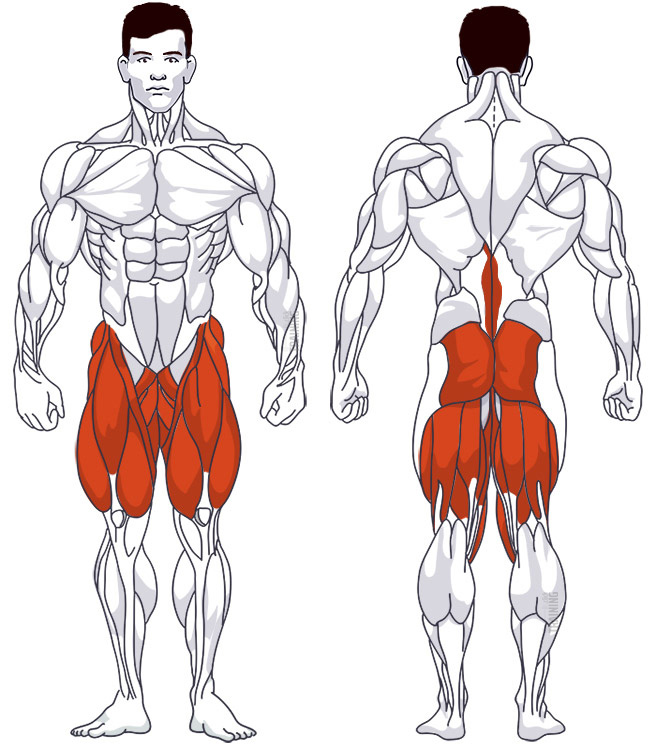
Involved main muscle groups:
Squat Jerk
The squat jerk is a demanding weightlifting technique: you catch a barbell overhead in a deep squat. Start with the bar on the fronts of your shoulders, dip briefly and drive it upward with your legs. Move underneath, straighten your arms and stand once the bar is steady. Your thighs and butt drive the lift and help you stand; your shoulders, arms and core support the bar.
In the Push Press, your legs stay straight after the drive while you finish pressing. In the Dumbbell Push Jerk, you catch two weights in a shallower squat. Barbell Squats keep the bar on your upper back. The squat jerk requires precise timing and a deep squat you can control with a weight overhead. Learn it with a weightlifting coach before adding substantial weight.
Correct execution
The demanding part is receiving the bar in a deep overhead squat and standing up from it.
Begin with an empty training bar and a clear lifting area. With your coach, work on the overhead squat, standing up from it and safely ending an unsuccessful attempt before adding speed. Rest the bar on the fronts of your shoulders with a secure jerk grip, your elbows slightly forward and your feet in a balanced stance.
Dip a short distance with your upper body upright, then drive strongly upward through your legs. Move your head clear as the bar rises and push yourself underneath it. Your arms straighten as you descend into the squat. Depending on the technique you’ve learned, you can move your feet from a narrower driving stance into your squat stance or keep them in place.
Catch the bar over your feet and steady it before standing. The deep squat is part of the catch; catching high and standing immediately is a different jerk. Once fully upright, lower the bar under control to your shoulders if the load allows, bending your knees slightly to cushion it, then rerack.
Video tutorial
Step-by-step instructions
Rest the bar on the fronts of your shoulders with a secure jerk grip.
Set your feet in a balanced stance.
Tighten your core and dip a short distance, keeping your upper body upright.
Drive upward strongly through your legs to accelerate the bar.
Move underneath as you extend your arms, descending into a deep overhead squat.
Hold the bar steady overhead with your feet firmly planted before standing up.
Stand all the way up with your arms straight, then lower and rerack the bar using the controlled return you’ve practiced.
Common mistakes
Leaning forward in the dip can send the bar away from the position you need to receive it in. Keep your upper body upright so you don’t have to chase the bar with a step or an exaggerated backward lean.
Don’t stand immediately to save a poorly positioned catch. Secure the overhead position first; if you can’t, end the attempt as you’ve practiced. Work on the deep squat and a simpler jerk with your coach if a light bar is hard to control. Pressing the bar fully overhead before you squat is a different movement: in the jerk, you descend under the bar as your arms straighten.
What the science says
The squat jerk has received little research attention and is used by relatively few competitive weightlifters. Most studies look at related overhead lifts such as the push press, push jerk and split jerk.
A 2024 study analyzed competition videos of 32 elite male weightlifters using the squat jerk or the split jerk. Both styles had essentially the same dip and drive, but differed in how the bar was caught and supported. The deep squat catch was much less stable front to back than the split stance, but more stable from side to side. Standing up from the squat catch also meant lifting the bar about 23 cm farther.[1]
In a 2024 study, 16 strength-trained adults (12 men, 4 women) did the push press, push jerk and split jerk with the same load. They had about 2 years of weightlifting experience. Force and power during the dip and drive didn’t differ between the lifts, no matter how the bar was then caught. The squat jerk wasn’t part of this comparison.[2]
A 2019 review found only 13 studies on overhead weightlifting lifts such as the push press, push jerk and split jerk. The authors describe them as lifts that require producing high force quickly by extending the hips, knees and ankles, and see them as a possible way to build power and strength in athletes. They also point out that evidence on long-term training effects is scarce.[3]
Sources
- Comparative Analysis of the Kinematic Characteristics of Lunge-Style and Squat-Style Jerk Techniques in Elite Weightlifters. Liu G, He Z, Ye B, Guo H, Pan H, Zhu H, et al. Life. 2024;14(9):1086. doi: 10.3390/life14091086.
- No differences in weightlifting overhead pressing exercises kinetics. Soriano MA, Lake J, Comfort P, Suchomel TJ, McMahon JJ, Jiménez-Ormeño E, et al. Sports Biomechanics. 2024;23(11):2080–2092. doi: 10.1080/14763141.2021.1993983.
- Weightlifting Overhead Pressing Derivatives: A Review of the Literature. Soriano MA, Suchomel TJ, Comfort P. Sports Medicine. 2019;49(6):867–885. doi: 10.1007/s40279-019-01096-8.