Cable Rope Overhead Triceps Extension
Isolation exercise, Cable pullThis article is verified by 3 studies/publications.
Overview
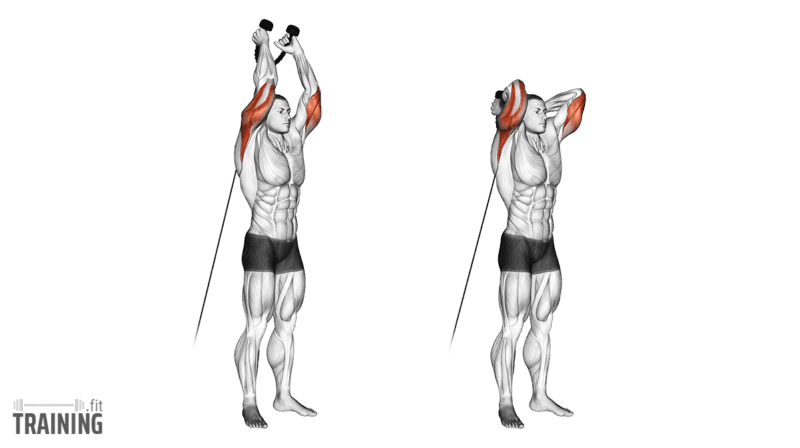
Main muscles
- Triceps: Three-headed arm muscle
(Musculus triceps brachii)
Training plans
Cable Rope Overhead Triceps Extension is a suitable substitute for similar exercises in or as a supplement to various training plans.
Cable Rope Overhead Triceps Extension: Basics and alternatives
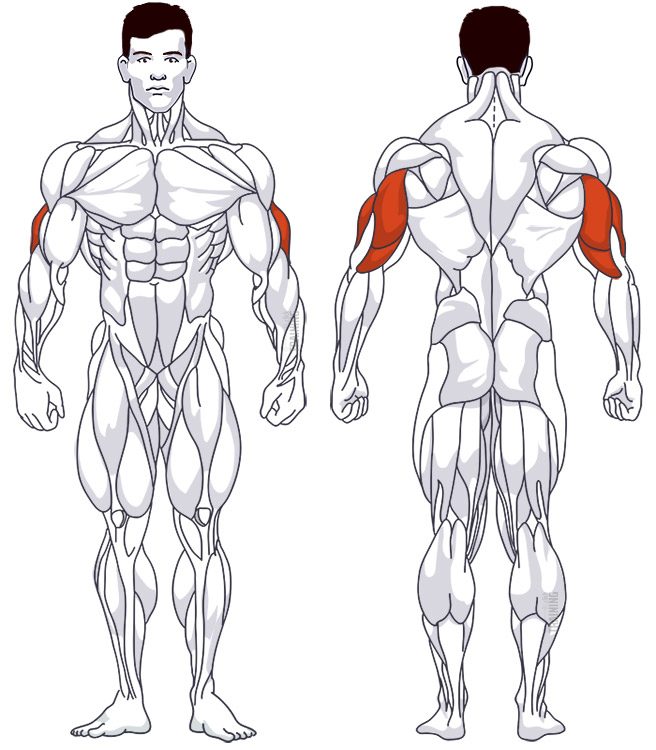
Involved main muscle groups:
Cable Rope Overhead Triceps Extension
Cable rope overhead triceps extensions offer a simple elbow-straightening movement for the backs of your upper arms. Face away from a low pulley, hold your upper arms beside your head and extend your elbows to push the rope upward. Keep your upper body steady against the cable’s pull from behind.
For a one-arm alternative, try the One Arm Overhead Tricep Extension. With Cable Tricep Pushdowns, your upper arms stay down by your sides.
Correct execution
Your raised upper arms set this extension apart from a pushdown. Choose an arm position you can hold while your elbows bend and straighten, without arching your back to help.
Attach a rope to a low pulley and begin with a light weight. Hold both ends, turn away from the station and take a stable staggered stance. Bring your hands behind your head, with your upper arms raised at an angle that feels comfortable.
Keep both sides of the rope about the same length, with enough room for your hands so the end stops don’t press against your head. The cable should move freely behind you. If the rope slips through its center fitting, wait until the weight stack is resting before you adjust it.
Keep your upper arms fairly still as you straighten your elbows; it’s fine if the rope ends move apart slightly as your hands go up. Straighten smoothly at the top, with no snap into the end position. Then bend your elbows slowly and lower only as far as you can while your upper arms stay in place and your lower back doesn’t arch.
In a 12-week study of 21 young adults, triceps volume increased more in the arm trained overhead than in the arm trained beside the body. The participants used one-arm cable extensions; the study didn’t directly test this two-handed rope version.[1]
Pick a weight you can also bring down comfortably after your set. Practice lowering the attachment and moving back toward the station with a light setting first.
Video tutorial
Step-by-step instructions
Connect a rope to a low pulley and select a weight you can position overhead comfortably.
Take both rope ends, turn away from the machine and step into a stable staggered stance.
Raise your upper arms beside your head and bend your elbows so your hands sit behind it.
Keep your torso steady and straighten both elbows to guide your hands upward.
Bend your elbows slowly and let the rope return behind your head, keeping your upper arms in place. After the final repetition, bring the attachment down under control and move toward the station until the stack rests. Step clear of the cable before turning back toward the machine.
Common mistakes
If you arch your lower back to keep your arms overhead, adjust your stance or use less weight. Keep your abs engaged so your chest doesn’t tip upward as you press.
Avoid moving your shoulders to push the rope forward on each rep. The movement should come from straightening your elbows while your upper arms stay in place, though you don’t need to squeeze your elbows tightly together. On the way back, control the rope so the stack doesn’t pull your hands abruptly behind your head.
What the science says
Very little research has examined the two-handed rope version specifically. Apart from the training study mentioned above, the studies below are single-session lab measurements, which show how the 3 triceps heads share the work, not how much each one grows.
A lab study with 10 healthy adults (8 men, 2 women) measured each triceps head during elbow extensions at 5 different arm angles. With the arm down by the side, the long head was the most active, and a computer model estimated that it also produced the most force. With the arm raised to 90 degrees or higher, as in this exercise, the model estimated the highest force for the medial head. For all 3 heads, estimated force was highest with the elbow still well bent, then fell as the arm straightened.[2]
In 21 resistance-trained men, overhead and lying dumbbell triceps extensions with a light load showed similar activity patterns in the long and outer heads. Triceps activity was greater during lifting than during lowering. During the lift, activity was higher in the first two-thirds of the range, while the elbows were more bent, than in the last third. This applied to both heads in the overhead version and to the outer head in the lying version. The authors therefore advise against doing both exercises in the same routine.[3]
Neither study measured muscle growth, whereas the 12-week study described above did.
Sources
- Triceps brachii hypertrophy is substantially greater after elbow extension training performed in the overhead versus neutral arm position. Maeo S, Wu Y, Huang M, Sakurai H, Kusagawa Y, Sugiyama T, Kanehisa H, Isaka T. European Journal of Sport Science. 2023;23(7):1240-1250. doi: 10.1080/17461391.2022.2100279.
- The different role of each head of the triceps brachii muscle in elbow extension. Kholinne E, Zulkarnain RF, Sun YC, Lim S, Chun JM, Jeon IH. Acta Orthopaedica et Traumatologica Turcica. 2018;52(3):201–205. doi: 10.1016/j.aott.2018.02.005.
- Effect of shoulder position on triceps brachii heads activity in dumbbell elbow extension exercises. Alves D, Matta T, Oliveira L. The Journal of Sports Medicine and Physical Fitness. 2018;58(9):1247–1252. doi: 10.23736/s0022-4707.17.06849-9.