Trap Bar Deadlift
Compound exercise, Free weightsThis article is verified by 5 studies/publications.
Overview
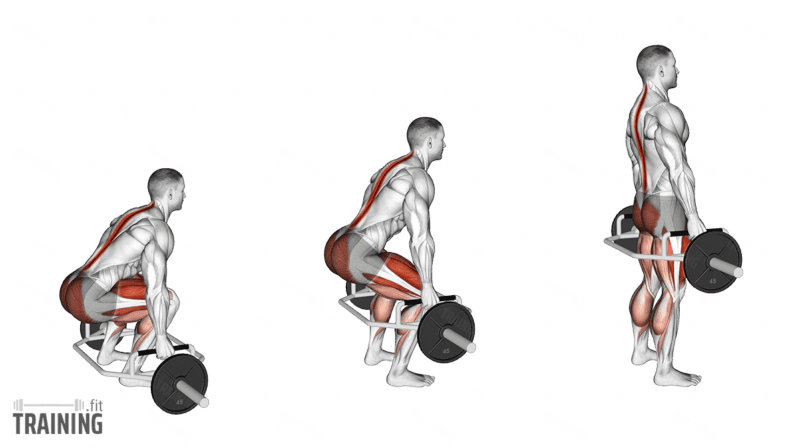
Main muscles
- Thigh: Quadriceps
(Musculus quadriceps femoris) - Buttocks: Large gluteus maximus
(Musculus gluteus maximus) - Back: Back extensor
(Musculus erector spinae)
Training plans
Here you can find example plans for trap bar deadlift training:
Trap Bar Deadlift: Basics and alternatives
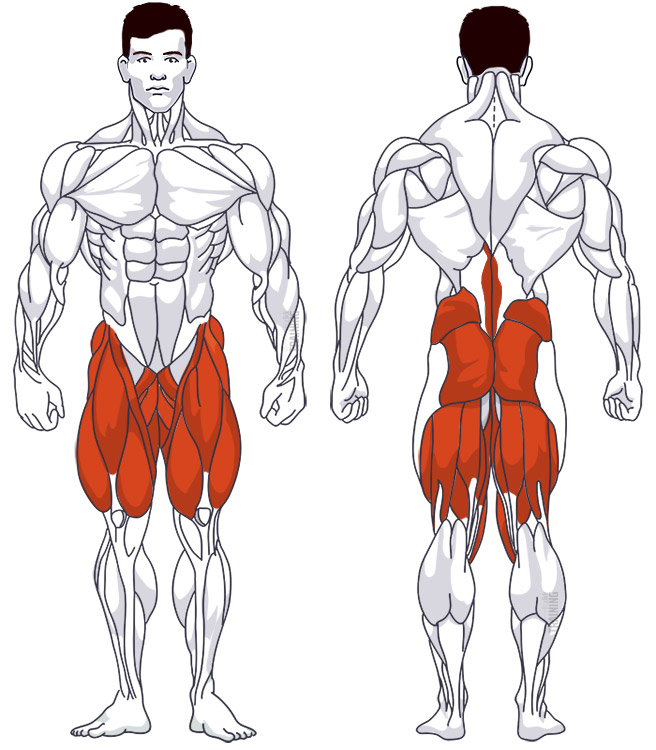
Involved main muscle groups:
Trap Bar Deadlift
Trap bar deadlifts offer a different setup from the classic straight-bar deadlift: stand inside the frame and grip the handles beside your legs. Straighten your hips and knees to lift, then lower to the floor. Your thighs, butt and back work together while your arms stay straight.
Unlike in a straight-bar deadlift, the bar doesn’t pass in front of your shins. A dumbbell deadlift also lets you hold weights beside your legs. Adding a walk after you stand up turns the movement into a trap bar farmer’s carry, which requires a clear walking route and a load you can control while moving.
Correct execution
The handle height changes how far you need to reach to start. Pick the height that lets you start in control; the lifting and lowering sequence stays the same.
Choose the handle height before loading. On some models, flipping the bar switches between raised and low handles. Raised handles shorten your reach; low handles give you a lower start. Use the same height on both sides, load evenly and secure the plates with collars.
Stand in the center with your feet about hip- to shoulder-width apart. Keeping your back in a neutral position, bend your hips and knees and grip both handles with your palms facing inward. Check that your hands sit evenly along the handles. Keep your whole foot on the floor and let your knees follow your toes.
Tighten your abs and take up the slack before you lift, so the frame leaves the floor smoothly. Push through your feet to stand, letting your hips and shoulders rise together. Keep your head in line with your upper body and finish standing tall; don’t shrug or lean back at the top.
Lower by bending your hips and knees. Let the bar settle on the floor and check your starting position before repeating. If one end lifts first, set it down and adjust your grip. Don’t try to level a tilted frame by bending one elbow.
In a study of 19 male powerlifters, the hexagonal bar produced lower peak joint moments at the lower back and hips, but higher moments at the knees, than a straight bar. The study measured mechanics, not injuries, so these findings don’t establish that every trap bar setup is safer.[1]
Video tutorial
Step-by-step instructions
Choose the handle height, load and collar the trap bar evenly, then stand in the center between its handles.
Bend your hips and knees with your back neutral and take a secure grip on both handles at the same height.
Tighten your core, keep your back neutral and keep your whole foot on the floor, with your knees following your toes.
Push through the floor, extending your hips and knees together while your arms stay straight.
Finish standing upright with the frame level, without leaning backward.
Keep your back neutral as you bend your hips and knees to lower the bar, then let it settle and reset before repeating.
Common mistakes
An off-center grip can tip the frame as it leaves the floor. Check your hand positions before lifting.
If your hips shoot up while your shoulders stay low, reduce the weight and raise them together. Keep your feet planted and leave room for the frame; don’t force your knees far outward or shift onto your heels. Bouncing the plates skips the reset, so let them settle before repeating.
What the science says
Most research on trap bar deadlifts uses straight-bar deadlifts for comparison. These studies measured muscle activity and lifting mechanics in single sessions, so they show how the 2 bars differ during a lift, not which one builds more muscle.
In one study, 13 resistance-trained men lifted the heaviest weight they could manage once in 3 exercises. The straight-bar deadlift produced 28% more activity in the outer hamstring (biceps femoris) than the trap bar deadlift. The hip thrust produced 16% more glute activity than the trap bar deadlift. Lower back activity didn’t differ between them.[2]
A 2025 study with 11 resistance-trained women compared conventional, sumo and trap bar deadlifts with the most weight they could lift 3 times, which was similar for all 3 (about 100–103 kg). With the trap bar, the bar moved faster, the women bent their hips and knees more, and the demand on the muscles that straighten the knees was higher. Near the top of the lift, the conventional and sumo versions placed greater demands on the hip muscles.[3]
In 20 men with deadlift experience, the maximum weight was nearly identical with both bars (about 181 kg). The trap bar produced more activity in the outer front thigh (vastus lateralis), while the straight bar produced more hamstring activity when lifting and more lower back activity when lowering. Using the trap bar increased peak force, power and bar speed.[4]
With raised handles, 31 strength-trained men and women lifted more with the trap bar than with a straight bar (about 155 vs. 135 kg). The bar traveled 22% less distance, and power, speed and force were higher, although the straight-bar deadlift involved more total work.[5]
Sources
- A Biomechanical Analysis of Straight and Hexagonal Barbell Deadlifts Using Submaximal Loads. Swinton PA, Stewart A, Agouris I, Keogh JWL, Lloyd R. Journal of Strength and Conditioning Research. 2011;25(7):2000–2009. doi: 10.1519/JSC.0b013e3181e73f87.
- Electromyographic Comparison of Barbell Deadlift, Hex Bar Deadlift, and Hip Thrust Exercises: A Cross-Over Study. Andersen V, Fimland MS, Mo DA, Iversen VM, Vederhus T, Rockland Hellebø LR, et al. Journal of Strength and Conditioning Research. 2018;32(3):587–593. doi: 10.1519/jsc.0000000000001826.
- A Biomechanical Comparison Between Conventional, Sumo, and Hex-Bar Deadlifts Among Resistance Trained Women. Gundersen AH, van den Tillaar R, Falch HN, Fredriksen AB, Larsen S. Journal of Strength and Conditioning Research. 2025;39(3):281–288. doi: 10.1519/jsc.0000000000005011.
- An Examination of Muscle Activation and Power Characteristics While Performing the Deadlift Exercise With Straight and Hexagonal Barbells. Camara KD, Coburn JW, Dunnick DD, Brown LE, Galpin AJ, Costa PB. Journal of Strength and Conditioning Research. 2016;30(5):1183–1188. doi: 10.1519/jsc.0000000000001352.
- The 1 Repetition Maximum Mechanics of a High-Handle Hexagonal Bar Deadlift Compared With a Conventional Deadlift as Measured by a Linear Position Transducer. Lockie RG, Moreno MR, Lazar A, Risso FG, Liu TM, Stage AA, et al. Journal of Strength and Conditioning Research. 2018;32(1):150–161. doi: 10.1519/jsc.0000000000001781.