Band Y Raise
Isolation exercise, Free weightsThis article is verified by 3 studies/publications.
Overview
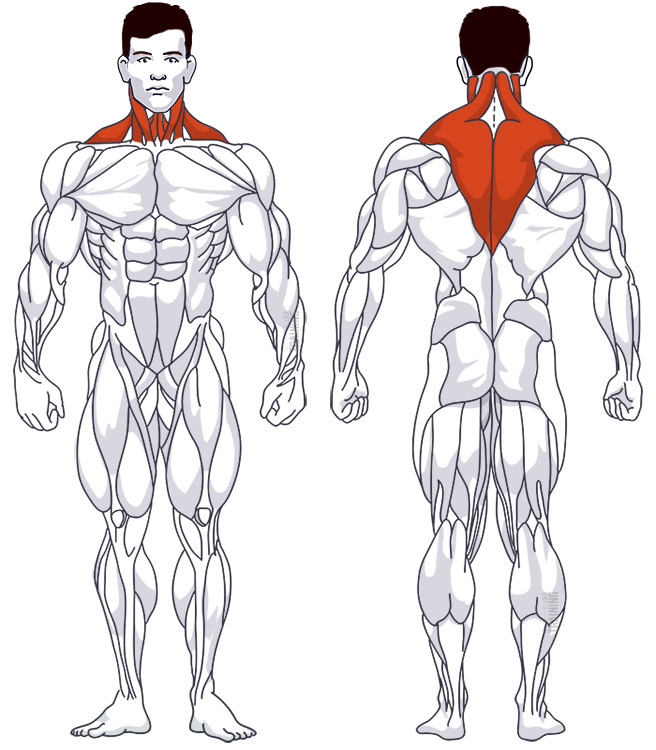
Main muscles
- Neck: Trapezius muscle
(Musculus trapezius) - Shoulder: Anterior deltoid muscle
(Musculus deltoideus, Pars clavicularis) - Shoulder: Medial deltoid muscle
(Musculus deltoideus, Pars acromialis)
Training plans
Band Y Raise is a suitable substitute for similar exercises in or as a supplement to various training plans.
Band Y Raise: Basics and alternatives
Involved main muscle groups:
Band Y Raise
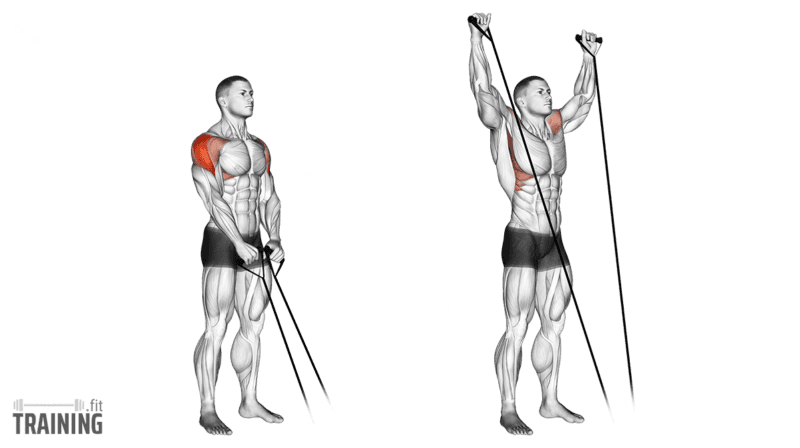
Band Y raises train your shoulders against a light band. Lift your arms diagonally forward and upward into a Y, with the band anchored low in front of you. Your shoulder muscles raise your arms, while muscles around your shoulder blades, including your trapezius, guide the movement.
Band reverse flys move your arms outward and backward. Band front raises follow a more direct forward path. For the Y raise, keep a slight bend in your elbows and reach out along the diagonal.
Correct execution
The Y-shaped path asks your shoulder blades to move with your arms. A light band leaves you room to learn that reach without leaning back to finish it.
Use a light band and a secure low anchor that can’t move toward you; a barbell on the floor only works if it can’t roll or slide. Stand centered in front of the anchor and hold equal band lengths. Step back until there’s light tension with your hands in front of your thighs.
Practice the Y shape without the band first. Raise your arms forward and outward, thumbs up and elbows slightly bent. Your hands finish wider than your shoulders; they don’t need to meet overhead or reach behind your head.
With the band attached, follow the same path and allow your shoulder blades to move with your arms. Stop before you need to lean back to reach higher. Pause briefly, then lower slowly along the same diagonals.
Check that neither band strand catches on the anchor or rubs against the other as your hands separate. Keep your feet in place during the lift. If you need to adjust the distance, lower your hands before moving.
Video tutorial
Step-by-step instructions
Attach the band to a secure low anchor and test that it holds against your pull.
Face the anchor and take one band end in each hand with your palms facing inward.
Stand upright with your hands low in front and your knees slightly bent.
Lift your arms diagonally forward and upward, forming a Y while keeping your elbows only slightly bent.
Pause at the highest position you can hold without moving your torso backward. Lower your hands slowly along the same diagonal paths and return to the start.
Common mistakes
Bending your elbows too much can turn the raise into a pull toward your body. Reduce the resistance if you can’t keep your elbows only slightly bent.
Pinning your shoulder blades down hard as you reach up stops them from moving with your arms. Let them move freely, just without a big shrug at the start. If the anchor moves, stop and secure it before continuing.
Stepping back mid-lift changes the resistance and your balance. To adjust the tension, lower your hands, move your feet, then test a full raise with light resistance at the new distance.
What the science says
There doesn’t seem to be a study on the standing band Y raise itself. The closest research comes from shoulder rehabilitation and measures the muscles around your shoulder blades while people raise their arms at an angle between front and side (the scapular plane) or overhead while lying face down. The measurements describe muscle activity, rather than muscle growth.
In 21 healthy people, raising the arms in the scapular plane (scaption) produced the highest activity in the upper trapezius, the part between your neck and shoulders. When the participants also rotated their arms outward against a band during the raise, the middle and lower trapezius worked harder instead. All measured muscles became more active when extra load was added.[1]
In a comparison of 10 exercises in 30 healthy people, lower trapezius activity was highest when participants lay face down and raised an arm overhead along the direction of that muscle’s fibers. The serratus anterior, which helps rotate the shoulder blade upward, was most active in exercises with a lot of upward rotation, such as raising the arm in the scapular plane above 120 degrees.[2]
An older study measured 8 shoulder blade muscles with fine-wire electrodes in 9 healthy people during 16 rehabilitation exercises. The authors included scaption among 4 exercises to form the core of a shoulder blade strengthening program, along with rowing and 2 pushing exercises.[3]
Raising your arms in the scapular plane therefore involves several shoulder blade muscles. The angle and rotation of the arms appear to influence which parts are most active.
Sources
- Superficial and Deep Scapulothoracic Muscle Electromyographic Activity During Elevation Exercises in the Scapular Plane. Castelein B, Cagnie B, Parlevliet T, Cools A. Journal of Orthopaedic & Sports Physical Therapy. 2016;46(3):184–193. doi: 10.2519/jospt.2016.5927.
- Surface Electromyographic Analysis of Exercises for the Trapezius and Serratus Anterior Muscles. Ekstrom RA, Donatelli RA, Soderberg GL. Journal of Orthopaedic & Sports Physical Therapy. 2003;33(5):247–258. doi: 10.2519/jospt.2003.33.5.247.
- EMG analysis of the scapular muscles during a shoulder rehabilitation program. Moseley JB Jr, Jobe FW, Pink M, Perry J, Tibone J. The American Journal of Sports Medicine. 1992;20(2):128–134. doi: 10.1177/036354659202000206.