Cable Bent Over Reverse Grip Row
Compound exercise, Cable pullThis article is verified by 3 studies/publications.
Overview
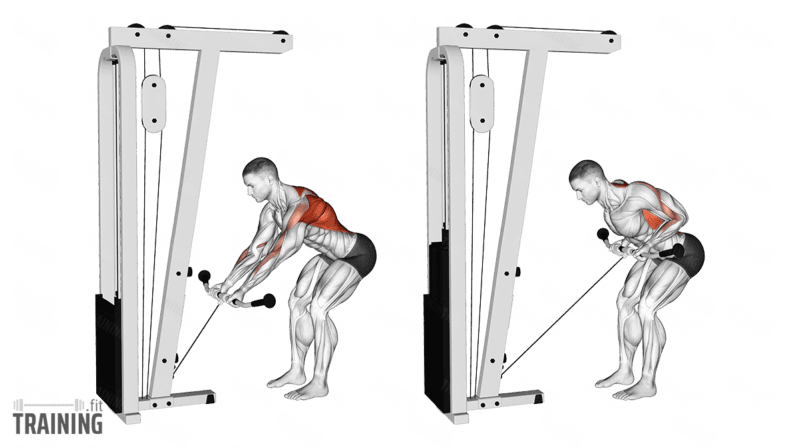
Main muscles
- Neck: Trapezius muscle
(Musculus trapezius) - Back: Large round muscle
(Musculus teres major) - Back: Large back muscle
(Musculus latissimus dorsi) - Back: Larger rhomboid muscle
(Musculus rhomboideus major) - Back: Small round muscle
(Musculus teres minor) - Back: Back extensor
(Musculus erector spinae) - Back: Lower back muscle
(Musculus infraspinatus) - Shoulder: Posterior deltoid muscle
(Musculus deltoideus, posterior deltoid muscle)
Training plans
Here you can find example plans for cable bent over reverse grip row training:
Cable Bent Over Reverse Grip Row: Basics and alternatives
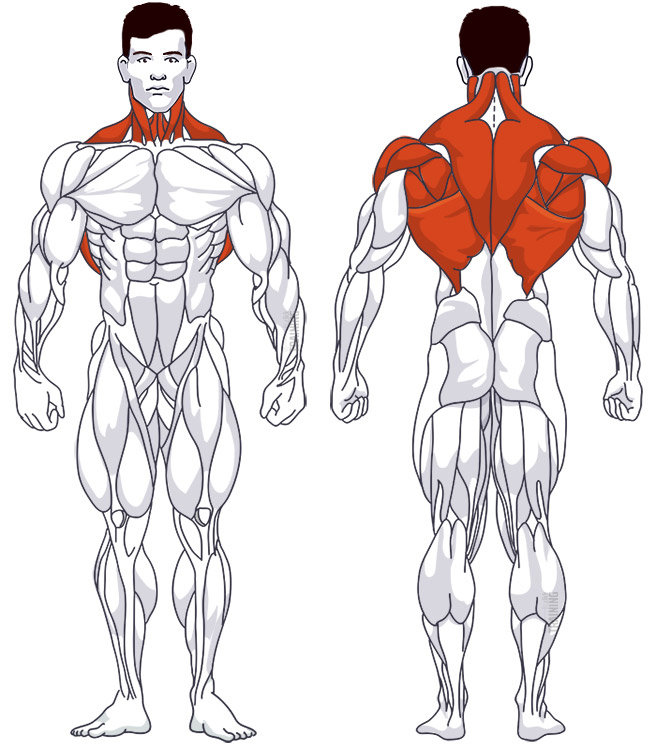
Involved main muscle groups:
Cable Bent Over Reverse Grip Row
The cable bent-over reverse-grip row adapts classic barbell rows to a low pulley. Hold the bent-over stance and pull the handle toward your abdomen with an underhand grip. Your back muscles move your arms behind you, while your elbow flexors bring the handle closer.
Unlike seated cable rows, there’s no seat or footplate to brace against, so it’s up to you to hold the bent-over position throughout the set. Since the cable pulls forward and down, your distance from the pulley matters just as much as your stance.
Correct execution
Your legs and trunk hold the bent-over position while your arms row. Finding a manageable load lets you concentrate on the pull without standing up to finish each repetition.
Fit a short straight or angled bar to the low pulley and choose a light starting weight. Take an underhand grip that lets your wrists stay comfortably aligned. Step back enough to give the handle room to move, then bend your knees slightly and push your hips back.
Hold your upper body at a steady forward angle as you pull toward your lower abdomen. Your elbows pass near your sides. Let your shoulder blades move back and forward with the row. On the way back, reach your arms forward while holding your stance against the pull of the cable. Keep your torso angle the same, too, since standing up a little on each rep turns this into a different movement.
Keep the bar path above your knees so the attachment doesn’t catch on them as it comes toward your abdomen. Spread your weight through both feet and leave enough room behind you to keep your hips back. If the cable pulls you onto your toes, lower the weight; leaning farther back to fight it isn’t the answer.
Look at the floor a little in front of you, so your head follows the angle of your torso. Pull your elbows back and let them return as your arms straighten. Keep your grip firm and your wrists in line with your forearms.
Video tutorial
Step-by-step instructions
Attach a suitable bar to the low pulley and take an underhand grip at about shoulder width.
Step back, bend your knees slightly and hinge at your hips with your weight balanced over both feet.
Brace your torso and extend your arms toward the pulley without losing the bent-over position.
Pull the handle toward your lower abdomen, bringing your elbows back beside your body.
Pause briefly without leaning farther back, then extend your arms slowly.
Repeat with the same torso angle and return the weight stack gently when you finish.
Common mistakes
Standing more upright with each pull changes the exercise and adds momentum. Lower the weight if you can’t hold the hinge.
Also avoid curling your wrists to force the bar against your stomach. Your hands are only there to hold the attachment; your arms and upper back do the rowing. If a straight bar makes the underhand grip uncomfortable, try a suitable angled attachment while keeping the same pulling direction.
If your feet slip, stop the set and don’t keep stepping back to catch your balance. Return the stack under control, stand up and reset. Check that the cable can travel through the full row at your chosen distance.
What the science says
Research on this exact cable row is scarce, but studies on free-weight bent-over rows and inverted rows show what the bent-over position and the underhand grip ask of your body. These were all single-session studies. They describe muscle activity and spinal loading during the exercises, rather than long-term muscle growth.
In a study with 15 resistance-trained men, the free-weight bent-over row produced 34% more activity in the lower back muscles (erector spinae) than a machine row when both were done with both arms at a similar effort. Rowing with one arm instead of both lowered lower back activity in seated cable rows and machine rows but made the side abdominal muscles (external obliques) work harder. The row variations showed no difference in six-pack muscle activity.[1]
Other research has examined the effect of grip position. When 13 men and 13 women did bodyweight inverted rows on a portable pull-up bar, the lats, biceps, lower trapezius and rear shoulder muscles were very active with both an underhand and an overhand grip. The 2 grips did produce different levels of lat activity.[2]
A small study with 7 healthy men compared the standing bent-over row with the inverted row and a standing one-arm cable row. The bent-over row produced high activity from top to bottom on both sides of the back, along with the greatest load on the lower spine. The inverted row caused the least spinal load, so the authors suggest it for people who want to spare their lower back.[3]
Sources
- The Effect of Performing Bi- and Unilateral Row Exercises on Core Muscle Activation. Saeterbakken A, Andersen V, Brudeseth A, Lund H, Fimland MS. International Journal of Sports Medicine. 2015;36(11):900–905. doi: 10.1055/s-0034-1398646.
- Activation of Spinal Stabilizers and Shoulder Complex Muscles During an Inverted Row Using a Portable Pull-up Device and Body Weight Resistance. Youdas JW, Keith JM, Nonn DE, Squires AC, Hollman JH. Journal of Strength and Conditioning Research. 2016;30(7):1933–1941. doi: 10.1519/jsc.0000000000001210.
- Comparison of Different Rowing Exercises: Trunk Muscle Activation and Lumbar Spine Motion, Load, and Stiffness. Fenwick CM, Brown SH, McGill SM. Journal of Strength and Conditioning Research. 2009;23(2):350–358. doi: 10.1519/jsc.0b013e3181942019.