Smith Machine Bench Press
Compound exercise, MachineThis article is verified by 4 studies/publications.
Overview

Main muscles
- Chest: Large pectoral muscle
(Musculus pectoralis major) - Chest: Small pectoral muscle
(Musculus pectoralis minor)
Training plans
Here you can find example plans for smith machine bench press training:
Smith Machine Bench Press: Basics and alternatives
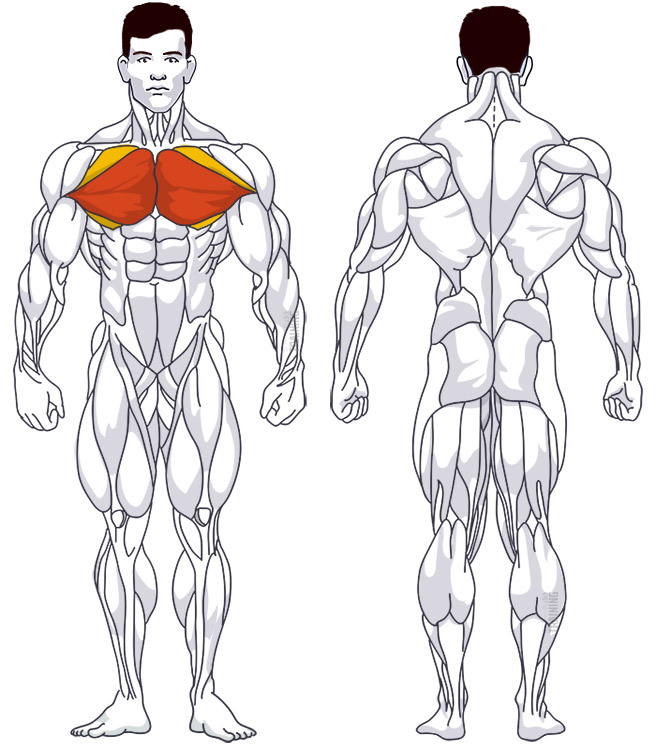
Involved main muscle groups:
Smith Machine Bench Press
With the Smith machine bench press, you’ll train the classic pressing movement along a guided path. On a flat bench, you lower the bar toward your chest and press it back up, working your chest, the fronts of your shoulders and your triceps. Since the rails fix the bar’s path, bench position really matters.
Dumbbell bench presses let each hand move on its own. Barbell bench presses use a free bar, so its path can change as you press. For an incline or decline bench, you’ll need a different setup.
Correct execution
Because the bar can’t follow your own path, you’ll need to fit the bench to the machine. A light practice set helps you find the pressing path before you load the bar.
Set the bench flat, lock the backrest and center the bench under the bar. Test the position with a light load: you should be able to lower the bar toward your middle-to-lower chest without reaching forward or lifting your shoulders off the bench. With angled rails, set up the bench facing the way the manufacturer recommends and try the whole path before adding weight.
Choose a rack height where you can lift the bar slightly and rotate it out of the hooks while your shoulders stay supported. Practice unhooking and re-hooking the light bar first, including the rotation needed on your machine, so you know you can lock it again from your pressing position with a firm grip.
Set both safety stops to the same height, just below the lowest point of your press, and make sure they still leave room for your body if you can’t finish a rep. If they don’t, change the setup before you load the bar.
Place your hands evenly on the bar, using matching grip marks where available. At the bottom of the press, your wrists should be roughly above your elbows. Keep your feet firmly planted, your upper back supported and your butt on the bench as you lower and press.
Video tutorial
Step-by-step instructions
Center a flat bench beneath the bar and check the full bar path with a light load.
Adjust the rack height and both safety stops. Check that the stops leave room for your body below the bar.
Lie on the bench and plant your feet. Take an even overhand grip and wrap your thumbs around the bar.
Lift and rotate the bar to release the hooks, then lower it slowly toward your chest, keeping your wrists roughly above your elbows.
Press the bar back up smoothly, keeping your hips on the bench.
After the set, rotate the bar back into both hooks and check that it is fully supported before letting go.
Common mistakes
If the bench is in the wrong place, the fixed bar path can pull your wrists and elbows out of alignment. Move the bench and test it again with a light weight instead of twisting your body to make the position work.
Don’t bounce the bar off your chest or let it drop onto the safety stops each rep. Instead, lower it slowly and press with control. The rails guide the bar, but you still need to check the stops and practice the locking rotation first.
What the science says
Research on this exercise mainly compares the Smith machine and free-weight bench press. The muscle activity studies show how hard your muscles work in a single session, not how much they grow over time.
In 29 untrained male college students pressing 60% of their 1-rep max, chest, front shoulder and triceps activity didn’t differ significantly between the Smith machine and a free barbell. Using the free barbell increased activity in the biceps, which help stabilize the elbow. The authors suggest the Smith machine may suit untrained people who haven’t yet learned to stabilize the elbow in this movement.[1]
In a 10-week study, 35 men with about 4 years of strength training experience did chest presses 2 times a week. They were split into 3 groups: Smith machine, dumbbells, or a barbell while lying on a Swiss ball. The Smith machine group improved its 6-rep max by about 17% in the free barbell bench press, which it hadn’t trained. The other 2 groups improved in this lift by about 12%. The researchers didn’t test whether these gains differed between the groups.[2]
In 12 resistance-trained men, the 1-rep max was about 3% higher with a free barbell than on the Smith machine, and 14% lower with dumbbells than on the Smith machine. The 3 lifts showed no difference in chest or front shoulder activity. The biceps worked harder as the lifts got less stable, and the triceps were more active on the Smith machine than with dumbbells.[3]
An older study with experienced and inexperienced bench pressers compared both versions at 70% and 90% of their 1-rep max. The side shoulder muscles (medial deltoids) were more active with the free barbell. Although the authors favor free weights for muscle development, muscle growth wasn’t measured in this study.[4]
Sources
- A comparison of muscle activation and concomitant intermuscular coupling of antagonist muscles among bench presses with different instability degrees in untrained men. Wang L, Qiao M, Tao H, Song X, Shao Q, Wang C, et al. Frontiers in Physiology. 2022;13:940719. doi: 10.3389/fphys.2022.940719.
- The effects of ten weeks resistance training on sticking region in chest-press exercises. Saeterbakken AH, Andersen V, van den Tillaar R, Joly F, Stien N, Pedersen H, et al. PLOS ONE. 2020;15(7):e0235555. doi: 10.1371/journal.pone.0235555.
- A comparison of muscle activity and 1-RM strength of three chest-press exercises with different stability requirements. Saeterbakken AH, van den Tillaar R, Fimland MS. Journal of Sports Sciences. 2011;29(5):533–538. doi: 10.1080/02640414.2010.543916.
- A Comparison of Muscle Activation Between a Smith Machine and Free Weight Bench Press. Schick EE, Coburn JW, Brown LE, Judelson DA, Khamoui AV, Tran TT, et al. Journal of Strength and Conditioning Research. 2010;24(3):779–784. doi: 10.1519/jsc.0b013e3181cc2237.