Chest Lift with Rotation
Compound exercise, Body weightThis article is verified by 3 studies/publications.
Overview
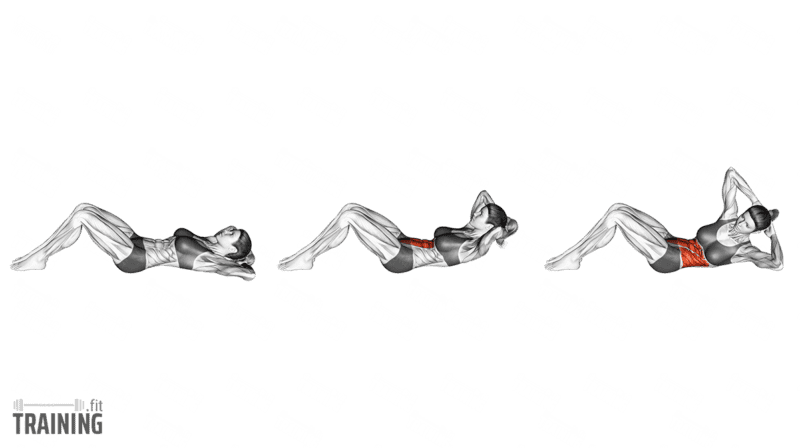
Main muscles
- Abdomen: Straight abdominal muscle
(Musculus rectus abdominis) - Abdomen: External oblique abdominal muscle
(Musculus obliquus externus abdominis) - Abdomen: Transverse abdominal muscle
(Musculus transversus abdominis)
Training plans
Chest Lift with Rotation is a suitable substitute for similar exercises in Abs workout or as a supplement to various training plans.
Chest Lift with Rotation: Basics and alternatives
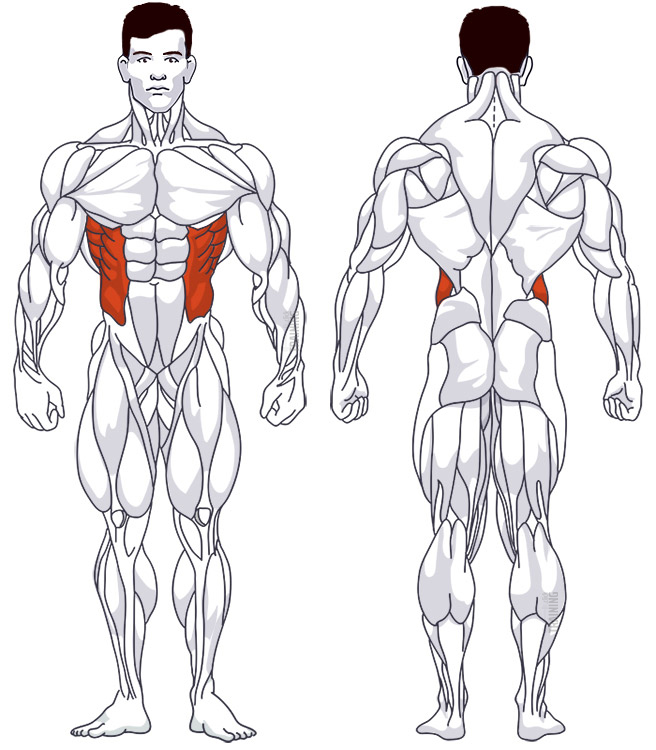
Involved main muscle groups:
Chest Lift with Rotation
Add a turn to a short abdominal curl and you get the chest lift with rotation, a simple mat exercise for your abs. You’ll lie on your back with both feet on the floor, lift your shoulder blades and turn your chest to one side while your pelvis stays on the mat. Your abs, including your obliques, work together as you lift and turn.
Ordinary crunches are a good way to practice the curl on its own. Alternate heel touches swap the chest turn for a sideways reach. And if you’d like to practice keeping your trunk steady while you move your legs, give dead bugs a try.
Correct execution
The turn comes from your upper body while your pelvis stays supported. A modest lift gives you room to practice that rotation without pulling on your head to reach farther.
Place your feet about hip width apart with your knees bent. Support the back of your head with both hands and keep your elbows comfortably open. Leave some space between your chin and chest. Your hands take some of the weight of your head, but they don’t pull you up.
Exhale and curl until your shoulder blades lift. Turn your chest right with your head following and your pelvis steady on the mat. Your left shoulder approaches your right knee, but your elbow doesn’t need to touch it. Return through the center and turn left at a similar height. Keep breathing through the turns, then lower your upper back and head slowly. Lower between turns if staying lifted makes you pull on your neck.
It helps to learn one turn at a time before linking both sides: curl up through the center, turn, come back to the center and lower. Make sure you’re turning your whole chest, not just moving one elbow across your face. Once the single turns feel controlled, keep your shoulders lifted and alternate sides.
Keep the pressure even under both feet. Pressing harder through one foot can roll your pelvis and carry your upper body with it, so reduce the turn if your knees start drifting sideways.
Video tutorial
Step-by-step instructions
Lie on your back with bent knees and both feet planted about hip width apart.
Support your head with both hands and keep your elbows comfortably open.
Exhale and curl your upper back until your shoulder blades lift from the mat.
Turn your rib cage toward the right without rolling your pelvis or knees with it.
Return through the center and repeat the turn toward the left. Return to the center and lower your upper back and head under control.
Common mistakes
Bringing an elbow across your face can look like a large turn even when your chest barely moves. Keep your elbows open enough to follow your rib cage and use a smaller, deliberate rotation.
If your knees sway or one side of your pelvis lifts, shorten the turn; the idea is to rotate your upper body above a steady lower body. Sitting all the way up or pulling your head forward to get higher is also a problem. Keep the lift short, and if your hands start doing the work, lower and reset.
What the science says
There’s hardly any research on this exact exercise, but several studies have measured muscle activity in short abdominal curls (curl-ups) with a twist, which is a very similar movement. These studies describe ab activity within a single session, rather than gains in muscle size or strength.
In a 2021 study, 10 healthy women did curl-ups with a twist to the left and to the right, while fine-wire sensors recorded activity in the abdominal muscles on the right side of their belly. On that side, the internal oblique and the deepest abdominal muscle (transversus abdominis) worked harder when the women turned right, and the external oblique worked harder when they turned left. Turning direction didn’t affect activity in the rectus abdominis, your six-pack muscle. In straight curl-ups, arm positions that added more load raised the activity of all 4 muscles.[1]
A 2011 study with 9 healthy women compared held curl-ups led by the chest with versions led by the pelvis, including diagonal versions of both. In the diagonal curl-up, leading with the chest produced more activity in the lower part of the six-pack muscle than leading with the pelvis. Across most of the tested movements, which also included standing tasks, moving the pelvis made the obliques work harder. The authors suggest that core stability programs include both movement patterns.[2]
An older study with 25 healthy adults found that the trunk curl with a twist produced about as much activity in the upper six-pack muscle as a plain trunk curl, a reverse curl and a V-sit. External oblique activity peaked in the V-sit and reverse curl rather than in the twisting curl.[3]
Sources
- Abdominal Muscle Activation During Common Modifications of the Trunk Curl-up Exercise. Crommert ME, Bjerkefors A, Tarassova O, Ekblom MM. Journal of Strength and Conditioning Research. 2021;35(2):428–435. doi: 10.1519/jsc.0000000000002439.
- Abdominal muscle activation changes if the purpose is to control pelvis motion or thorax motion. Vera-Garcia FJ, Moreside JM, McGill SM. Journal of Electromyography and Kinesiology. 2011;21(6):893–903. doi: 10.1016/j.jelekin.2011.08.003.
- Relative Activity of Abdominal Muscles During Commonly Prescribed Strengthening Exercises. Willett GM, Hyde JE, Uhrlaub MB, Wendel CL, Karst GM. Journal of Strength and Conditioning Research. 2001;15(4):480–485. doi: 10.1519/1533-4287(2001)015<0480:raoamd>2.0.co;2.