Kettlebell Slingshot
Compound exercise, Free weightsOverview
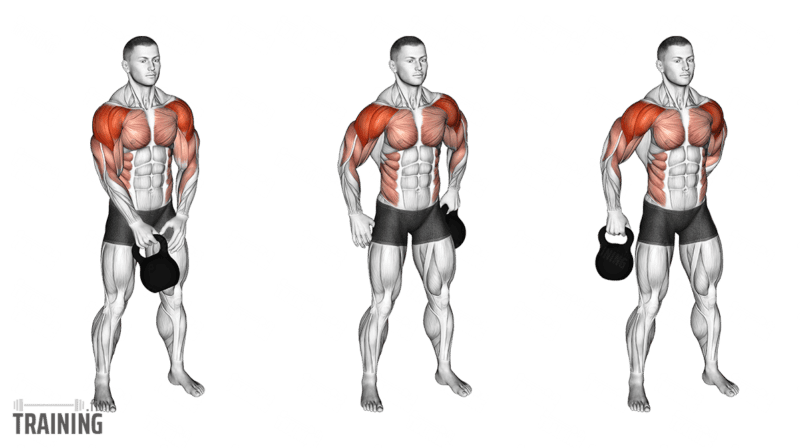
Main muscles
- Shoulder: Anterior deltoid muscle
(Musculus deltoideus, Pars clavicularis) - Shoulder: Posterior deltoid muscle
(Musculus deltoideus, posterior deltoid muscle) - Abdomen: External oblique abdominal muscle
(Musculus obliquus externus abdominis) - Abdomen: Transverse abdominal muscle
(Musculus transversus abdominis)
Training plans
Kettlebell Slingshot is a suitable substitute for similar exercises in Abs workout or as a supplement to various training plans.
Kettlebell Slingshot: Basics and alternatives
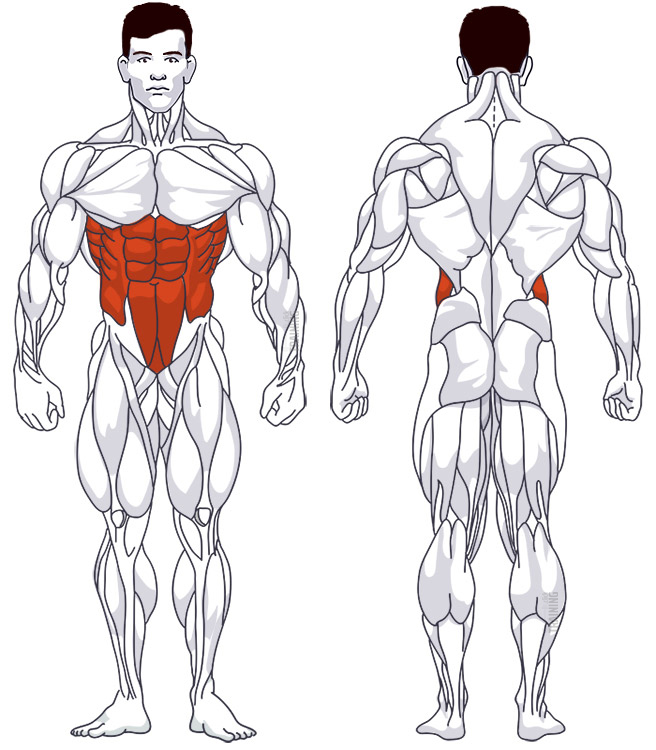
Involved main muscle groups:
Kettlebell Slingshot
The kettlebell slingshot follows a simple path around your hips. You’ll pass one bell from hand to hand in front of your body and behind your back, keeping the circle compact. Your grip carries the weight, your shoulders guide your arms, and your core keeps your torso still.
In the Kettlebell Figure 8, the weight passes between and around your legs in a lowered stance. In Kettlebell Pirate Ships, it rises in alternating arcs across the front while your body turns. In the slingshot, you stay upright with your torso still. And despite the name, you don’t actually sling the bell: you keep hold of it through every transfer.
Correct execution
Start with a light kettlebell and enough space around your body. Stand tall with soft knees and hold the handle in front of your hips. Leave enough room for the other hand to take the handle beside your current grip. Practice the hand change in front before attempting it behind your back.
Guide the bell around one hip with your arm relaxed beside you. Reach behind with the other hand and take the handle securely before letting go. Continue around the other hip and change hands again in front. Keep the bell close to your body, but not so close that it bumps into you. Breathe normally and keep looking ahead. Once the circle feels smooth, practice the other direction. To reverse, slow down and hold the bell securely in front first, so you’re not yanking a fast-moving weight back the other way.
Get your free hand behind you before the bell arrives, then guide the handle into it. Keep your elbows loose so the bell can pass below your waist while your shoulders stay down. If you have to bend forward to reach behind you, stop and practice the transfer with a lighter bell. To finish, take the handle with both hands in front, let the weight settle, then bend your hips and knees to set it on the floor.
Video tutorial
Step-by-step instructions
Stand upright with a light kettlebell in front of your hips and clear space around you.
Guide it around one hip while the other hand reaches behind your back.
Take the handle securely with the receiving hand before letting go with the first hand.
Continue around the other hip and transfer the bell again in front.
Keep the circle compact and your torso steady as you continue.
Slow down into a secure front hold before reversing direction or setting the kettlebell down.
Common mistakes
A wide circle can make your body sway or turn. Reduce the speed and keep the weight close enough that your torso stays still.
Finding the handle behind your back shouldn’t mean wrenching your shoulder backward. Use a light bell and a reach that feels comfortable, and if you can’t make a smooth transfer behind your back yet, stop and practice the hand change in front. Also, hold on until your other hand has a secure grip before you let go.