Kettlebell Pirate Ships
Compound exercise, Free weightsOverview
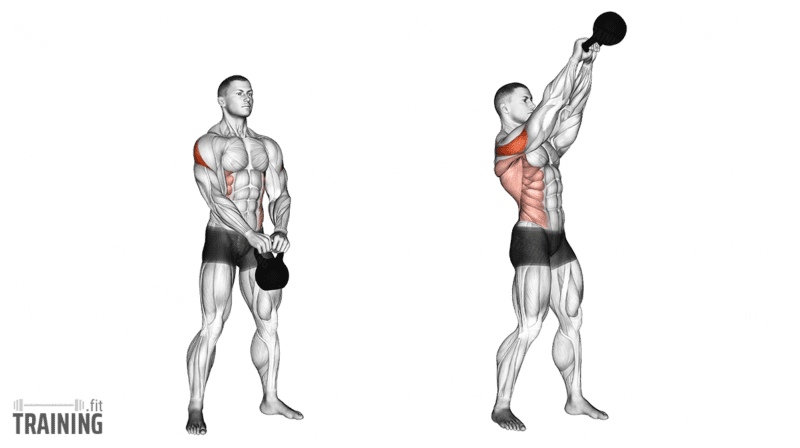
Main muscles
- Shoulder: Anterior deltoid muscle
(Musculus deltoideus, Pars clavicularis) - Shoulder: Medial deltoid muscle
(Musculus deltoideus, Pars acromialis) - Abdomen: External oblique abdominal muscle
(Musculus obliquus externus abdominis) - Abdomen: Transverse abdominal muscle
(Musculus transversus abdominis) - Buttocks: Large gluteus maximus
(Musculus gluteus maximus)
Training plans
Kettlebell Pirate Ships is a suitable substitute for similar exercises in Shoulder training or as a supplement to various training plans.
Kettlebell Pirate Ships: Basics and alternatives
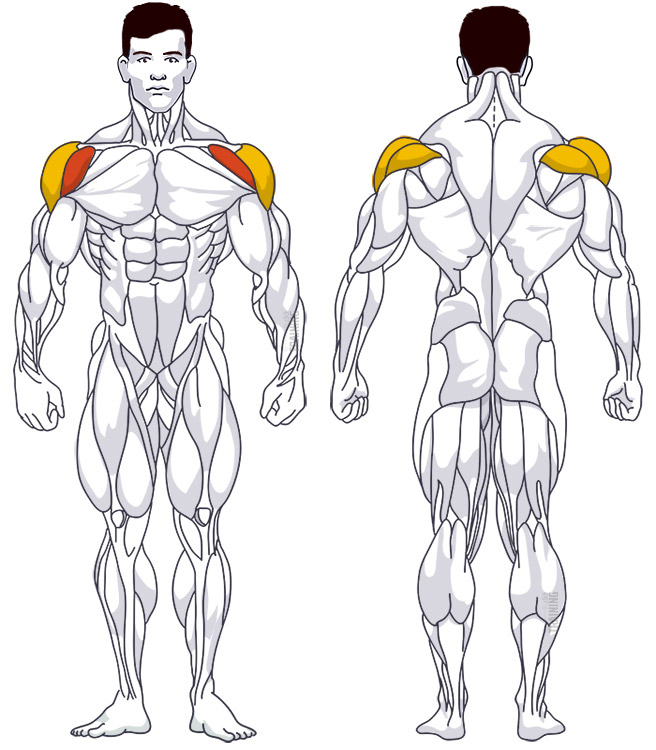
Involved main muscle groups:
Kettlebell Pirate Ships
In kettlebell pirate ships, the bell moves in a rocking, side-to-side arc. You’ll hold the handle with both hands and swing the kettlebell across the front of your body as your hips and upper body turn. Your shoulders guide the weight, while your abs and back muscles control each change of direction.
Unlike in the Kettlebell Swing, the bell doesn’t swing back between your legs; it travels across the front of your body. The Standing Cable Lift follows a diagonal path against cable resistance. Kettlebell windmills are a slower alternative: you hold the weight overhead while moving your hips and turning your upper body.
Correct execution
The side-to-side swing needs room to slow down as well as speed up. You can begin with a low arc while learning how your hips and upper body follow the bell.
Use a light kettlebell and clear enough space for the whole swing. Stand with your feet a little wider than shoulder-width apart with your knees slightly bent. Hold the handle firmly with both hands in front of your hips.
Start with a small arc to one side, turning your hips and upper body with the weight. Guide the bell downward through the middle, then up toward the other side. The bell passes in front of your thighs, just clear of your knees. Keep your hands side by side on the handle and your elbows slightly bent.
Let your feet pivot as needed so your knees keep following the direction of your toes. Keep the swing at chest height or lower at first, using a similar height on both sides. Once you can slow the bell down and change direction smoothly while staying upright and balanced, you can make the arc bigger.
Momentum is part of this swing, but you still need to control where the kettlebell goes. To finish, make each arc a little smaller until the weight comes to rest in front of you, then lower it to the floor.
Video tutorial
Step-by-step instructions
Clear the swing area and hold a light kettlebell with both hands in a stable, slightly wide stance.
Keep your knees slightly bent and start with the kettlebell in front of your hips.
Turn your hips and upper body to guide the kettlebell in a small, rising arc toward one side.
Guide the bell downward across the center and turn toward the other side.
Pivot your feet as needed and keep your knees following your toes as you alternate.
Gradually shorten the arcs, settle the bell in front of you and lower it to the floor under control.
Common mistakes
A large upper-body twist with fixed hips and feet can concentrate the turning in your spine. Let all three turn together, and shorten the arc if you can’t keep your knees following your toes.
Leaning back or yanking the handle to gain height reduces control. Swing only as high as you can guide the bell back down. Slow the swing gradually before stopping, and end the set if you can no longer hold the handle firmly.