Band Decline Sit Up
Compound exercise, Free weightsThis article is verified by 4 studies/publications.
Overview
Main muscles
- Abdomen: Straight abdominal muscle
(Musculus rectus abdominis) - Abdomen: External oblique abdominal muscle
(Musculus obliquus externus abdominis)
Training plans
Band Decline Sit Up is a suitable substitute for similar exercises in Abs workout or as a supplement to various training plans.
Band Decline Sit Up: Basics and alternatives
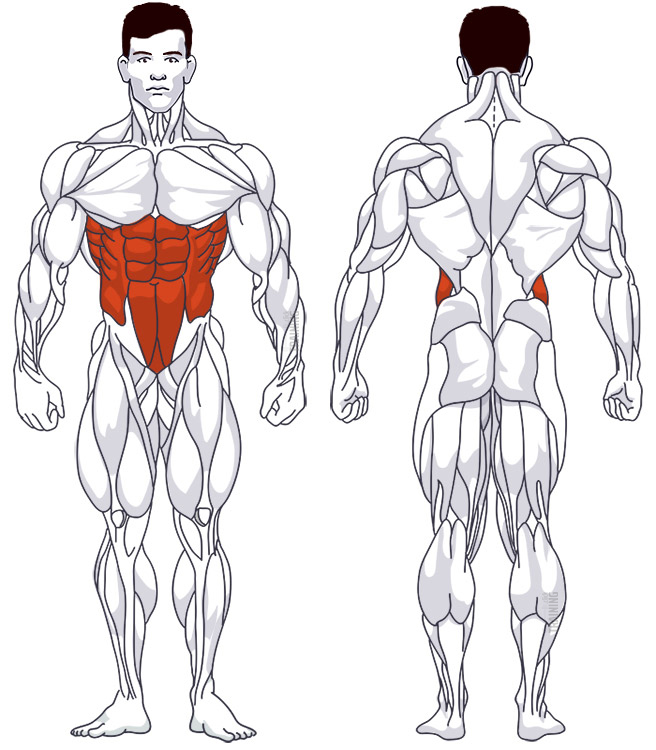
Involved main muscle groups:
Band Decline Sit Up
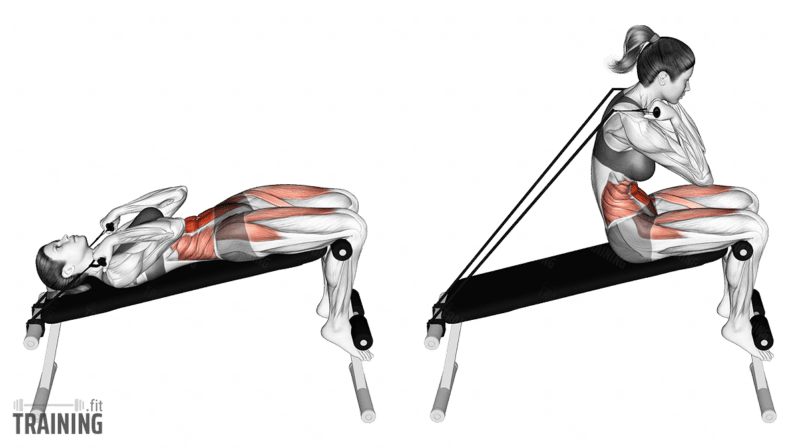
A resistance band makes classic Decline Sit-Ups more challenging. Secure your legs in the bench supports and hold the band beside your shoulders, anchored behind the head end. The band stretches as you sit up and pulls you back as you lower. Your abs and hip flexors raise your upper body.
Practice the bench movement without a band first. Arms Extended Sit Ups change the leverage without this band-and-bench setup. In either version, lower as smoothly as you rise.
Correct execution
The bench angle and band tension both affect how this sit-up feels. Starting with a slight decline and light tension gives you a chance to learn the combined setup before making it harder.
Start with a slight decline and check the bench adjustment and leg pads. Attach a light band to a secure low anchor behind the head end. If you anchor the band to the bench, use an attachment point designed for it that stays put under the pull; don’t use loose or removable parts or objects that can move.
Inspect the entire band for wear, especially where it passes around the anchor, and replace it if it’s damaged. Keep its path clear of the bench pad and frame. Hold equal lengths on both sides so the pull doesn’t turn you toward one shoulder.
Sit on the bench, secure your legs and hold the handles near your shoulders. Lower carefully until your back rests on the pad, keeping the band clear of your neck and face. Exhale and curl your upper body toward your thighs. Your hands stay beside your shoulders throughout.
Pause briefly at the top, then lower slowly, resisting the band’s pull until your back is supported. Start with light resistance and check the top position, where the band is stretched farther. Reduce the resistance if you have to jerk yourself up or can’t control the descent. Change the bench angle or band resistance one at a time, then test the movement again.
Video tutorial
Step-by-step instructions
Secure a light band low behind the head end of a stable decline bench.
Check the bench angle and leg pads, then sit down and secure your legs.
Hold the band ends near your shoulders and lower your back onto the bench.
Exhale and sit up toward your thighs while keeping your hands near your shoulders.
Pause briefly and lower slowly, resisting the band’s pull.
Finish with your back supported on the bench. Slowly move the handles toward the anchor until the band is slack, then let go before getting off the bench.
Common mistakes
Don’t push the handles forward with your arms: that changes the resistance on your core. Keep your hands near your shoulders, and switch to a lighter band if they start to drift.
Control the descent until your back is supported; don’t let the band accelerate the last part. Check the head-end anchor before starting. Anchoring at the foot end pulls from in front and changes the exercise.
Never adjust the anchor with the band stretched. Rest your back on the bench, carefully release the tension and then reposition the attachment.
What the science says
There doesn’t seem to be a study on band-resisted sit-ups on a decline bench. Related studies cover band-resisted sit-ups, hip flexor involvement and training programs using incline sit-ups. Most of this research measured muscle activity in single sessions, which shows how hard a muscle works, not how much it grows.
In a 2014 study, 24 men did sit-ups on the floor, without their feet held down, with body weight and with elastic bands heavy enough that they could just manage 10 reps. With the bands, a BOSU ball under the lower back increased activity in the six-pack muscle (rectus abdominis) by 21–24% compared with a stable surface. During bodyweight sit-ups, this setup instead lowered activity in the outer muscle on the side of the abdomen (external oblique).[1]
A 1998 study with 5 men and 3 women found that all forms of sit-ups activated the deep hip flexor (psoas) more than a curl-up did. A curl-up involves lifting your head and shoulders a little, rather than raising the whole upper body.[2]
In 6 men who tried 38 variations of sit-ups and leg lifts, the hip flexors were strongly active only when the movement bent the hips. When sit-ups raised the whole upper body, bending and securing the legs increased hip flexor activity, generally without changing ab activity.[3]
In a 10-week study, 45 men and women aged 18–26 trained 3 times a week with one of two ab machines or with incline sit-ups. Abdominal strength and endurance improved in every group. Abdominal skinfolds tended to increase and girth measurements generally stayed the same, so the ab training alone didn’t reduce belly fat.[4]
Sources
- Effects of BOSU Ball(s) During Sit-Ups With Body Weight and Added Resistance on Core Muscle Activation. Saeterbakken AH, Andersen V, Jansson J, Kvellestad AC, Fimland MS. Journal of Strength and Conditioning Research. 2014;28(12):3515–3522. doi: 10.1519/jsc.0000000000000565.
- Quantitative intramuscular myoelectric activity of lumbar portions of psoas and the abdominal wall during a wide variety of tasks. Juker D, McGill S, Kropf P, Steffen T. Medicine & Science in Sports & Exercise. 1998;30(2):301–310. doi: 10.1097/00005768-199802000-00020.
- Abdominal and hip flexor muscle activation during various training exercises. Andersson EA, Nilsson J, Ma Z, Thorstensson A. European Journal of Applied Physiology. 1997;75(2):115–123. doi: 10.1007/s004210050135.
- Resistance exercise program effects on abdominal function and physique. Thomas TR, Ridder MB. The Journal of Sports Medicine and Physical Fitness. 1989;29(1):45–48. PMID: 2528028.