Dragon Flag
Compound exercise, Body weightOverview
Main muscles
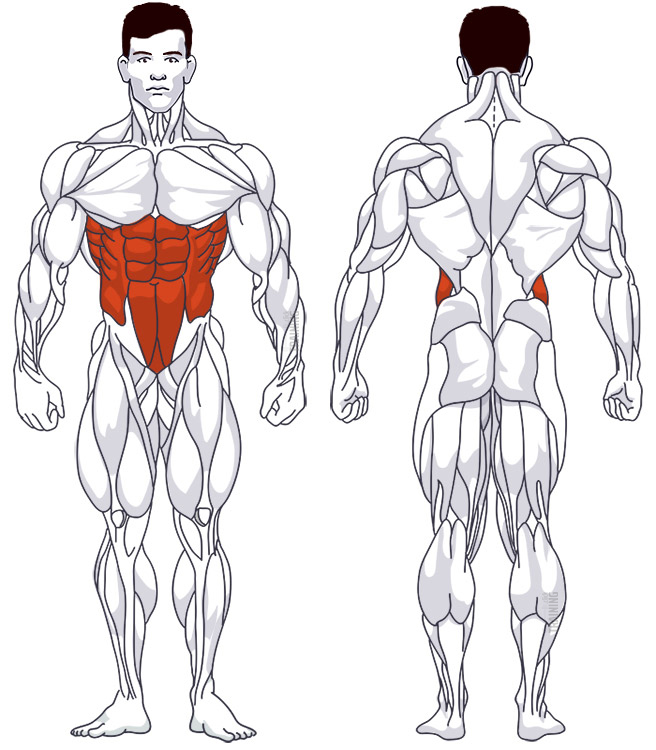
- Abdomen: Straight abdominal muscle
(Musculus rectus abdominis) - Abdomen: Transverse abdominal muscle
(Musculus transversus abdominis) - Back: Large back muscle
(Musculus latissimus dorsi) - Triceps: Three-headed arm muscle
(Musculus triceps brachii)
Training plans
Dragon Flag is a suitable substitute for similar exercises in Abs workout or as a supplement to various training plans.
Dragon Flag: Basics and alternatives
Involved main muscle groups:
Dragon Flag
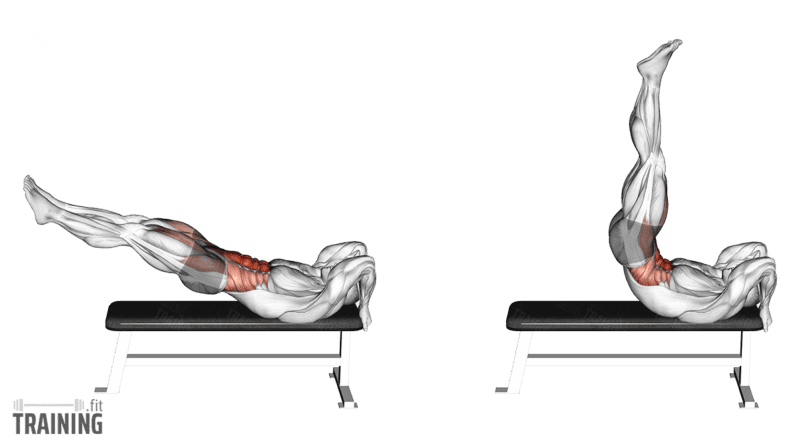
The dragon flag is a demanding, advanced core exercise. Lying on a flat bench, you hold a secure part of the bench behind your head and raise and lower your legs and torso together while your upper back stays supported. Your hips stay extended as your body lowers toward a diagonal, your abs hold your trunk in position, and your shoulders and arms keep your upper body in place.
Although the movement is sometimes called a leg raise, it differs from simply bending at your hips. Reverse crunches let you practice lifting your pelvis with a shorter movement. Front planks and dead bugs are other ways to work on trunk control before attempting this advanced variation.
Correct execution
You’ll need a sturdy bench that can’t tip or slide when you pull on it, with a fixed grip point within reach behind your head that’s strong enough to hold your weight. Lie down with your head fully supported and grip behind it firmly with both hands.
Pull your knees toward your chest and curl your pelvis up. With your weight across your shoulders and upper back, straighten your hips and legs so they point diagonally upward. Keep your head still so the weight doesn’t roll onto your neck. Tighten your abs and butt so your torso, hips and legs form one straight line.
Slowly lower your torso and legs together, stopping before your hips sag, your lower back arches or your pelvis reaches the bench. Then come back up in one straight line. You don’t have to reach a low horizontal position. If the way up is too hard, perform only the controlled lowering, then bend your knees and reset; don’t kick yourself back up. Bent knees also make the movement easier to control. To finish, bend your knees and lower your back gradually before letting go.
Video tutorial
Step-by-step instructions
Check that the bench and gripping point are fixed and can’t tip or slide.
Lie with your head supported and grip securely behind it with both hands.
Pull in your knees and curl your pelvis up until you’re resting on your shoulders and upper back.
Straighten your hips and legs so they point diagonally upward, keeping your head still.
Lower your torso and legs together only as far as you can keep them in one straight line.
Return without folding at your hips, or bend your knees and reset after the lowering phase.
Bend your knees and lower your spine onto the bench before letting go.
Common mistakes
Lowering your feet while leaving your hips high turns the repetition into a different leg movement. Keep your torso and legs moving together, or practice with bent knees if you can’t control the straight-leg version.
Trying to reach horizontal can take you past a controllable range. Shorten the movement before your hips sag or your back arches. If you feel neck pressure, your grip slips or the bench moves, come down and fix the setup before another repetition.