Spell Caster
Compound exercise, Free weightsOverview
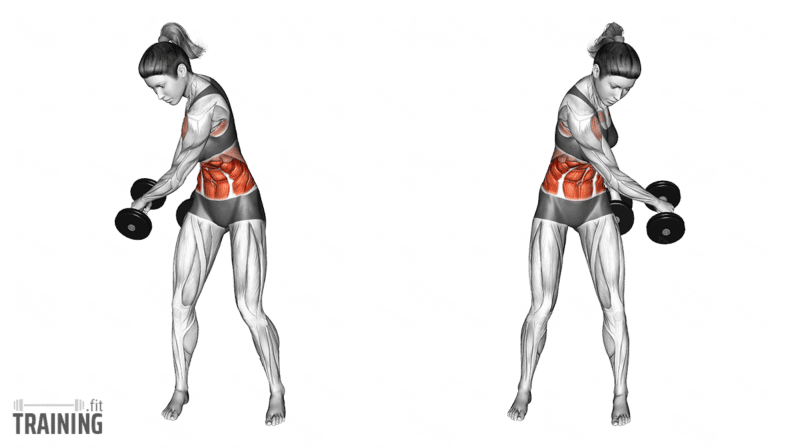
Main muscles
- Abdomen: External oblique abdominal muscle
(Musculus obliquus externus abdominis) - Abdomen: Straight abdominal muscle
(Musculus rectus abdominis) - Abdomen: Transverse abdominal muscle
(Musculus transversus abdominis) - Shoulder: Anterior deltoid muscle
(Musculus deltoideus, Pars clavicularis)
Training plans
Spell Caster is a suitable substitute for similar exercises in Abs workout or as a supplement to various training plans.
Spell Caster: Basics and alternatives
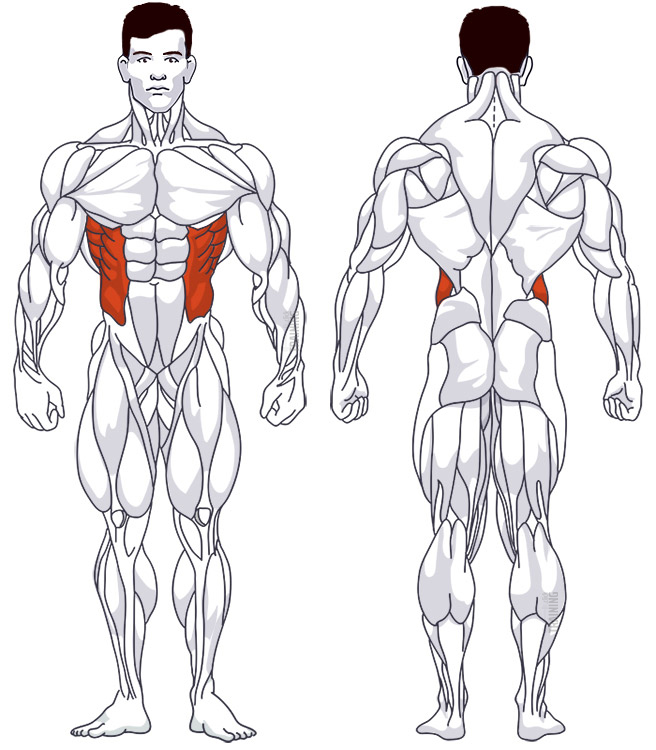
Involved main muscle groups:
Spell Caster
The spell caster shown here uses a low, flowing side-to-side path. You’ll hold one dumbbell in each hand and guide both across the front of your body as your torso and hips turn. Your obliques control the turn while your shoulders and arms hold the weights around hip and thigh height.
The movement is related to standing abdominal twists, where you can hold one weight in both hands. Kettlebell Pirate Ships use a kettlebell for a pendulum-like movement across the front of your body. Dumbbell wood chop squats combine a more pronounced high-to-low diagonal with a squat.
Correct execution
Use two light, compact dumbbells so your hands and the weights can move without knocking together. Stand in a comfortable, slightly wider-than-hip-width stance with soft knees. Hold your arms in front of your thighs with a slight elbow bend and a secure grip.
Turn gently to bring both weights beside your right hip or upper thigh, then guide them across the front to the left. Let your hips follow your chest, and pivot your feet a little when the turn calls for it. Keep your knees pointing the same way as your feet. Use a smooth arc that you can slow down at either end. Your knees can bend and straighten slightly with the movement, but this version doesn’t need a deep squat or an overhead lift. Keep breathing, and bring the weights to rest in front of you before lowering them to your sides.
Move the dumbbells as a pair with a small gap between them throughout the arc, so neither hand trails behind and has to catch up with a sudden tug. Keep the same slight bend in both elbows, even as the weights pass your thigh, so you don’t curl one of them.
If your feet and hips feel out of step with your hands, practice the turn without weights first. You’re ready for the dumbbells once you can change direction without crossing your feet or taking an extra step to catch your balance.
Video tutorial
Step-by-step instructions
Hold a light dumbbell in each hand.
Take a stable stance with slightly bent knees.
Hold your arms in front with a slight elbow bend and a small gap between the weights.
Turn gently to bring both dumbbells beside your right hip or thigh.
Guide them across the front toward the left while your hips and, if needed, your feet follow the turn.
Reverse smoothly and continue within a range you can control at both ends.
Hold the weights still in front of you, then lower them and set them down with control.
Common mistakes
Swinging the dumbbells fast and out of control can carry them beyond the range you intended. Start slowly enough to pause at either side, and use lighter weights if you have to jerk them back.
Also avoid locking your feet and forcing a big twist through your waist. Let your hips and feet share the turn, or make it smaller. Keep the weights low, even if lifting them toward your face would make the arc bigger. If the dumbbells bump into each other, use smaller weights or hold your hands slightly wider apart.