Barbell Press Sit-Up
Compound exercise, Free weightsOverview
Main muscles
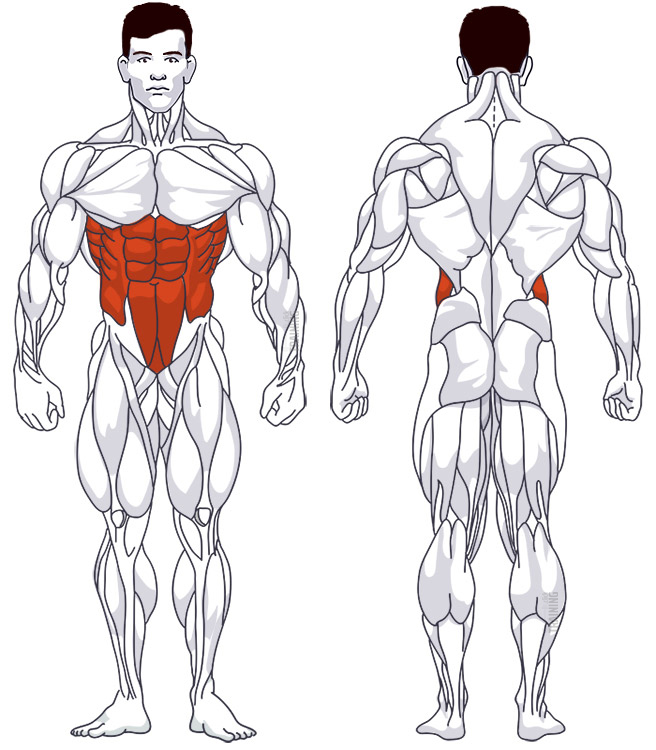
- Abdomen: Straight abdominal muscle
(Musculus rectus abdominis) - Abdomen: External oblique abdominal muscle
(Musculus obliquus externus abdominis) - Shoulder: Anterior deltoid muscle
(Musculus deltoideus, Pars clavicularis) - Triceps: Three-headed arm muscle
(Musculus triceps brachii)
Training plans
Barbell Press Sit-Up is a suitable substitute for similar exercises in Abs workout or as a supplement to various training plans.
Barbell Press Sit-Up: Basics and alternatives
Involved main muscle groups:
Barbell Press Sit-Up
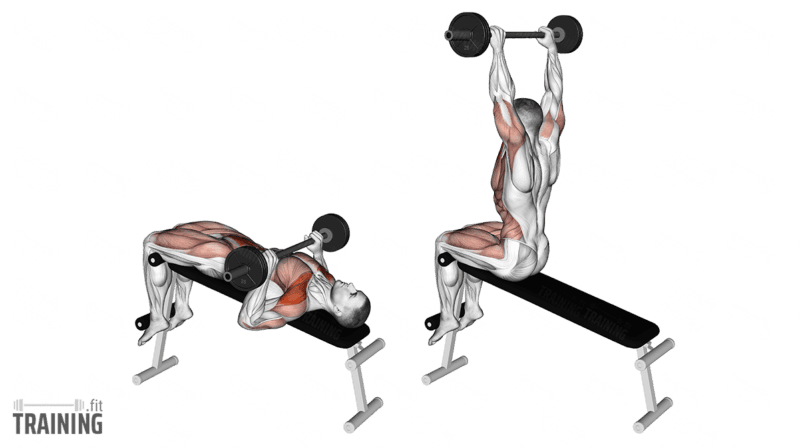
The barbell press sit-up combines a classic decline sit-up with an overhead press. Starting with the bar near your chest, you’ll sit up and straighten your arms to bring it above your shoulders. Your abs and hip flexors raise your upper body, while your shoulders and triceps help press the bar.
Start with Decline Sit-Ups before adding weight. Arms Extended Sit Ups let you practice with your arms overhead and no bar. For the combined sit-up and press, use a light technique bar you can control through both movements.
Correct execution
Here you’re combining a sit-up with a bar held overhead, so the handoff and return deserve as much attention as the repetition. A practice run with a light bar makes the sequence easier to learn.
Use a stable decline bench with secure leg supports and enough room overhead. Choose a slight decline, secure your legs under the supports and plan the bar handoff or rack return. Your rack or spotter should let you take the bar without reaching behind you while lying back. If you add plates, secure them with collars and check that they clear the bench.
Hold the bar near your upper chest with a closed overhand grip, slightly wider than shoulder width. Exhale and curl your upper body up while pressing the bar overhead. Keep your wrists in line with your forearms and straighten both elbows together so the bar stays level.
At the top, your upper body comes beneath the bar, with the weight above your shoulders. Don’t lean far backward just to make your arms look vertical. If you can’t find this position with a light bar, practice the overhead hold separately before combining it with the sit-up.
Pause briefly, bring the bar back toward your chest and lower your upper body onto the bench under control. In a related version, your arms stay extended throughout the sit-up, but the exercise shown here includes a press. If the sit-up or the bar starts to feel unstable, stop and hand the bar off or rack it as planned.
Video tutorial
Step-by-step instructions
Set a stable decline bench to a manageable angle, sit down and hook your legs under its leg pads.
Take a light bar from your spotter or the rack with a closed overhand grip slightly wider than shoulder width.
Lie back, keeping the bar steady near your upper chest.
Sit up while pressing the bar above your shoulders and extending your elbows.
Pause, lower the bar toward your chest and lower your upper body back onto the bench.
Repeat only as long as you can control both movements, then hand the bar back or return it to the rack as planned.
Common mistakes
Don’t throw the bar forward: that adds momentum to the sit-up and pulls the weight off its path. Use less weight and raise your upper body and the bar smoothly.
Adding weight or a steeper decline too soon makes control harder. Practice the sit-up and press separately first. Bring the bar to your chest under control before lowering yourself slowly; don’t fall backward with the weight still moving overhead.