Medicine Ball Crunch at the Chest
Isolation exercise, Free weightsThis article is verified by 4 studies/publications.
Overview
Main muscles
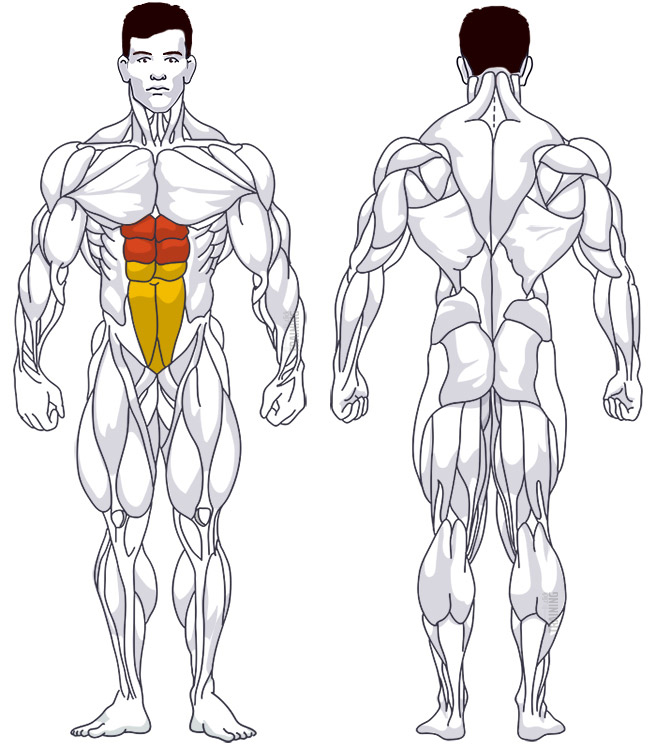
- Abdomen: Straight abdominal muscle
(Musculus rectus abdominis)
Training plans
Medicine Ball Crunch at the Chest is a suitable substitute for similar exercises in Abs workout or as a supplement to various training plans.
Medicine Ball Crunch at the Chest: Basics and alternatives
Involved main muscle groups:
Medicine Ball Crunch at the Chest
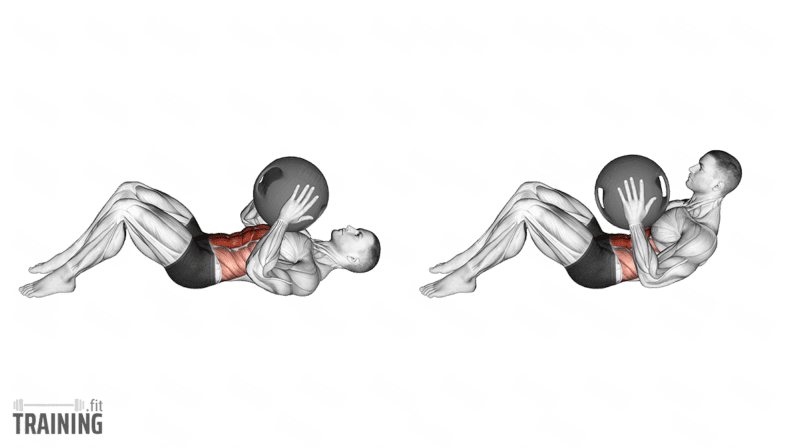
A medicine ball held at your chest adds resistance to the classic crunch. Keep both feet planted and lift your shoulder blades by curling your upper back. Your abs do the curling while your bent arms keep the ball close.
Ordinary crunches use the same movement without the ball. In medicine ball crunches with extended arms, you hold the ball above your chest with your arms extended. Cable crunches offer another way to work your abs against resistance.
Correct execution
Choose a light medicine ball that you can hold securely with both hands. Sit on a mat with the ball close to you, then lie back and plant your feet about hip-width apart. Bend your knees and settle your pelvis and lower back on the mat. Position the ball close to your chest with bent elbows.
Exhale as you curl your upper back and lift your shoulder blades, keeping a comfortable gap between your chin and chest. The movement is shorter than a sit-up: you don’t sit all the way up. Keep the ball close to your chest as your shoulders rise, with your elbows bent and moving along with your torso. There’s no pressing or throwing involved. Just hold the ball securely without pushing it into your neck.
Lower your shoulders slowly, keeping your feet and pelvis still, and inhale as you return. Settle before the next rep. When you’re done, keep the ball against your chest as you sit up, then set it down. If the ball makes your curl jerky or your grip feels insecure, set it aside and practice the curl on its own.
Pick a ball small enough to sit against your chest below your chin, and support it at the sides with both hands. Keep your elbows off your thighs so they can’t give you a push as you curl up.
Video tutorial
Step-by-step instructions
Sit on a mat with a light medicine ball held securely in both hands.
Lie back, bend your knees and plant both feet about hip-width apart.
Hold the ball close to your chest with bent elbows.
Exhale and curl your upper back until your shoulder blades lift, keeping your pelvis down.
Lower your shoulders gradually while keeping the ball in the same position. After your last repetition, keep the ball close to your chest as you sit up, then set it down.
Common mistakes
Swinging the ball toward your knees is a common mistake, since it gives your upper body momentum. Keep your elbows bent and the ball at your chest as you curl. A heavier ball won’t help if you can’t control where it goes.
Also watch out for head nods or a full sit-up in place of the curl. Let your head follow your upper back and keep the movement short. If your feet lift or your pelvis rocks, shorten the curl or put the ball aside and practice without it. Dry hands and a dry ball help you grip securely, so check both before starting.
What the science says
There’s little research on this exact exercise, but several studies have measured how hard your abs work in curl-ups and crunches with and without extra load. The single-session measurements describe muscle effort rather than gains in ab strength or size.
In a 2021 study with 10 healthy women, fine-wire sensors recorded the abdominal muscles during curl-ups with 3 different arm positions. Activity increased in all 4 measured abdominal muscles when the arm position added more load. The deepest one (transversus abdominis) reached only about 40% of its maximum, so the authors suggest that curl-ups may not be the most suitable exercise for strengthening it.[1]
A classic 1997 study with 9 volunteers compared 12 abdominal exercises, weighing how hard the abs worked against how much the lower spine was compressed. Unloaded partial curl-ups generally gave the most abdominal work for the least spinal compression. The authors recommend a variety of exercises because none challenged all the abdominal muscles while also minimizing spinal loading.[2]
In a 2009 study, 13 young, physically active adults did crunches with loads between 20% and 100% of the most they could manage once. Ab activity was greatest at the heaviest load. There was generally no difference between nearby loads, such as 20% and 40%.[3]
A 2005 study with 15 healthy young men found more abdominal activity when they held a 5-kg weight behind their head than in a standard crunch. A crunch on a gym ball and one with raised legs produced even more. In this test, the weight was held behind the head rather than against the chest.[4]
Sources
- Abdominal Muscle Activation During Common Modifications of the Trunk Curl-up Exercise. Crommert ME, Bjerkefors A, Tarassova O, Ekblom MM. Journal of Strength and Conditioning Research. 2021;35(2):428–435. doi: 10.1519/jsc.0000000000002439.
- Low back loads over a variety of abdominal exercises: searching for the safest abdominal challenge. Axler CT, McGill SM. Medicine & Science in Sports & Exercise. 1997;29(6):804–811. doi: 10.1097/00005768-199706000-00011.
- EMG activation of abdominal muscles in the crunch exercise performed with different external loads. Moraes AC, Pinto RS, Valamatos MJ, Valamatos MJ, Pezarat-Correia PL, Okano AH, et al. Physical Therapy in Sport. 2009;10(2):57–62. doi: 10.1016/j.ptsp.2009.01.001.
- An electromyographic investigation of abdominal exercises and the effects of fatigue. Robinson M, Lees A, Barton G. Ergonomics. 2005;48(11-14):1604–1612. doi: 10.1080/00140130500101338.