Cable Horizontal Pallof Press
Compound exercise, Cable pullThis article is verified by 2 studies/publications.
Overview
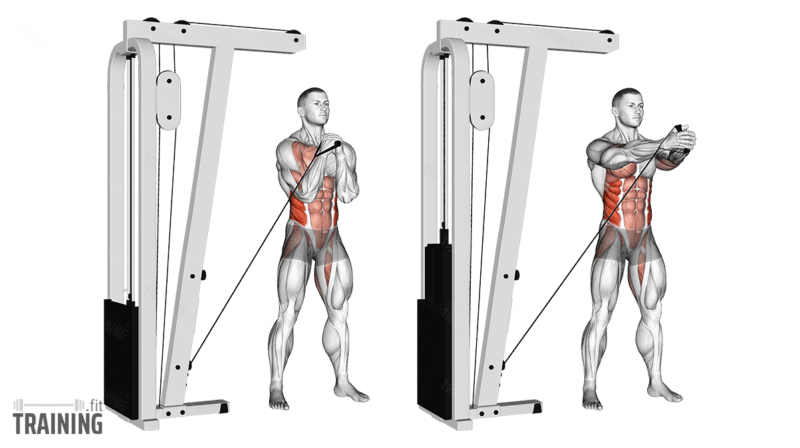
Main muscles
- Abdomen: External oblique abdominal muscle
(Musculus obliquus externus abdominis) - Abdomen: Transverse abdominal muscle
(Musculus transversus abdominis) - Abdomen: Straight abdominal muscle
(Musculus rectus abdominis)
Workout plan
Here you can find example plans for cable horizontal pallof press training:
Cable Horizontal Pallof Press: Basics and alternatives
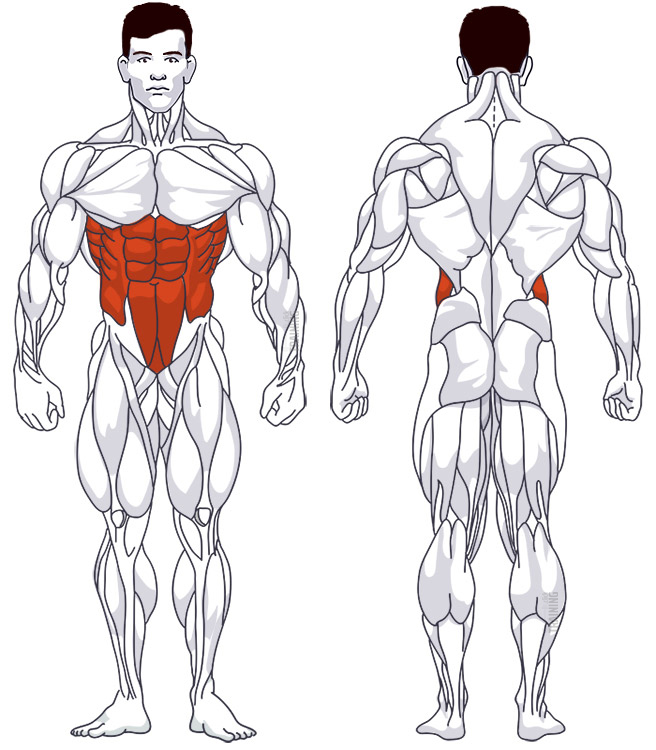
Involved main muscle groups:
Cable Horizontal Pallof Press
The Pallof press is a useful core exercise for resisting rotation. Stand side-on to a cable, hold its handle at your chest and press forward while your shoulders and hips face ahead. The farther you reach, the harder it is to stay still.
In band side bends, you bend your upper body sideways. A side plank holds your body above the floor with support on one side. The Pallof press keeps you standing as your arms move and your upper body stays still.
Correct execution
For the usual version, set the pulley at about chest height and choose a light weight. You can also use a lower pulley: your hands still press straight forward, but the cable pulls down as well as sideways, so start light if you’d like to try that angle.
Stand side-on to the machine and hold the handle in both hands at your chest. Step sideways away from the stack until the cable is taut. Place your feet about shoulder-width apart, bend your knees slightly and keep your upper body upright.
Press your hands straight forward at chest height, centered in front of you, with your shoulders and hips facing ahead. Keep your wrists aligned with your forearms and straighten your elbows naturally; don’t force them past straight. Pause briefly, keep breathing and return the handle to your chest along the same path.
Start with a short reach and press farther out as long as you can keep your body still. Use the same stance on both sides. When you’ve finished your reps, bring the handle back to your chest, step toward the machine to let the weight stack rest, then switch sides.
Video tutorial
Step-by-step instructions
Select a light load and set the pulley around chest height, or set it lower if you want to try the low-pulley version.
Stand side-on to the cable and hold the handle in both hands at your chest.
Step out to tension the cable and settle into a stable stance with slightly bent knees.
Press your hands straight forward while keeping your shoulders and pelvis facing ahead.
Pause briefly, breathe and return your hands to your chest without turning. Repeat, reduce the cable tension and change sides.
Common mistakes
Letting the cable rotate your shoulders turns the press into a twisting movement. Lower the weight or shorten the reach until your shoulders and hips stay facing forward.
When the weight is too heavy, it’s easy to end up leaning away from the stack to counterbalance it. Lower the weight, keep your ribs above your pelvis and spread the pressure through both feet. With a low pulley, also make sure your hands stay at the height you chose and don’t drift down in an arc.
Don’t step sideways instead of pressing; walking out with the cable is a separate variation. Set your feet first and move only your arms.
What the science says
The Pallof press itself remains little studied. The 2 studies below used an elastic band instead of a cable, and neither measured muscle activity or muscle growth, so they tell you more about difficulty and control than about training results.
A 2024 study evaluated the Pallof press as a strength test in 18 middle-aged men and women with chronic low back pain and 17 healthy peers. They held the press for 5 seconds at a time while the band tension rose step by step. The test stopped as soon as they shifted out of position to compensate. Results were highly consistent across 2 sessions. No one reported discomfort or pain during or after the tests.[1]
In a 2025 study, 12 physically active young adults (6 men and 6 women) held 5 versions of the band Pallof press with their arms straight at shoulder height. A smartphone on the pelvis recorded how much the pelvis moved, as a measure of how hard it was to stay still. The version standing on a half ball was clearly the most demanding. Standing on the floor with one foot in front of the other was harder than kneeling on a foam pad, and there was no significant difference between men and women.[2]
Sources
- Using Resistance-Band Tests to Evaluate Trunk Muscle Strength in Chronic Low Back Pain: A Test–Retest Reliability Study. Franco-López F, Durkalec-Michalski K, Díaz-Morón J, Higueras-Liébana E, Hernández-Belmonte A, Courel-Ibáñez J. Sensors. 2024;24(13):4131. doi: 10.3390/s24134131.
- Effect of Body Position and Support Surface on the Postural Control Challenge During the Pallof Press Exercise: A Smartphone Accelerometer-Based Study. Juan-Recio C, Prat-Luri A, Rondón-Espinosa H, Barbado D, Vera-Garcia FJ. Medicina. 2025;61(2):312. doi: 10.3390/medicina61020312.