Pilates Corkscrew
Compound exercise, Body weightOverview
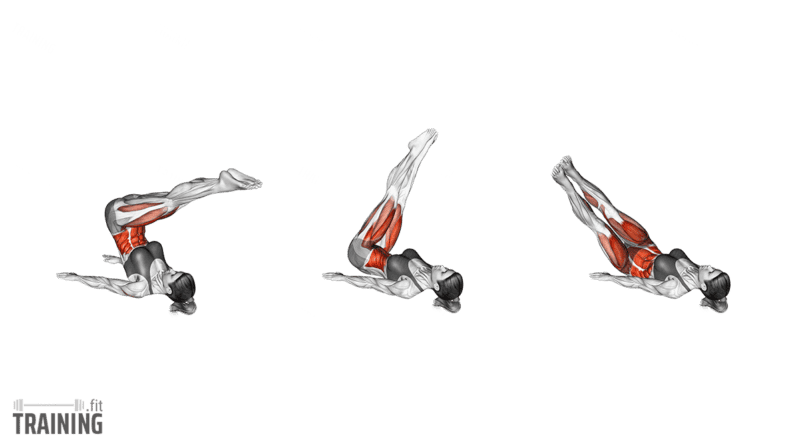
Main muscles
- Abdomen: Straight abdominal muscle
(Musculus rectus abdominis) - Abdomen: External oblique abdominal muscle
(Musculus obliquus externus abdominis) - Abdomen: Transverse abdominal muscle
(Musculus transversus abdominis)
Training plans
Pilates Corkscrew is a suitable substitute for similar exercises in Abs workout or as a supplement to various training plans.
Pilates Corkscrew: Basics and alternatives
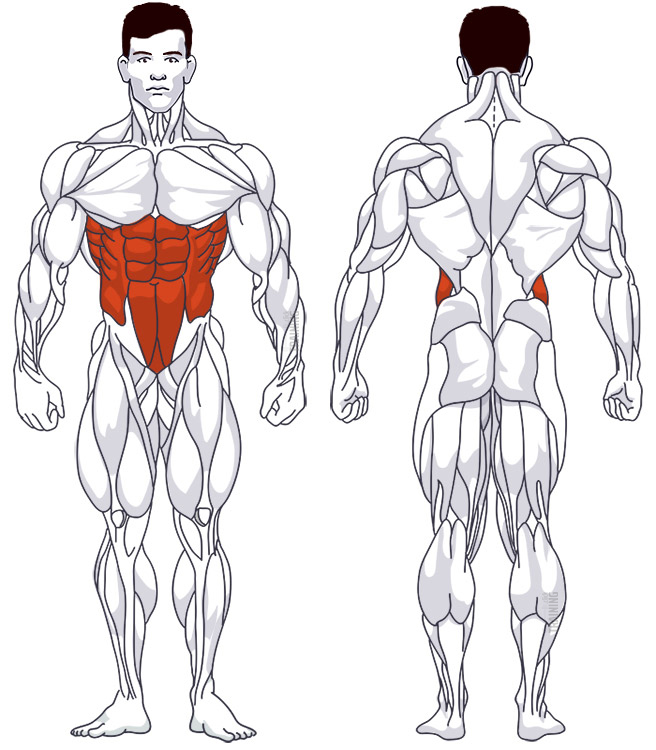
Involved main muscle groups:
Pilates Corkscrew
This advanced Pilates corkscrew combines a leg circle with a controlled rollover onto your upper back. With your legs together, you’ll lift your pelvis, lower slightly to one side and guide your legs around before curling back up. Your abs control your pelvis and spine as the legs change direction.
Reverse crunches lift your pelvis more directly, with no circle. In the chest lift with rotation, you turn your upper body while your pelvis stays down. Dead bugs offer a simple alternative for practicing trunk control with your back on the mat.
Correct execution
This version includes lifting the pelvis, so it asks for more control than a small leg circle on the floor. The supported upper-back position needs to stay steady while your legs trace the circle.
Lie on a firm, padded mat with your arms beside you and your palms pressing down. Start with your legs together above your hips. Curl your pelvis up and bring your legs toward a high diagonal over your torso. Your shoulders and upper back support you, and your head stays still. Don’t roll your weight onto your neck or try to reach the floor behind your head.
Lower your back gradually with your legs slightly to the right. As your pelvis approaches the mat, sweep your legs through a small arc left, then curl up from that side and reverse direction. Keep your legs together and the arc controlled, with no sudden twist or drop; the low point can stay well above the floor. If you can’t control the rollover, do small leg circles with your pelvis down. Finish by bending your knees and lowering your spine gradually through the center.
Pause briefly in the high position before changing direction. Keep your feet side by side so neither leg leads, and make the circle the same small size in both directions. If coming back from one side feels harder, make both circles smaller so you can stay slow and keep your weight spread across both shoulders.
Video tutorial
Step-by-step instructions
Lie on a padded mat with your arms beside your body and legs together above your hips.
Press your palms down, curl your pelvis up and bring your legs to a high diagonal, supported on your upper back.
Keep your head still and lower your back gradually with your legs slightly to the right.
Sweep your legs through the bottom of the circle in a small arc to the left.
Curl back to the raised position and reverse the direction for the next circle.
Bend your knees and lower your spine through the center to finish.
Common mistakes
Try not to make the circle too big too soon. If your legs drop or your lower back arches uncontrollably, the circle is more than you can control, so make it smaller or keep your pelvis on the mat. A small circle also lets you move smoothly, so you don’t need momentum to get around.
Keep your head still while your pelvis is raised, with your weight across your shoulders and upper back. If you feel pressure building on your neck, come down and change the setup or choose a different exercise. Flinging your legs overhead to get back up is another typical mistake: curl up with control instead.