Dead Bug
Compound exercise, Body weightThis article is verified by 3 studies/publications.
Overview

Main muscles
- Abdomen: Straight abdominal muscle
(Musculus rectus abdominis) - Abdomen: External oblique abdominal muscle
(Musculus obliquus externus abdominis) - Abdomen: Transverse abdominal muscle
(Musculus transversus abdominis)
Training plans
Here you can find example plans for dead bug training:
Dead Bug: Basics and alternatives
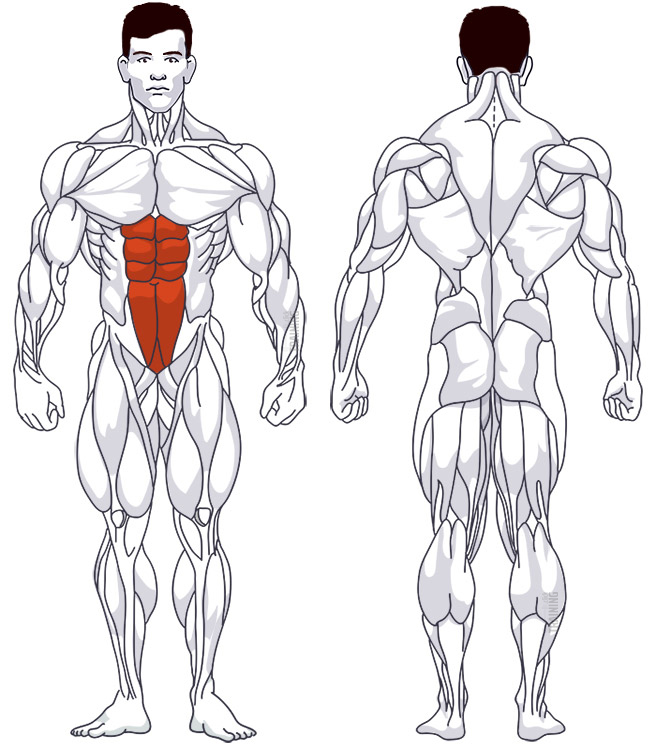
Involved main muscle groups:
Dead Bug
The dead bug is a useful core-control exercise with your back supported on the floor. This legs-only variation keeps both arms above your shoulders as you extend and return one leg, starting with your knees bent over your hips. Your abs steady your back and pelvis. The classic version also lowers the opposite arm behind your head as the leg extends.
In the bird dog, you reach with one arm and the opposite leg while on your hands and knees. A front plank holds your body on your forearms and toes. In the dead bug, contact with the floor helps you notice if your back or pelvis moves as you extend a leg.
Correct execution
The floor gives you feedback about your back position while your limbs move. You can shorten the reach whenever a longer one makes it difficult to keep that contact steady.
Lie comfortably with your head and shoulders supported. Raise your arms toward the ceiling and bring your knees over your hips, bent at about a right angle. Gently tighten your abs and let your lower back settle toward the floor; there’s no need to press it down as hard as you can.
Reach one heel away while slowly straightening that knee. Stop before your back arches farther or your pelvis tips. Your foot doesn’t need to touch the floor: a higher, shorter reach is easier to control. Bring your leg back before changing sides. Keep your arms vertical throughout this variation and breathe steadily. If the starting position is already difficult to hold, keep one foot on the floor and move only the other leg before trying a longer reach.
For an easier leg movement, keep your knee bent and lower your heel toward the floor, then return. Practice this heel tap before trying the longer reach. Keep your other thigh still and both arms raised above your shoulders.
Try breathing out as you reach and in as your leg comes back; there’s no need to force the air out. The floor tells you how you’re doing: if your ribs lift and your back position changes, bring your leg back and make the next reach shorter.
Video tutorial
Step-by-step instructions
Lie on your back.
Raise both arms toward the ceiling.
Raise your knees over your hips, keeping them bent at roughly a right angle.
Gently brace your abs and settle your lower back toward the floor.
Reach one heel away by extending that leg while keeping the other knee over your hip.
Stop before your back position changes, then return your leg slowly.
Alternate legs with your arms still vertical. To finish, lower one foot at a time to the floor.
Common mistakes
Lowering your leg farther than you can control often lifts your lower back from its starting position. Keep your heel higher and reduce the reach instead.
Keep your stationary knee over your hip rather than drawing it toward your chest to make room for the moving leg. Moving both legs together or adding an arm movement changes this legs-only version; practice those variations deliberately rather than drifting into them as you tire.
Lifting your head to watch your feet might feel natural, but your head should stay supported. How far your heel goes matters less than how well you keep your trunk under control.
What the science says
Studies of the dead bug use ultrasound or muscle-activity sensors to assess how hard the trunk muscles work. They show the effort in a single session, not strength or muscle gains over time, and the versions studied weren’t always this legs-only variation.
In a 2024 study, 44 recreationally active young men and women did 7 core exercises. Ultrasound showed how much their deep abdominal muscles and a deep back muscle (multifidus) thickened, a sign of how hard they were working. Overall, the dead bug didn’t differ significantly from the top-ranked bird dog and side plank, though those 2 worked the internal oblique harder. All measured muscles thickened more when participants drew the belly button in (hollowing) than when they tightened their whole midsection (bracing).[1]
A 2023 study had 44 women with at least 3 years of Pilates experience hold the dead bug in its starting position while drawing the belly in. Their arms were raised and their hips and knees bent at right angles. The dead bug thickened the deepest abdominal muscle (transversus abdominis) more than 4 other Pilates exercises, including the side plank. The rankings were similar in younger and middle-aged women.[2]
In a 2017 study, 19 healthy adults and 13 adults with chronic low back pain, all Pilates beginners, did 3 Pilates mat exercises while muscle activity was recorded. The twisting criss-cross made the abdominal muscles work hardest, while the dead bug and the single-leg stretch produced similar, lower activity. During the dead bug, activity was higher in the obliques than in the six-pack muscle or multifidus.[3]
The dead bug ranks differently across studies because the comparison exercises and participant groups differ.
Sources
- A Comparison between Core Stability Exercises and Muscle Thickness Using Two Different Activation Maneuvers. Tsartsapakis I, Bagioka I, Fountoukidou F, Kellis E. Journal of Functional Morphology and Kinesiology. 2024;9(2):70. doi: 10.3390/jfmk9020070.
- Transversus Abdominis Ultrasound Thickness during Popular Trunk–Pilates Exercises in Young and Middle-Aged Women. Tsartsapakis I, Gerou M, Zafeiroudi A, Kellis E. Journal of Functional Morphology and Kinesiology. 2023;8(3):110. doi: 10.3390/jfmk8030110.
- Trunk Muscle EMG During Intermediate Pilates Mat Exercises in Beginner Healthy and Chronic Low Back Pain Individuals. Pereira ILR, Queiroz B, Loss J, Amorim C, Sacco ICN. Journal of Manipulative and Physiological Therapeutics. 2017;40(5):350–357. doi: 10.1016/j.jmpt.2017.02.010.