Kettlebell Figure 8
Compound exercise, Free weightsOverview
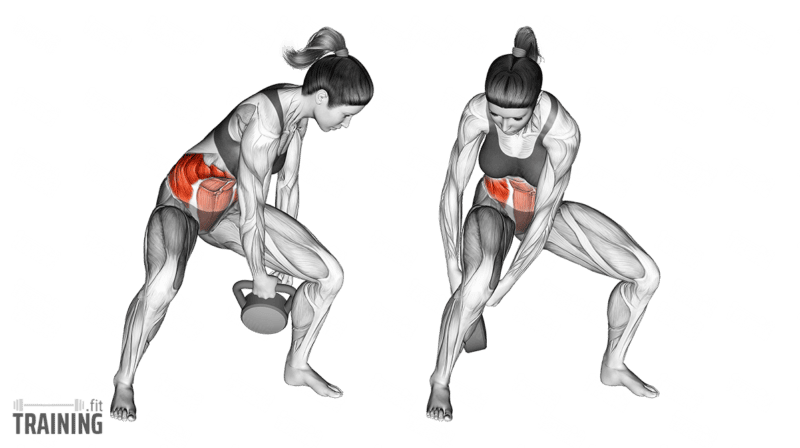
Main muscles
- Abdomen: External oblique abdominal muscle
(Musculus obliquus externus abdominis) - Abdomen: Transverse abdominal muscle
(Musculus transversus abdominis) - Thigh: Quadriceps
(Musculus quadriceps femoris) - Buttocks: Large gluteus maximus
(Musculus gluteus maximus) - Back: Back extensor
(Musculus erector spinae)
Training plans
Kettlebell Figure 8 is a suitable substitute for similar exercises in Abs workout or as a supplement to various training plans.
Kettlebell Figure 8: Basics and alternatives
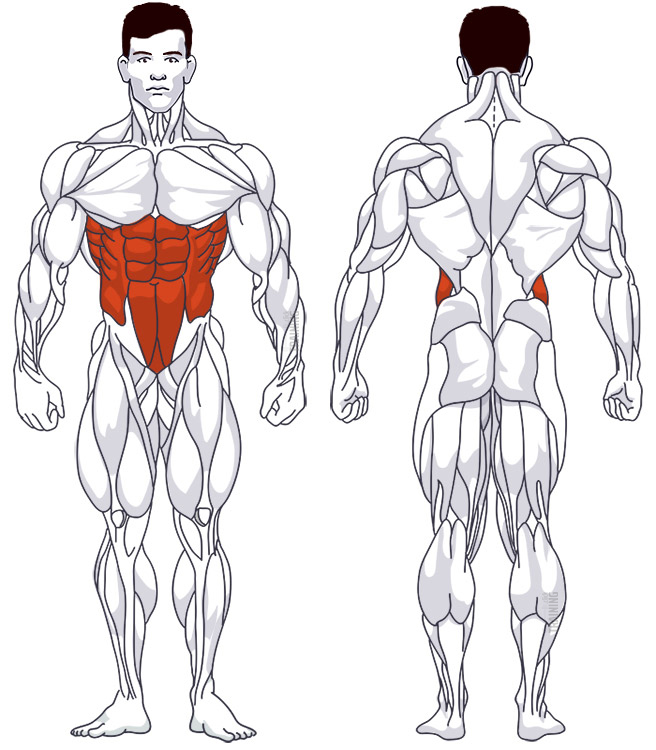
Involved main muscle groups:
Kettlebell Figure 8
In the kettlebell figure eight, you pass one bell between and around your legs in a figure-eight pattern. You stay in a partial squat with your hips slightly back. Your hands alternate on the handle, your legs hold the squat, and your abs and back steady your torso as the weight changes sides.
In the Kettlebell Slingshot, the bell circles your hips while you stand upright. In Kettlebell Pass-Through Lunges, you transfer it beneath your front thigh during a lunge. In the figure eight, you’ll keep both feet in place. It also differs from the Kettlebell Swing: you guide the weight around your legs instead of repeatedly driving it forward with a quick hip extension.
Correct execution
Choose a light kettlebell with room on the handle for the receiving hand. Take a comfortably wide stance and bend your hips and knees enough to pass the bell behind either thigh. Keep your back steady and both feet flat on the floor. You don’t need to sit so low that the bell scrapes the floor.
Start with the bell in your right hand. Guide it between your legs toward the back of your left thigh, where your left hand reaches around to take it. Let your left hand grip the handle securely before you let go with your right. Bring the bell around the outside of your left leg and forward, then guide it through the center behind your right thigh into your right hand. Complete the loop around your right leg and keep going. Keep the bell’s path clear of your knees and your side-to-side sway small. This version stays low; catching the bell up at the chest is a separate variation.
Have your receiving hand waiting behind your thigh, ready for the open part of the handle. Look at the floor just ahead; you don’t need to watch every handover. Practice one loop around a leg and stop in front, then connect both loops once each transfer is secure and your feet stay in place.
Video tutorial
Step-by-step instructions
Stand with your feet comfortably wide.
Hold a light kettlebell in your right hand.
Bend your hips and knees into a controlled partial squat with enough space behind both thighs.
Pass the bell through the center behind your left thigh and take it securely with your left hand.
Guide it around the outside of your left leg and back through the center behind your right thigh.
Take the handle in your right hand and complete the loop around your right leg.
Continue smoothly, then slow the movement and set the kettlebell down under control.
Common mistakes
Letting go early and hoping your other hand catches the handle leaves the bell unsupported for a moment. Practice slowly until every handover happens with a secure grip, and if the bell hits your knee, pause and adjust your stance and the bell’s path.
If you follow the weight by rounding your back or shifting heavily from leg to leg, it gets hard to hold your position. Use a lighter bell or shorten the set, keeping both feet flat. Guide the bell around your legs rather than moving your knees out of its way.