Standing Cable Lift
Compound exercise, Cable pullThis article is verified by 2 studies/publications.
Overview
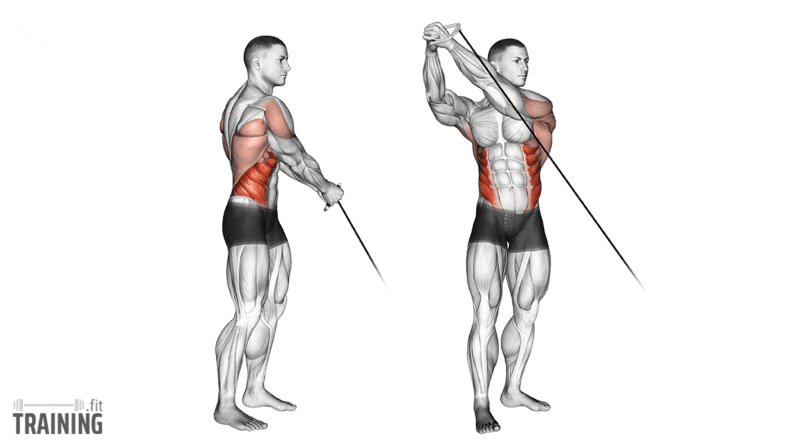
Main muscles
- Abdomen: External oblique abdominal muscle
(Musculus obliquus externus abdominis) - Abdomen: Straight abdominal muscle
(Musculus rectus abdominis) - Abdomen: Transverse abdominal muscle
(Musculus transversus abdominis) - Shoulder: Anterior deltoid muscle
(Musculus deltoideus, Pars clavicularis)
Training plans
Standing Cable Lift is a suitable substitute for similar exercises in Abs workout or as a supplement to various training plans.
Standing Cable Lift: Basics and alternatives
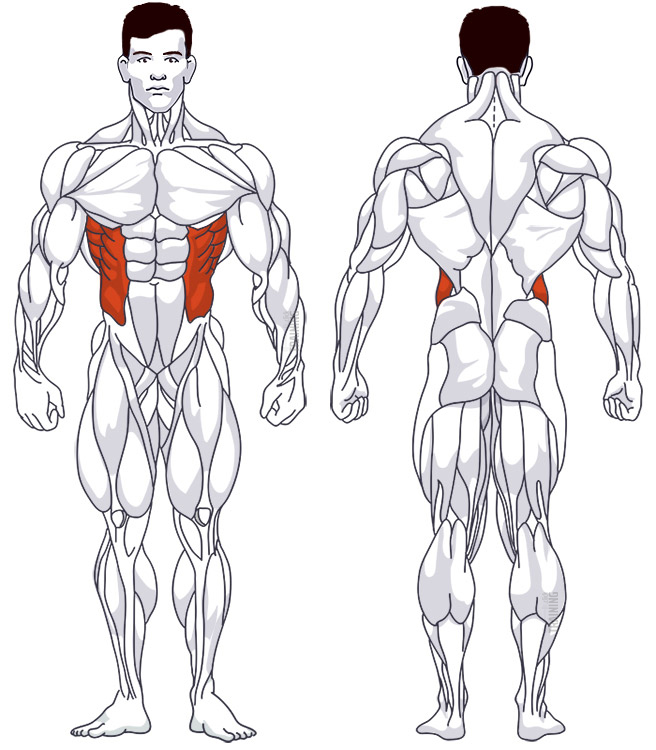
Involved main muscle groups:
Standing Cable Lift
The standing cable lift is a diagonal exercise for your abs and shoulders. Standing sideways to a low pulley, you’ll lift its handle with both hands from one hip toward your opposite shoulder. Your abs control the turn and steady your upper body.
Cable crunches and regular crunches curl your upper body forward. The cable lift adds a turn and an upward diagonal. Dumbbell wood chop squats combine a similar path across your body with a dumbbell and a squat.
Correct execution
You can begin with a smaller range while you learn to let your feet and hips move with your upper body.
Attach a handle to a low pulley and choose a weight you can lift smoothly with both hands. Begin with your left side toward the station, your feet about shoulder-width apart and your knees slightly bent. Hold the handle beside your left hip and step away until the cable is taut but doesn’t pull you off balance.
Hold the handle comfortably with both hands; don’t force either wrist backward. Keep it far enough in front of you for the cable to clear your hip and thigh at the bottom.
Lift your hands diagonally toward your right shoulder, keeping your arms almost straight with a small bend in your elbows. Let your chest and hips turn together. Your left foot can pivot as needed, with your knee following its direction. You can go a little above shoulder height, as long as you stay upright and your lower back doesn’t arch.
Pause briefly, then reverse the turn and bring the handle back down along the same diagonal, all the way to your hip. Complete the repetitions on one side and let the stack rest before changing your grip or stance. For the other side, start beside your right hip and lift toward your left shoulder.
Video tutorial
Step-by-step instructions
Attach a handle to the low pulley.
Select a manageable weight.
Stand with your left side toward the station, feet about shoulder-width apart and knees slightly bent. Hold the handle beside your left hip with both hands.
Tighten your abs and lift your hands diagonally toward your right shoulder, keeping a small, steady elbow bend.
Let your chest and hips turn together, allowing your left foot to pivot if needed. Stay upright without leaning backward.
Lower the handle along the same diagonal under control and repeat on that side.
Let the weight stack rest, then turn your right side toward the station and repeat from your right hip toward your left shoulder.
Common mistakes
A common mistake is leaning back to get the handle higher, which means your arms are no longer lifting it under control. Stop lower and reduce the weight if you can’t stay upright; you don’t have to reach fully overhead.
Don’t force a big turn of your chest with your feet fixed. Let the foot nearest the pulley pivot a little or keep the turn shorter, and start each lift smoothly, with no jerk to get the stack moving.
Keep the slight elbow bend consistent. Pulling the handle into your chest and then pressing it out turns the diagonal lift described here into a different exercise.
What the science says
In the 2 studies below, diagonal cable movements served as tests of trunk and arm power. They didn’t measure muscle activity or training effects, so they can’t tell you what the exercise builds over time.
A 2017 study with 23 fit men used the standing cable wood chop on a weight-stack machine. It’s a related rotation done with the elbows close to the body, so it differs from the lift described here. The men did single all-out reps with weights raised step by step up to their maximum, then a set of 20 reps. Their power readings were very consistent, and depending on the person, power peaked at about 67%, 75% or 83% of the heaviest weight they could move. Power fell by about 10–14% between the first and last reps of the 20-rep set.[1]
In a 2011 study, 18 healthy adults (10 men and 8 women, average age 32) did half-kneeling diagonal chop and lift tests on 3 days at least 1 week apart, using a resistance machine that measures power. Peak lift power varied little from one test day to another. People with more lift power tended to hold a longer side plank, although the association was only moderate. Lift power had no relationship with performance on a back-extensor endurance test.[2]
Sources
- A Novel Method for Assessing Muscle Power During the Standing Cable Wood Chop Exercise. Zemková E, Cepková A, Uvaček M, Šooš L. Journal of Strength and Conditioning Research. 2017;31(8):2246–2254. doi: 10.1519/jsc.0000000000001692.
- Interday Reliability of Peak Muscular Power Outputs on an Isotonic Dynamometer and Assessment of Active Trunk Control Using the Chop and Lift Tests. Palmer TG, Uhl TL. Journal of Athletic Training. 2011;46(2):150–159. doi: 10.4085/1062-6050-46.2.150.