Bodyweight Frog Hip Thrust
Isolation exercise, Body weightThis article is verified by 3 studies/publications.
Overview
Main muscles
- Buttocks: Large gluteus maximus
(Musculus gluteus maximus)
Training plans
Bodyweight Frog Hip Thrust is a suitable substitute for similar exercises in Butt training or as a supplement to various training plans.
Bodyweight Frog Hip Thrust: Basics and alternatives
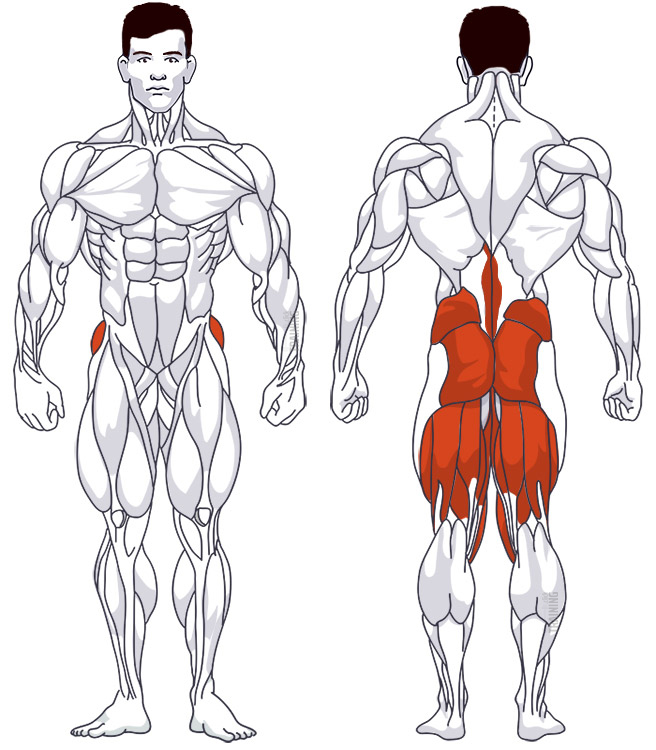
Involved main muscle groups:
Bodyweight Frog Hip Thrust
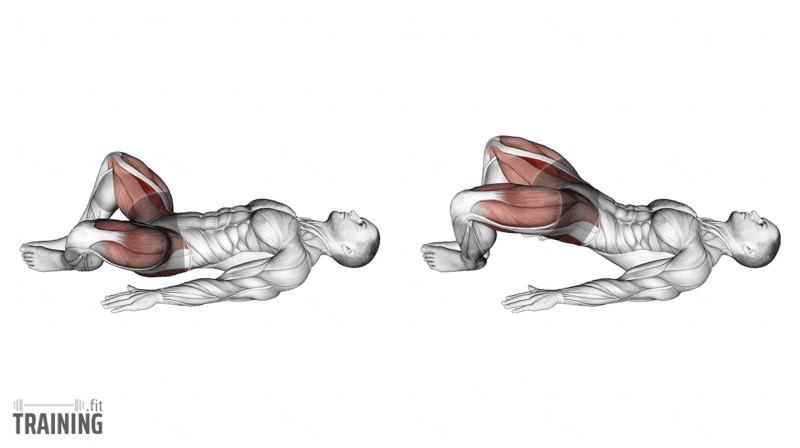
For frog pumps, bring the soles of your feet together and let your knees open to the sides. Lying on your back, you’ll lift and lower your hips, using your butt to drive the movement. Despite the alternative name frog hip thrust, this version stays on the floor.
The position feels quite different from a bridge with your thighs parallel. If it’s uncomfortable, simply switch to the usual flat-footed version or a heel-supported glute bridge.
Correct execution
The open-knee position changes how a familiar bridge feels. You can keep the lift short and let your hips decide how far your knees open, rather than treating the exercise as a forced stretch.
Bring your feet toward your butt until the position feels stable, with your soles touching and the outer edges of your feet resting on the floor. Keep your head and upper back down and place your arms beside you. Your knees only need to open as far as feels comfortable for your hips.
Gently tighten your abs and raise your hips slowly and smoothly, keeping your feet in place. You don’t need to lift as high as in a regular bridge, so stop before your lower back starts arching to gain extra height. Pause briefly, then lower back to the floor with control.
Set the open-knee position before you lift; there’s no need to keep pushing your legs apart during the rep. Keep your soles lightly touching and press your heels into the floor. If your feet roll apart as you lift, adjust how far your heels are from your butt. A folded mat can make this more comfortable, as long as it stays firm under your feet.
Breathe in before lifting and out as your hips rise. Keep your head on the floor and your chin relaxed; you don’t need to look at your knees. Check your foot position by sitting up briefly, then lie back and rest your head again before you start.
Video tutorial
Step-by-step instructions
Lie on your back and bend your knees, bringing the soles of your feet together.
Allow your knees to open outward and adjust the distance between your heels and butt for a stable position.
Rest your head, upper back and arms on the floor and lightly brace your core.
Squeeze your butt and lift your pelvis without forcing your knees wider.
Pause briefly, then lower your hips gently while keeping your feet together.
If your feet slide, reset them before beginning the next repetition.
Common mistakes
Pressing your knees down with your hands turns the setup into a forced stretch. Let your hips decide how far your knees can comfortably open instead.
Avoid lifting your head or pushing your ribs up to make the bridge look taller. This shifts the movement away from your hips, which is where it should stay. If your feet lose contact or you find yourself jerking through each rep, shorten the range or go back to a regular glute bridge.
What the science says
There doesn’t seem to be a study that has tested frog pumps directly. Several studies have examined features of the frog position during glute bridges: moving the thighs apart and turning them outward. They measured muscle activity in single sessions, which shows how hard a muscle works, not how much it grows.
In a 2015 study with 21 healthy people, pressing the knees outward against an elastic band during a bridge increased glute activity and reduced the forward tilt of the pelvis. There was no significant change in hamstring or lower back muscle activity.[1]
Outward rotation of the legs may also affect muscle activity. In a 2018 study, 28 men held a bridge with straight legs and their ankles resting on a table. With the legs turned out by 25 degrees, glute activity was almost 3 times as high as with the toes pointing straight up (about 19% vs. 7% of their maximum). Glute activity was lower when a gym ball replaced the table.[2]
A 2016 study with 10 men and 10 women compared bent-knee bridges with each thigh moved 0, 15 or 30 degrees out to the side. Glute activity was highest in the widest position. Compared with the narrower positions, this position also reduced lower back muscle activity and forward pelvic tilt.[3]
These findings suggest that opening the hips and turning the thighs outward may place more of the work on the glutes. None of the studies tested the frog position with the soles of the feet together.
Sources
- Isometric hip abduction using a Thera-Band alters gluteus maximus muscle activity and the anterior pelvic tilt angle during bridging exercise. Choi SA, Cynn HS, Yi CH, Kwon OY, Yoon TL, Choi WJ, et al. Journal of Electromyography and Kinesiology. 2015;25(2):310–315. doi: 10.1016/j.jelekin.2014.09.005.
- The effect of the trunk and gluteus maximus muscle activities according to support surface and hip joint rotation during bridge exercise. Kim CM, Kong YS, Hwang YT, Park JW. Journal of Physical Therapy Science. 2018;30(7):943–947. doi: 10.1589/jpts.30.943.
- Modifying the hip abduction angle during bridging exercise can facilitate gluteus maximus activity. Kang SY, Choung SD, Jeon HS. Manual Therapy. 2016;22:211–215. doi: 10.1016/j.math.2015.12.010.