Bent Knee Glute Kickback
Isolation exercise, Body weightThis article is verified by 4 studies/publications.
Overview
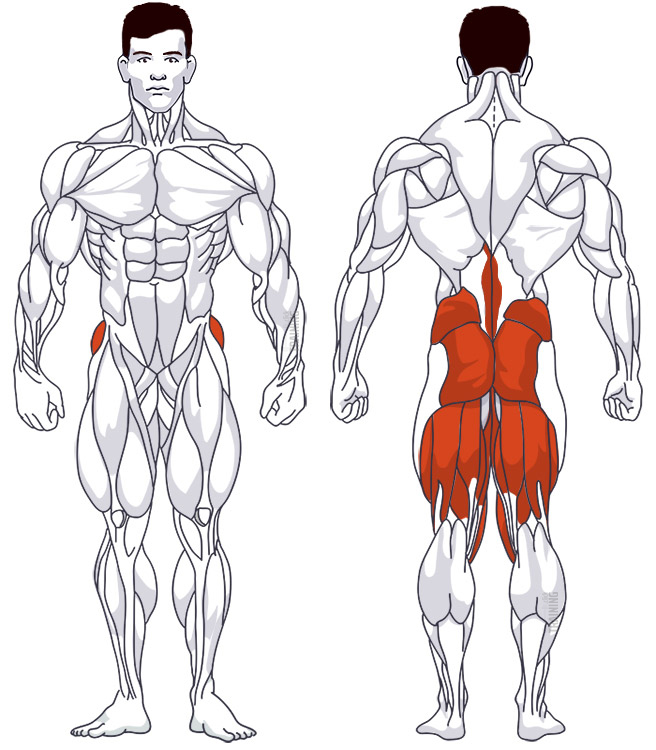
Main muscles
- Buttocks: Large gluteus maximus
(Musculus gluteus maximus)
Training plans
Bent Knee Glute Kickback is a suitable substitute for similar exercises in Butt training or as a supplement to various training plans.
Bent Knee Glute Kickback: Basics and alternatives
Involved main muscle groups:
Bent Knee Glute Kickback
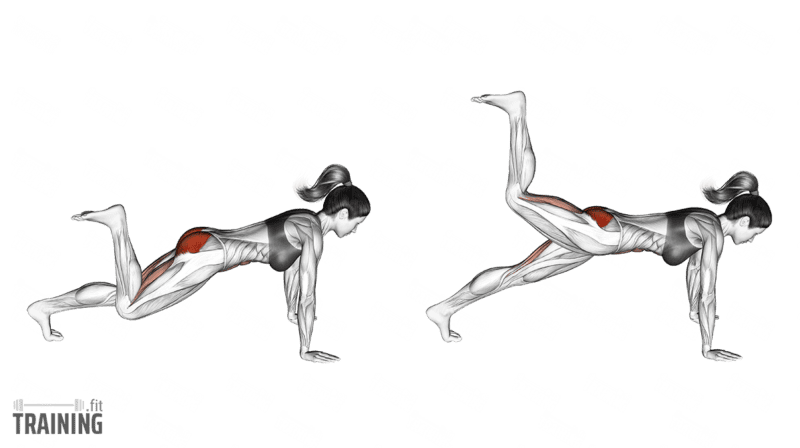
Bent-knee glute kickbacks train your butt with a simple bodyweight setup. You’ll lift one bent leg behind you, extending your hip while your abs steady the rest of your body.
Begin on your hands and knees, as in the tutorial. The illustration shows the harder version from a high plank, with the supporting leg straight. Bird dogs combine a leg reach with an arm reach on the opposite side.
Correct execution
The working thigh moves while your pelvis stays mostly still. That gives you a useful limit: you don’t need to lift your heel higher once your lower back starts doing the movement.
For the kneeling version, place your hands under your shoulders and your knees under your hips. Keep the working knee bent at about a right angle. Raise that thigh behind you, stopping before your lower back starts to arch more. Your heel points toward the ceiling, but you don’t need to lift it as high as possible.
Keep roughly the same knee bend as you lift and lower, so the movement comes from your hip, not from kicking your foot back. Then slowly lower your knee to the starting position and repeat.
For the plank version, start with both hands and toes on the floor and your legs straight. Check that the supporting foot has a firm grip, then bend the other knee. Hold steady on both hands and one foot before raising the thigh with the knee bent. Use a smaller lift if needed.
In either version, keep your pelvis facing the floor and press through both hands without sinking into your shoulders. Return to the kneeling version if you can’t keep the plank steady while moving the leg.
Video tutorial
Step-by-step instructions
Begin on your hands and knees with your wrists below your shoulders and your knees below your hips.
Gently tighten your abs and look down at the floor.
Keep one knee bent at around a right angle and lift that thigh behind you.
Stop before your pelvis turns or your lower back begins to arch more.
Lower your knee slowly to the starting position and repeat, then change sides. For the plank variation, start in a high plank with both legs straight. Bend one knee and lift that thigh as described above while keeping the other leg straight. Lower the thigh under control before repeating or changing sides.
Common mistakes
Trying to push your foot as high as possible often adds a back arch or turns your pelvis. Shorten the lift and keep both hip bones facing the floor.
Some people shift both hands toward the working side, hoping to isolate the butt even more. Keep your hands beneath your shoulders instead, and lift and lower slowly enough that the rest of your body stays still.
Don’t turn your raised heel outward or rotate your pelvis to make your leg look higher. Check your knee and pelvis together, and lower your thigh if your pelvis starts to turn. Moving the thigh slightly out to the side on purpose, with your pelvis still facing the floor, is a variation rather than a mistake: in a face-down version of this exercise, it increased glute activity.
What the science says
Research on this movement largely comes from physical therapy, where the kneeling exercise is known as quadruped hip extension. The studies measured muscle activity in single sessions, so they show how hard your glutes work, not how much they grow.
A study with 20 healthy people looked at quadruped hip extension with the knee bent or straightening. Both versions worked the side glutes and the upper part of the main glute muscle (gluteus maximus) significantly harder than a small muscle at the outer front of the hip (tensor fasciae latae). Only the clam, side steps and single-leg bridge favored the glutes even more strongly.[1]
When 30 healthy people lifted one bent leg while lying face down, moving the thigh 30 degrees out to the side increased gluteus maximus activity compared with 15 or 0 degrees. Hamstring activity was highest when the thigh stayed in line with the body. In this position, the hamstrings also began working before the glutes.[2]
In 16 healthy men, a face-down hip extension on a table with the knee bent at 90 degrees produced clearly more gluteus maximus activity than the straight-leg versions on the floor or on the table. Neither outer hamstring (biceps femoris) nor lower back activity increased. Pelvic tilt and rotation didn’t increase either.[3]
A study with 19 men and 11 women compared 9 bodyweight exercises. For the main glute muscle (gluteus maximus), the authors singled out the opposite arm and leg lift on all fours, known as the bird dog. It pushed glute activity above 45% of its maximum, the level they considered useful for building strength.[4]
Sources
- Which Exercises Target the Gluteal Muscles While Minimizing Activation of the Tensor Fascia Lata? Electromyographic Assessment Using Fine-Wire Electrodes. Selkowitz DM, Beneck GJ, Powers CM. Journal of Orthopaedic & Sports Physical Therapy. 2013;43(2):54–64. doi: 10.2519/jospt.2013.4116.
- Activation of the gluteus maximus and hamstring muscles during prone hip extension with knee flexion in three hip abduction positions. Kang SY, Jeon HS, Kwon O, Cynn HS, Choi B. Manual Therapy. 2013;18(4):303–307. doi: 10.1016/j.math.2012.11.006.
- Comparison of gluteus maximus and hamstring electromyographic activity and lumbopelvic motion during three different prone hip extension exercises in healthy volunteers. Jeon IC, Hwang UJ, Jung SH, Kwon OY. Physical Therapy in Sport. 2016;22:35–40. doi: 10.1016/j.ptsp.2016.03.004.
- Electromyographic Analysis of Core Trunk, Hip, and Thigh Muscles During 9 Rehabilitation Exercises. Ekstrom RA, Donatelli RA, Carp KC. Journal of Orthopaedic & Sports Physical Therapy. 2007;37(12):754–762. doi: 10.2519/jospt.2007.2471.