Barbell Glute Bridge
Isolation exercise, Free weightsThis article is verified by 3 studies/publications.
Overview
Main muscles
- Buttocks: Large gluteus maximus
(Musculus gluteus maximus) - Thigh: Thigh flexor
(Musculus biceps femoris)
Training plans
Barbell Glute Bridge is a suitable substitute for similar exercises in Butt training or as a supplement to various training plans.
Barbell Glute Bridge: Basics and alternatives
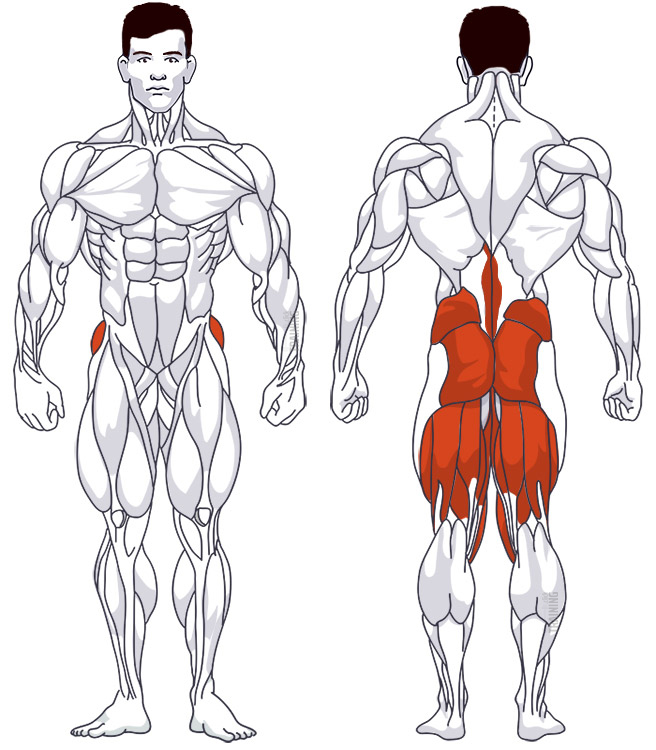
Involved main muscle groups:
Barbell Glute Bridge
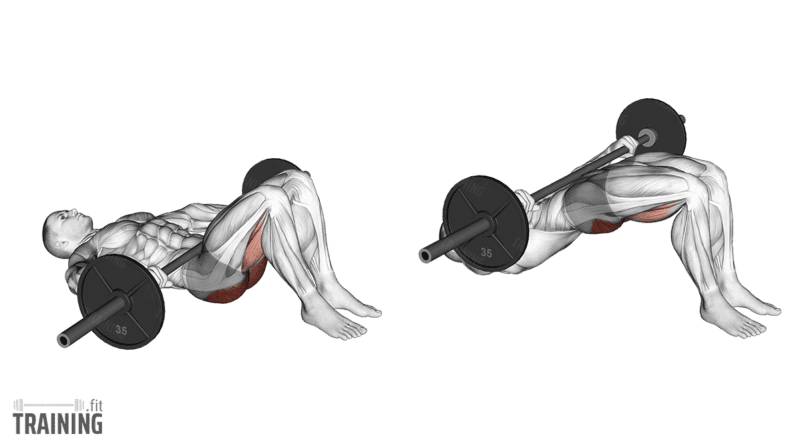
For the barbell glute bridge, you place a padded bar across your hips, then lift and lower them while your upper back stays on the floor. Your butt and hamstrings do the lifting, while your core helps keep you steady.
For a hip thrust, your shoulders rest on a bench. In the glute bridge, they stay on the floor, which makes the setup simpler: there’s no bench to arrange behind you. Just choose a bar and weight you can get into position and move smoothly.
Correct execution
The floor supports your upper back, leaving you to concentrate on lifting your hips. Getting the bar into and out of position is part of the setup, too.
Load the bar evenly, secure the plates and place a suitable pad across your hip crease. If the plates are big enough to clear your legs, sit behind the bar and roll it over your legs into position. Smaller plates or a preloaded bar may not leave enough room; in that case, use full-diameter bumper plates at a weight you can control and check again. Don’t drag the bar across your body.
Large plates may touch the floor while your hips are still slightly raised. That’s your lowest point, so don’t force your pelvis farther down against the bar.
Lie back and plant your feet about hip-width apart, with your shins roughly upright at the top of the bridge. Hold the bar steady with both hands. Press through your feet and lift your hips until your shoulders, hips and knees are approximately in line. Keep your abs engaged and stop before you start arching your lower back.
Keep your head and upper back on the floor, and push with your feet, not the back of your head. Your hands just keep the bar from rolling. At the end, lower the bar and your hips slowly and let the weight settle before moving the bar away.
Video tutorial
Step-by-step instructions
Load the barbell evenly, secure the plates and place padding across your hip crease.
Bring the bar into position with enough clearance over your legs, then lie back with your knees bent.
Plant your feet about hip-width apart and hold the bar steady with both hands.
Press through your feet and lift your hips, keeping your shoulders and head on the floor.
Pause when your shoulders, hips and knees are roughly in line. Lower your hips and the bar slowly, stopping if the plates reach the floor first. After the set, let the weight settle, then remove the bar the same way you brought it into position.
Common mistakes
A common problem is the bar rolling toward your stomach. Lower it, re-center the bar and pad across your hip crease and use less weight if you can’t keep it steady.
Avoid bouncing your hips or jolting the bar up with your legs. Keep your feet planted, lift smoothly and stop once your hips are extended; don’t arch your back to gain height.
If one plate rises before the other, check that the bar is centered and both feet are the same distance from your hips. Make these adjustments with the weight supported, instead of trying to straighten a tilted bar during the lift.
What the science says
There isn’t much research on the barbell glute bridge yet. Most studies compare it with the hip thrust, in which your upper back rests on a bench.
In a 2025 study, 40 teenage male soccer players with at least 2 years of strength training experience were randomly assigned to hip thrusts, glute bridges or no exercise. The 2 exercise groups lifted at 60% and at 84% of their 1-rep max and sprinted again 7 minutes later. Both showed moderate short-term improvements in horizontal force and power while sprinting and small improvements in sprint performance, while the control group barely changed. There was little difference between the 2 exercises.[1]
In a 2024 study, 10 men did barbell glute bridges and barbell hip thrusts. The upper and lower parts of the main glute muscle (gluteus maximus) were more active in the glute bridge, and so, on average, was the smaller side glute muscle. The hip thrust worked the outer front thigh harder.[2]
The closest evidence currently available on long-term muscle growth comes from hip thrust training. In a 2023 study, 34 untrained young adults trained for 9 weeks with either hip thrusts or back squats. MRI scans showed similar glute growth in both groups, and while the glutes were more active during hip thrusts, that didn’t predict who built more glute muscle.[3]
The only direct muscle-activity comparison available so far found that the glute bridge worked the glutes at least as hard as the hip thrust. But higher muscle activity in a single session doesn’t automatically mean more muscle growth.
Sources
- The Acute Effects Of Hip Thrust and Glute Bridge Exercises With Different Loads on Sprint Performance and Horizontal Force–Velocity Profile in Adolescent Soccer Players: A Post-Activation Performance Enhancement Approach. Çabuk S, İnce İ. European Journal of Sport Science. 2025;25(2):e12255. doi: 10.1002/ejsc.12255.
- Electromyographic differences of the gluteus maximus, gluteus medius, biceps femoris, and vastus lateralis between the barbell hip thrust and barbell glute bridge. Kennedy D, Casebolt JB, Farren GL, Fiaud V, Bartlett M, Strong L. Sports Biomechanics. 2024;23(12):2935–2949. doi: 10.1080/14763141.2022.2074875.
- Hip thrust and back squat training elicit similar gluteus muscle hypertrophy and transfer similarly to the deadlift. Plotkin DL, Rodas MA, Vigotsky AD, McIntosh MC, Breeze E, Ubrik R, et al. Frontiers in Physiology. 2023;14:1279170. doi: 10.3389/fphys.2023.1279170.