Barbell Hip Thrust
Compound exercise, Free weightsThis article is verified by 4 studies/publications.
Overview
Main muscles
- Buttocks: Large gluteus maximus
(Musculus gluteus maximus) - Thigh: Thigh flexor
(Musculus biceps femoris)
Workout plan
Here you can find example plans for barbell hip thrust training:
Barbell Hip Thrust: Basics and alternatives
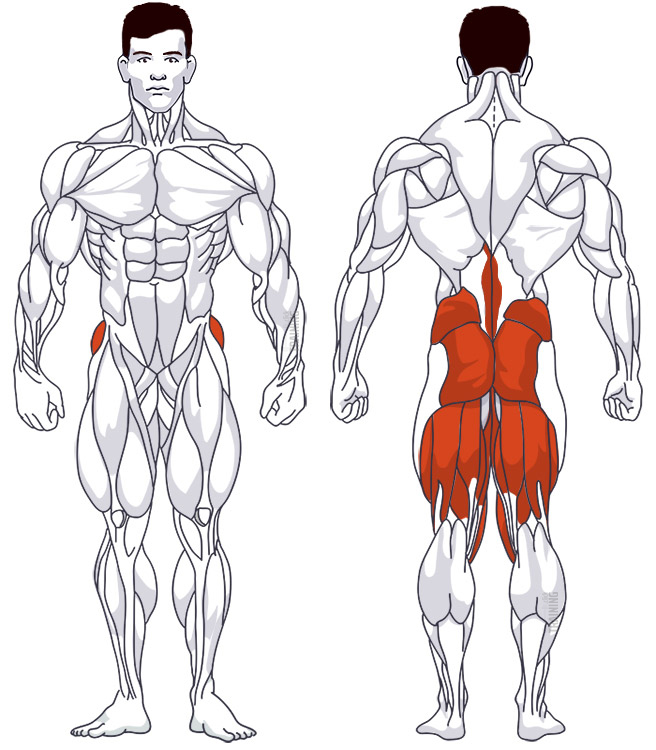
Involved main muscle groups:
Barbell Hip Thrust
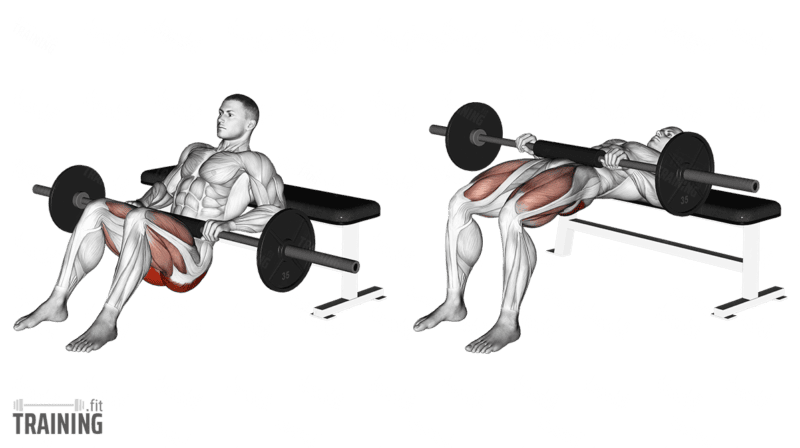
For the barbell hip thrust, rest your upper back on a bench with both feet planted and a padded bar across your hips. Raise and lower your hips to work your butt and hamstrings, using your hands to steady the bar over your hip crease.
If the bench setup is new to you, practice the movement without extra weight first. In barbell glute bridges, your shoulders stay on the floor, so there’s less room to lower your hips. Just pick the version you can set up and do comfortably.
Correct execution
The bench supports your upper back while your hips move below it. Its height should let you keep that contact throughout, so the setup is worth rehearsing before the bar goes on your hips.
Secure the bench and check its height with an unweighted repetition before loading the bar. The edge should support your upper back around the lower part of your shoulder blades, staying clear of your neck as your hips move. You don’t need to lower your hips all the way to the floor if that makes you lose contact with the bench.
Load both sides of the bar evenly, secure the plates and fit a suitable pad to the middle of the bar. Since a thick pad takes up some space under the bar, check the clearance with the pad on before you roll the bar over your legs. If it doesn’t roll over comfortably, don’t force it; change the setup or ask someone to help you position and remove the bar.
Plant your feet so your shins are roughly upright at the top. Tighten your abs, hold the bar level and raise your hips until your shoulders, hips and knees are approximately in line. Let your head follow the movement of your upper body and stop before you arch your lower back. Continue breathing throughout the movement.
Pause briefly, then lower your hips and the bar smoothly while keeping your upper back supported and your feet planted. Bench height, plate size and your proportions affect how far you can go. If you need to move your feet, lower the bar and let it rest first.
Video tutorial
Step-by-step instructions
Secure the bench, load the bar evenly and fasten the plates with collars.
Sit in front of the bench and roll the padded bar into position across your hip crease.
Rest your upper back on the bench, plant both feet and hold the bar steady.
Tighten your abs and press through your feet. Raise your hips until your shoulders, hips and knees are roughly in line, without arching your lower back.
Pause at the top, then lower your pelvis and bar smoothly while keeping your upper back supported. After the last repetition, lower yourself into a seated position and let the weight settle before moving the bar away.
Common mistakes
Throwing your head back or arching your lower back can raise the bar without further hip extension. Keep your abs tight and finish the hip lift before that happens.
The bar should stay level across your hips. If it rolls toward your stomach or tilts to one side, check the pad, your grip and your foot placement. And if you can’t lower smoothly or keep the bench and your feet stable, reduce the weight.
What the science says
The hip thrust has been studied more than most glute exercises, usually in comparison with the squat.
In a 2023 study, 34 untrained young adults trained for 9 weeks with either hip thrusts or back squats. On MRI scans, the 2 groups showed roughly equal glute muscle growth. The squat group also gained more muscle in the front and inner thighs, and each group got strongest in the exercise it had practiced. The glutes were more active during hip thrusts, but that didn’t predict who built more glute muscle.[1]
A different result emerged from a 12-week study involving 22 well-trained women. The squat group increased the thickness of their glutes more than the hip thrust group (9.4% vs. 3.7%) and gained far more in the front of the thighs (12.2% vs. 2%). Both groups got stronger in the hip thrust, but only the squat group improved its squat considerably.[2]
When a study with 10 men compared the hip thrust with the barbell glute bridge, the glutes were more active during the glute bridge. The outer front thigh (vastus lateralis) was more active during the hip thrust.[3]
A 2019 review of 12 studies with trained participants found that the hip thrust activates the glutes and hamstrings more than the squat, while the straight-bar deadlift activates the hamstrings even more. Of these, 4 studies found faster sprints shortly after hip thrusts; results for sprint times over longer training periods were mixed.[4]
The hip thrust is an effective glute exercise. However, the training studies available so far haven’t found greater glute growth from hip thrusts than from squats. Keep in mind that muscle activity measured in a single session shows how hard a muscle works, not how much it grows.
Sources
- Hip thrust and back squat training elicit similar gluteus muscle hypertrophy and transfer similarly to the deadlift. Plotkin DL, Rodas MA, Vigotsky AD, McIntosh MC, Breeze E, Ubrik R, et al. Frontiers in Physiology. 2023;14:1279170. doi: 10.3389/fphys.2023.1279170.
- Back Squat vs. Hip Thrust Resistance-training Programs in Well-trained Women. Barbalho M, Coswig V, Souza D, Serrão JC, Hebling Campos M, Gentil P. International Journal of Sports Medicine. 2020;41(5):306–310. doi: 10.1055/a-1082-1126.
- Electromyographic differences of the gluteus maximus, gluteus medius, biceps femoris, and vastus lateralis between the barbell hip thrust and barbell glute bridge. Kennedy D, Casebolt JB, Farren GL, Fiaud V, Bartlett M, Strong L. Sports Biomechanics. 2024;23(12):2935–2949. doi: 10.1080/14763141.2022.2074875.
- Barbell Hip Thrust, Muscular Activation and Performance: A Systematic Review. Neto WK, Vieira TL, Gama EF. Journal of Sports Science & Medicine. 2019;18(2):198–206. PMID: 31191088.