Band Front Raise
Isolation exercise, Free weightsThis article is verified by 4 studies/publications.
Overview
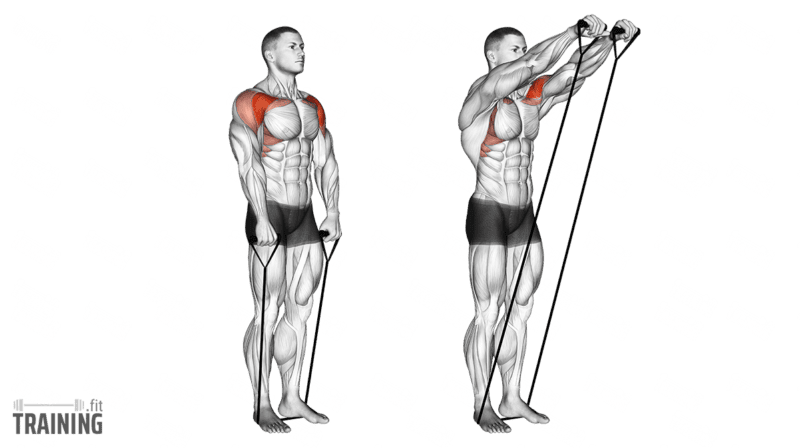
Main muscles
- Shoulder: Anterior deltoid muscle
(Musculus deltoideus, Pars clavicularis)
Training plans
Band Front Raise is a suitable substitute for similar exercises in or as a supplement to various training plans.
Band Front Raise: Basics and alternatives
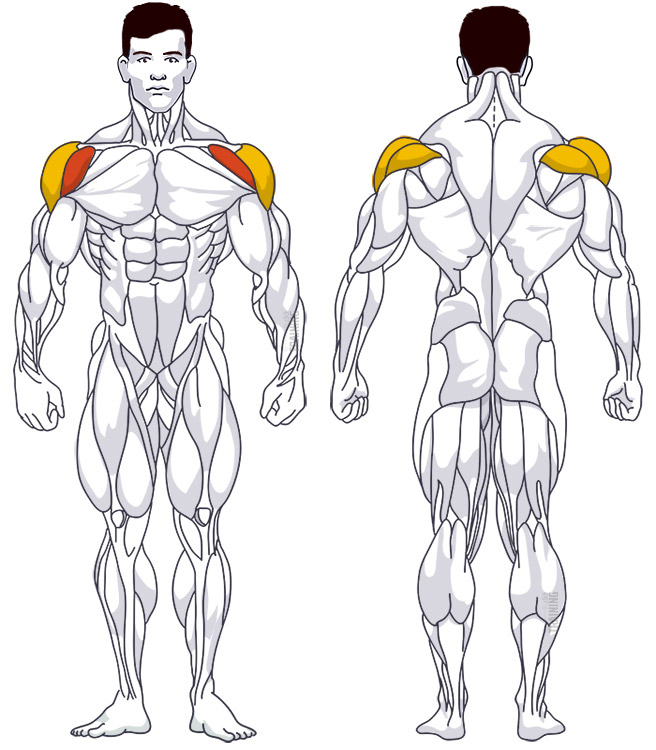
Involved main muscle groups:
Band Front Raise
Band front raises train your front shoulders with a simple setup: stand on the middle of the band and lift both arms forward with your elbows slightly bent. Even a light band can feel challenging with your arms this far out, especially as it stretches near the top.
The movement is the same as in ordinary front raises, with the band replacing the weights. If you’d like to lift your arms out to the sides, try band lateral raises. Both work well for band training at home.
Correct execution
The band usually becomes harder to stretch as your hands rise.[1] Pick your band based on how it feels near shoulder height, not just on how easy the first few centimeters are.
Place the band under the middle of both shoes and hold its sides at similar lengths. Stand upright with your feet flat and your knees slightly bent. Keep that knee position steady throughout the raise.
With a small bend in your elbows, lift your arms forward to about shoulder height. Each hand stays in front of its own shoulder, so the two sides of the band don’t cross. Keep your wrists in line with your forearms and hold the handles securely.
Use a shorter range if you can’t reach shoulder height without leaning back or lifting your chin. Your hands don’t have to reach nose height. Lower them slowly to your thighs, keeping roughly the same elbow bend and resisting the band’s pull.
If you’re not sure about the path yet, try it without resistance first. Then pick a band that lets you repeat it with your feet planted and your upper body still. To change the band length or swap bands, release the tension first.
Video tutorial
Step-by-step instructions
Check the band for tears or other damage, place its middle beneath both feet and stand about hip-width apart.
Take one side in each hand and hold your hands in front of your thighs, palms facing your body.
Keep a slight elbow bend and lift both arms forward, letting your palms face the floor as they rise.
Stop at about shoulder height, keeping your chin level and your upper body upright.
Lower your hands slowly to the starting position, resisting the band’s pull. If the band has moved, release the tension and reposition it under both feet before beginning the next repetition.
Common mistakes
Bending your elbows more as you lift shortens the lever and changes the movement. Keep your elbow angle about the same and use a lighter band if needed.
Letting your hands drop and bounce into the next rep costs you control, so lift and lower them smoothly. If one arm rises faster, first check that you’re holding both sides of the band at the same length.
Also watch out for dipping your knees before each raise, since that lets your legs add momentum. Keep your knees softly bent at the same angle and start each rep once the band has stopped moving.
What the science says
Few studies have examined band front raises as an exercise for building muscle. The available studies look at effort, muscle activity and joint loads during single sessions, which show how hard your muscles work, not how much they grow.
In 20 healthy, physically active people, researchers tested front and lateral raises with elastic bands. Each person did 1 set with a band grip that allowed a maximum of 15 reps and a lighter set with the grip 50% wider. Muscle activity, heart rate and the participants’ ratings of perceived effort were all significantly higher in the harder set, leading the authors to suggest that a perceived-effort scale can help you judge the intensity of a band exercise.[2]
When 10 male competitive bodybuilders did dumbbell front raises and 4 versions of the lateral raise, the front raise produced more activity in the front shoulders and the chest than every lateral raise during the lifting phase. The side shoulders, on the other hand, were much more active in a lateral raise with neutral arm rotation than in the front raise. Similar patterns appeared while the weights were being lowered.[3]
A study with 21 healthy people calculated the load on the shoulder muscles during front, side and diagonal arm raises without weight, with dumbbells and with an elastic band. The front and diagonal raises put the highest peak load on the muscles that lift the arm forward. Overall, peak loads were highest with dumbbells. The type of resistance affected both the size of the peak and where it occurred in the movement.[4]
Sources
- Thera-band® elastic band tension: reference values for physical activity. Uchida MC, Nishida MM, Sampaio RAC, Moritani T, Arai H. Journal of Physical Therapy Science. 2016;28(4):1266–1271. doi:10.1589/jpts.28.1266. Study.
- Concurrent Validation of the OMNI-Resistance Exercise Scale of Perceived Exertion With Thera-Band Resistance Bands. Colado JC, Garcia-Masso X, Triplett TN, Flandez J, Borreani S, Tella V. Journal of Strength and Conditioning Research. 2012;26(11):3018–3024. doi: 10.1519/jsc.0b013e318245c0c9.
- An Electromyographic Analysis of Lateral Raise Variations and Frontal Raise in Competitive Bodybuilders. Coratella G, Tornatore G, Longo S, Esposito F, Cè E. International Journal of Environmental Research and Public Health. 2020;17(17):6015. doi: 10.3390/ijerph17176015.
- Comparison of shoulder resultant net moment between three different exercises and load conditions. de Toledo JM, Ribeiro DC, de Castro MP, Forte FC, Körbes TS, Rusch MW, et al. Physiotherapy Theory and Practice. 2013;29(2):124–132. doi: 10.3109/09593985.2012.699606.