Standing Dumbbell Around the World
Isolation exercise, Free weightsOverview
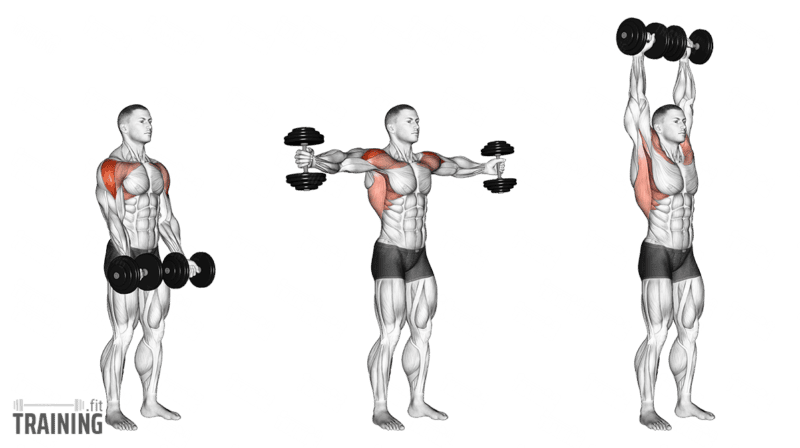
Main muscles
- Shoulder: Medial deltoid muscle
(Musculus deltoideus, Pars acromialis)
Training plans
Standing Dumbbell Around the World is a suitable substitute for similar exercises in or as a supplement to various training plans.
Standing Dumbbell Around the World: Basics and alternatives
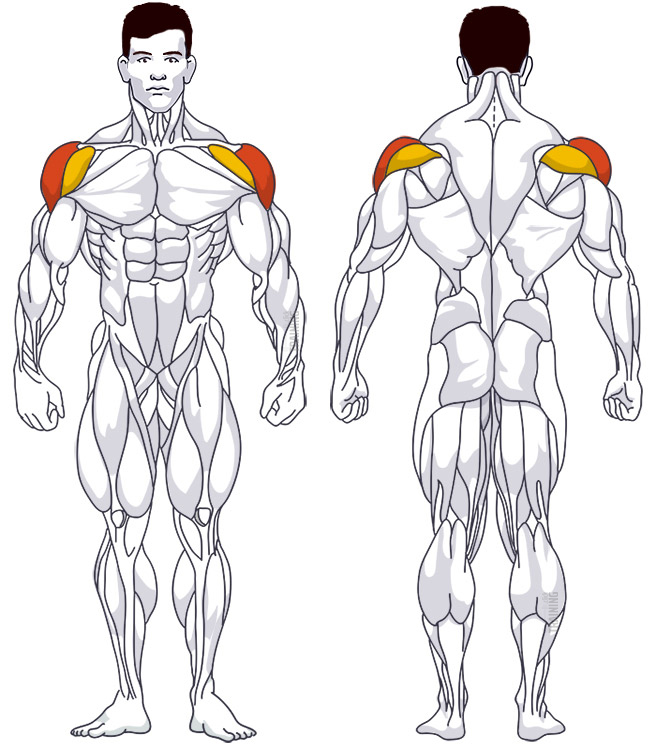
Involved main muscle groups:
Standing Dumbbell Around the World
The standing dumbbell around-the-world is a flowing shoulder exercise: you lift your arms in wide arcs from beside your thighs toward an overhead position. Your shoulders do the lifting while your elbows stay slightly bent. It’s different from the lying chest exercise that goes by the same name.
With lateral raises, you lift your arms out to the sides and usually stop around shoulder height. Band Y raises take the arms diagonally upward against a band. Here, you’ll continue the wide sideways arc only as far overhead as you can comfortably control.
Correct execution
Start with very light dumbbells and turn your palms forward. Keep your wrists comfortable as your arms move outward and upward. Your shoulder blades need to move with your arms, so don’t hold them pinned down throughout the exercise.
Lift only as high as you can control with your lower back steady and your shoulders comfortable. The weights don’t need to touch overhead, and if the full arc feels awkward, a shorter range or regular lateral raises work too. Lower the dumbbells along the same wide path, not suddenly down in front of your face.
Leave room beside and above you for the full arc, including the dumbbell ends. Rehearse with empty hands to find a height you can reach while staying upright, and look straight ahead.
Your hands can turn naturally as your arms move, but keep your wrists in line with your forearms instead of twisting them suddenly at shoulder height to force the weights higher. Move both arms at the same pace; if one side runs out of comfortable range first, stop both arms at that point.
On the return, pass through shoulder height without bending your elbows into a curl. Let the dumbbells come to a stop beside your thighs before starting again. This makes it easier to notice whether the next arc begins with your shoulders or with a swing from your hips.
Video tutorial
Step-by-step instructions
Stand upright with a light dumbbell in each hand beside your thighs.
Turn your palms forward and keep a slight bend in both elbows.
Lift your arms outward in wide, controlled arcs.
Continue toward an overhead position, stopping before you need to lean back or force your shoulders.
Reverse the movement smoothly and lower the dumbbells along the same arcs. Bring your hands back beside your thighs and settle your posture before repeating.
Common mistakes
Grabbing the dumbbells you use for lateral raises might feel natural, but they may be too heavy for this longer movement. Pick a weight you can control through the full range you plan to use.
Leaning back to bring your hands together above your head is a common mistake. It might look like more range, but the extra movement comes from your torso, not your shoulders. At the bottom, let the dumbbells come to a stop beside your thighs; swinging them behind your body just gives the next repetition momentum.