Resistance Band Lateral Raises
Isolation exercise, Free weightsThis article is verified by 6 studies/publications.
Overview
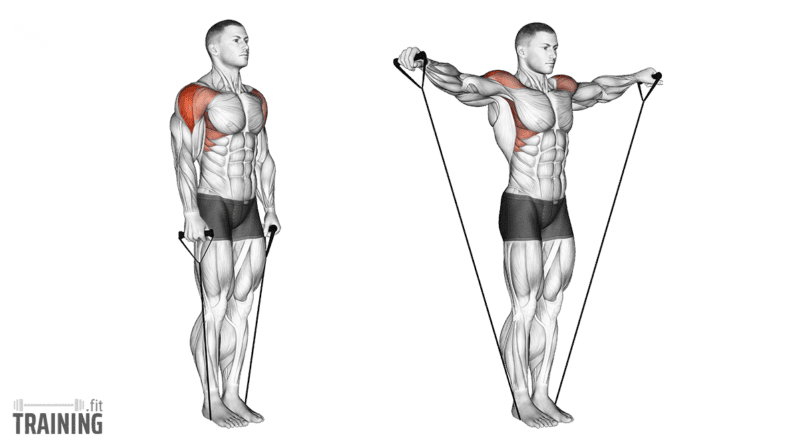
Main muscles
- Shoulder: Medial deltoid muscle
(Musculus deltoideus, Pars acromialis)
Training plans
Resistance Band Lateral Raises is a suitable substitute for similar exercises in or as a supplement to various training plans.
Resistance Band Lateral Raises: Basics and alternatives
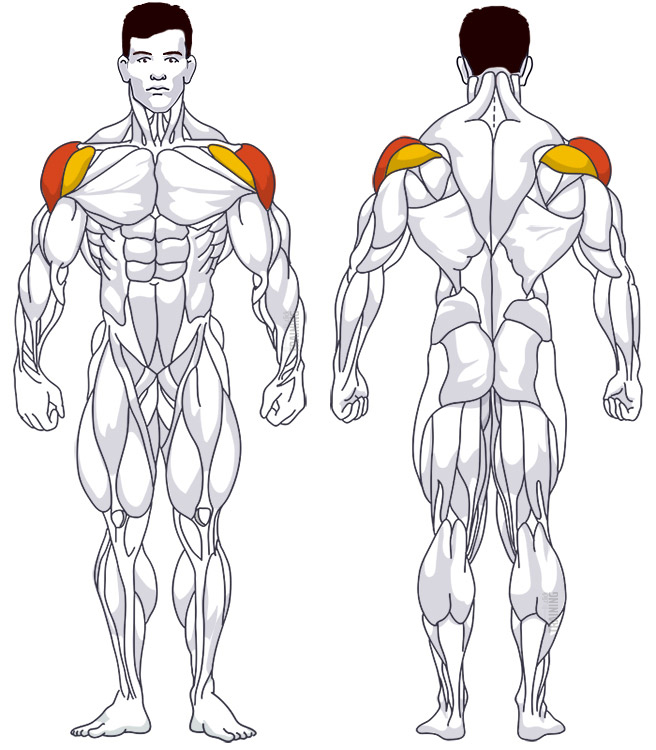
Involved main muscle groups:
Resistance Band Lateral Raises
Resistance band lateral raises let you train your shoulders at home. Stand on the band and lift your arms to the sides to work the middle part of your shoulders, keeping a slight elbow bend.
The movement is similar to regular lateral raises. In band front raises, your arms move forward to work the fronts of your shoulders. Here, keep your arms moving out to the sides, even as the band gets tough.
Correct execution
The top of the raise is often the hardest part with a band. A lighter resistance can help you keep the same controlled path on the way down as on the way up.
Pick a band that’s light enough to lift to about shoulder height with control. Hold equal lengths on both sides and keep your wrists in line with your forearms. It’s fine if your arms travel a little in front of your body.
Let your shoulder blades move naturally as your arms rise, and keep your neck relaxed so the lift doesn’t start with a big shrug. The resistance generally increases as the band stretches during the lift.[1] Choose a band you can control near the top as well as at the start.
Let the band run up along the outside of each leg. Before lifting, check that it lies flat beneath your shoes and isn’t trapped under just a small edge of the sole. Keep your weight on both feet as your hands move apart. You shouldn’t have to roll outward onto the edges of your feet to make room for the band.
Reach outward, raising your elbows and hands at the same rate so they’re at a similar height near the top, and keep the slight bend in your elbows. A mirror in front of you can help you check the path; just keep your head facing forward during each rep.
Video tutorial
Step-by-step instructions
Place the band beneath the middle of both feet and stand upright.
Hold one side in each hand with your arms beside your thighs and your elbows slightly bent.
Lift both arms outward, slightly in front of the line of your torso if that feels more comfortable.
Stop around shoulder height while keeping your wrists straight and your body steady.
Lower your hands slowly, maintaining roughly the same elbow bend.
Return to the starting position without bouncing the band into the next repetition.
Common mistakes
Leaning sideways or rocking your hips adds body momentum to the lift. Use a lighter band if you can’t keep your upper body steady.
Don’t bend your elbows sharply halfway up or tip your hands as if you were pouring from a jug. Keep a comfortable grip and roughly the same slight elbow bend throughout, and check the band if one side starts slipping under your foot.
Don’t assume that matching band colors mean equal resistance across brands.[2] Test your band through a full raise. Choose one you can lower evenly on both sides. Keep your grip and foot spacing the same each time so you can compare your attempts.
What the science says
Research on band lateral raises mainly consists of single-session laboratory tests. These studies show how hard your muscles work, not how much they grow.
In one study, 20 physically active people did band front and lateral raises at 2 intensities, set by how far apart they gripped the band. The harder sets raised muscle activity, heart rate and participants’ effort ratings. The authors conclude that a scale for rating how hard an exercise feels (the OMNI scale) can be used to track the intensity of band exercises.[3]
In 16 female workers with mild neck and shoulder pain, lateral raises and 2 other arm exercises were done with dumbbells and with elastic tubing at increasing resistance. At the heaviest resistance each woman could manage for 3 reps, the main working muscles were about equally active with dumbbells (59–87% of their maximum) and tubing (64–86%). These findings apply to controlled repetitions performed without jerking.[4]
In another study, 15 untrained women performed band lateral raises as a heavy 3-rep set and a lighter set of about 15 reps taken to failure. In the lighter set, muscle activity started lower but climbed with each rep, rose above the heavy set’s level in the later reps and leveled off 3–5 reps before failure.[5]
In 15 adults holding a lateral raise at different arm heights with elastic tubing, the tension rose in a straight line as the tubing stretched and differed between band colors. Despite that, the shoulder-loading curve resembled the one produced by a free weight.[6]
Sources
- Thera-band® elastic band tension: reference values for physical activity. Uchida MC, Nishida MM, Sampaio RAC, Moritani T, Arai H. Journal of Physical Therapy Science. 2016;28(4):1266–1271. doi:10.1589/jpts.28.1266. Study.
- Loading Patterns of Rubber-Based Resistance Bands across Distributors. Fuentes AD, Smith CJ, Shoepe TC. Sports. 2019;7(1):21. doi:10.3390/sports7010021. Study.
- Concurrent Validation of the OMNI-Resistance Exercise Scale of Perceived Exertion With Thera-Band Resistance Bands. Colado JC, Garcia-Masso X, Triplett TN, Flandez J, Borreani S, Tella V. Journal of Strength and Conditioning Research. 2012;26(11):3018–3024. doi: 10.1519/jsc.0b013e318245c0c9.
- Muscle Activation and Perceived Loading During Rehabilitation Exercises: Comparison of Dumbbells and Elastic Resistance. Andersen LL, Andersen CH, Mortensen OS, Poulsen OM, Bjørnlund IB, Zebis MK. Physical Therapy. 2010;90(4):538–549. doi: 10.2522/ptj.20090167.
- Muscle Activation Strategies During Strength Training With Heavy Loading vs. Repetitions to Failure. Sundstrup E, Jakobsen MD, Andersen CH, Zebis MK, Mortensen OS, Andersen LL. Journal of Strength and Conditioning Research. 2012;26(7):1897–1903. doi: 10.1519/jsc.0b013e318239c38e.
- Resistance Properties of Thera-Band® Tubing During Shoulder Abduction Exercise. Hughes CJ, Hurd K, Jones A, Sprigle S. Journal of Orthopaedic & Sports Physical Therapy. 1999;29(7):413–420. doi: 10.2519/jospt.1999.29.7.413.