Dumbbell Wood Chop Squat
Compound exercise, Free weightsOverview
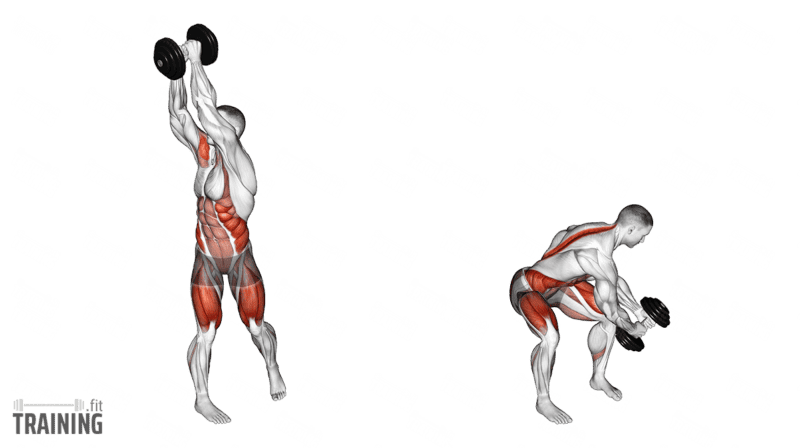
Main muscles
- Abdomen: External oblique abdominal muscle
(Musculus obliquus externus abdominis) - Abdomen: Transverse abdominal muscle
(Musculus transversus abdominis) - Thigh: Quadriceps
(Musculus quadriceps femoris) - Buttocks: Large gluteus maximus
(Musculus gluteus maximus) - Shoulder: Anterior deltoid muscle
(Musculus deltoideus, Pars clavicularis)
Training plans
Dumbbell Wood Chop Squat is a suitable substitute for similar exercises in Abs workout or as a supplement to various training plans.
Dumbbell Wood Chop Squat: Basics and alternatives
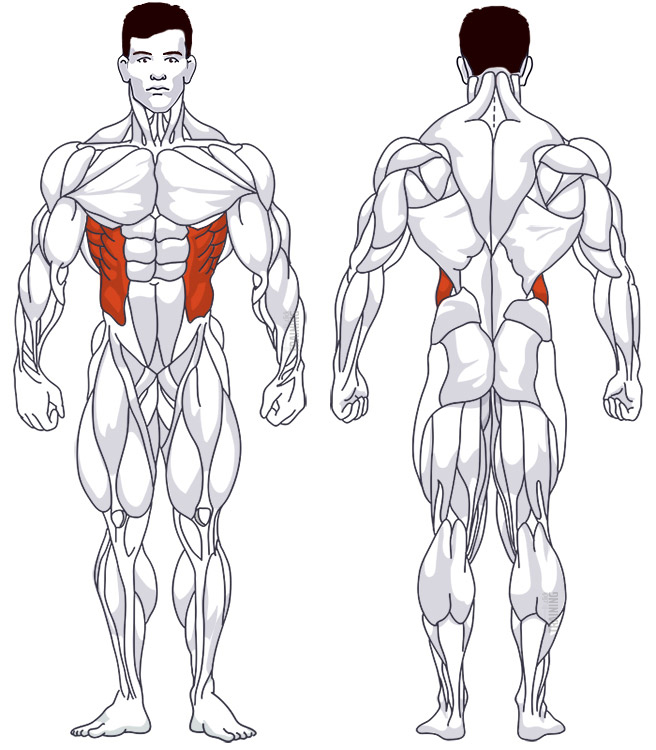
Involved main muscle groups:
Dumbbell Wood Chop Squat
The dumbbell wood chop squat pairs a diagonal chop with a classic squat. You’ll hold one dumbbell in both hands, guide it from above one shoulder toward the opposite knee as you squat, then stand and reverse the path. Your thighs and butt move your lower body; your abs control the turn and your shoulders guide the weight.
Standing cable lifts use a cable pulling from one side during a low-to-high diagonal. Spell casters move two dumbbells from side to side. If you want to practice the squat on its own, try dumbbell goblet squats, where you keep one dumbbell close to your chest throughout.
Correct execution
Start with a light dumbbell held securely in both hands. Stand with your feet about shoulder-width apart, leaving enough room for the weight to pass outside either knee. Practice the diagonal at a lower height before you raise the weight above your shoulder, and keep your elbows gently bent and your wrists comfortable.
From above your left shoulder, guide the dumbbell down across your body toward the outside of your right knee while bending your hips and knees. Let your chest and hips turn together, and let your left foot pivot as needed so your knee follows it. Don’t force a big twist while your lower body stays locked in place. Lower yourself only as far as you can control while keeping the weight outside your knee; don’t reach down toward the floor. Stand again while bringing the weight up toward your left shoulder. Skip the overhead finish if you would otherwise have to lean back. Repeat along the same diagonal, then bring the weight back to your chest before changing sides.
Practice stopping at the bottom before adding speed, leaving room so neither your hands nor the plates hit your leg. Raise the dumbbell as you stand. Before switching diagonals, hold it still near your chest; don’t swing through a change of direction overhead.
In the video below, you’ll see a faster version that brings the dumbbell between the legs and uses more momentum. The instructions here keep the weight outside the opposite knee and use a controlled path; use the video only as a broad movement reference, not as the exact tempo or bottom position.
Video tutorial
Step-by-step instructions
Take one light dumbbell securely in both hands.
Stand with your feet around shoulder-width apart.
Bring the dumbbell up above your left shoulder, or to a lower starting height that feels comfortable.
Bend your hips and knees while moving the weight diagonally toward the outside of your right knee.
Let your hips and feet turn together, keeping your knees in line with your toes and your trunk controlled.
Stand and guide the dumbbell back up the same diagonal.
Bring the weight to your chest before changing sides and lower it with control when you finish.
Common mistakes
If you throw the dumbbell down, it can pull your torso farther than you intended. Guide it down instead, change direction smoothly at the bottom and keep the weight light enough that you could stop there.
You don’t need a deep squat or a large turn. Shorten the squat or turn if your heel lifts unintentionally, your knee twists away from your foot or your back rounds. Use a lower starting point if the overhead finish makes you lean back, and control the full path before progressing.